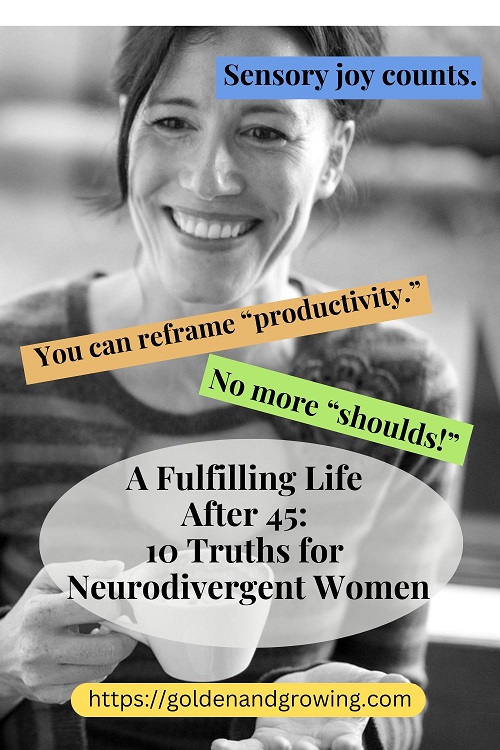
Creating a fulfilling life after 45 can be especially tricky for late-diagnosed neurodivergent women. These touchstones for midlife reinvention and purpose will help.
The story.
The sun felt like a ball of fire on my back. A heavy one that made it hard to walk. I forced my feet to move toward our house, though I wasn’t sure what I’d do when I entered it.
Last fall, I’d been positive I was supposed to write a creative, story-based homeschooling math curriculum. But every step toward completing it had felt like pulling one of my own teeth out with a pair of pliers.
I’d tried several YouTube channels on several topics.
Same result.
When we moved here, I thought we’d be able to grow most of our own produce. Then reality hit with an abundance of tenacious fungal disease. I was beginning to see that the idea had been just one of my short-lived impulses.
I’d self-published several Christian romance novel series, but writing those had long since lost its pleasure.
I didn’t understand. From early adulthood until a few years ago I had a clear sense of purpose, what it took for me to feel fulfilled. But now I felt like I was trying to tread water in a pit of tar.
Nothing I tried doing to give my life purpose stuck or felt right.
Was it hormones? Or was I supposed to be happy being no more than a wife to my husband and a mother to my son?
My jaw tightened. I would have cried if I hadn’t been tired of crying over having completely lost all sense of direction for my life.
Neurodivergent burnout and midlife: a collision of accumulated stress and missing hormones.
The question, “How do you find your purpose after menopause?” is one that many women over the age of forty-five struggle with in silent misery. One of the major reasons is that they have given their lives to raising their children, and now that their children are gone, they feel bereft.
Another big reason that experts in the field have largely ignored is the drop in estrogen. The hormone we typically associate with reproductive health has a lot to do with mental health, as well. When a woman’s brain is producing sufficient levels of its “feel-good” neurotransmitters, clear thinking comes easy. So does resilience against obstacles that try to interfere with her goals.
When lowering levels of estrogen causes those neurotransmitters to go AWOL, however, a kind of brain chaos ensues. That includes confusion, foggy thinking, spiritual lethargy, and anxiety and depression that hover in the background every.
Single.
Morning.
And then, there’s the neurodivergent brain…
Neurodivergent women finding purpose after 45 is a particularly acute struggle. This is due to our brain chemistry being messed up long before perimenopause shows up for its unwelcome, years-long visit.
For us late-diagnosed neurodivergent woman? This sudden inability to find purpose can be emotionally and psychologically debilitating because we discover that we haven’t been living a life true to our own best interests.
Either way, the simple life we crave slides out of reach, because not having any sense of purpose puts us in a perpetual state of imbalance.
If what I’ve said so far resonates with you, first of all, let me give you a virtual hug. I know exactly what you’re going through, because I’ve been there. Am still there sometimes, depending on the weather.
Second, keep reading, because I want to encourage you that the dark pit you seem to have fallen into isn’t interminable. Eventually, you will see the proverbial light. I want to help you by showing you ten truths about neurodivergent women’s reinvention and purpose after forty.
Here they are, in no particular order.
Truth #1: You might be at an in-between stage.
The first thing to understand is that you may well be in between callings or specific life purposes. That’s where I was in my late forties to early fifties, the general time where the introductory story took place.
But thanks to perimenopausal anxiety, I perceived it as an existential crisis rather than a time to relax and enjoy one day at a time while life was unfolding the next phase of my life.
If you’re feeling at odds with yourself regarding purpose and fulfillment, I urge you to drop your worry, live in the moment the best you can, and take one day at a time.
Consider it a vacation time, an opportunity to rest and rejuvenate.
Read more about finding purpose and meaning in midlife.
Truth #2: Now is the perfect time for creating a fulfilling life – after 45, 50, even 60!
If you’re like I was – and a lot of 45-plus women are – you may have set up your road block.
You may have convinced yourself that you’re “too old” to reinvent your life. That nobody would value what you do. That nobody would benefit from what you do.
Because your skin has begun to sag and your hair is turning gray.
The truth is, now is the perfect time. In midlife, reinventing yourself to discover fresh purpose might be easier than ever. You probably have more free time than before. You definitely have more knowledge and wisdom to make better choices than you did when you were younger.
A hard, wonderful truth: you’re not “too old.” You’re the perfect age to reinvent yourself.
Here’s a detailed post with five reasons for starting over at 45+.
Truth #3: You have the freedom to redefine “fulfillment.”
Whether from life experience or brain chemistry change, what fulfills the midlife woman is different from what fulfilled her when she was in her twenties and thirties.
If you’re having a problem sensing a purpose to your life, it might be that you need to make a paradigm shift. Trying to make what felt fulfilling when you were younger, feel fulfilling as a 45-plus-old woman, is like trying to shove a large square peg into a small round hole.
Sit down with a pen and piece of paper and do some brainstorming. You might be surprised that rediscovering your purpose is a simple matter of realizing what truly fulfills you in this next stage of life.
Truth #4: You have the ability to become your own Elder.
In indigenous cultures, an Elder is a member of the community who teaches and retains the customs and traditions. They are looked up to and respected. You might call them the “guru” of the community.
You may not feel like a guru, but once you hit fifty, you know a WHOLE lot more about life and the world than people in their twenties, thirties, and sometimes even forties. More to the point of this blog, you have figured out what works and what doesn’t work for your body and brain.
We never want to get to the place where we stop learning from other people. But if you’re neurodivergent, particularly a late-diagnosed neurodivergent woman, your purpose has likely been largely defined by mainstream society. You have spent your life looking to the neurotypical world to try to find answers on how to build a meaningful life.
Now you’re older and know better. You are not only in a place where you can gently mentor younger women, but also where you can mentor yourself. You can take what you’ve learned and experienced, add it to Internet and book research, and discover the right answers to your most important questions.
In discovering those answers, you find more fulfillment.
Read about how becoming my own elder led to wonderful self-discovery in menopause.
Truth #5: Engaging in your special interests or hobbies is key.
An autistic “special interest” is a broad deep-dive into a particular area of study or society that lasts weeks, months, even a lifetime. Hobbies are more specific and structured, and an essential part of the life of most neurodivergent adults.
They are both key in reinventing your life after 40 and finding fulfillment. They are part of your core being. When you stop sacrificing them at the altar of Everybody Else’s Opinions, you just may find that delving into those interests is all you need to reignite a sense of purpose.
Read, “The Day My Hobbies Changed My Life.”
Truth #6: Neurodivergent aging brings a lot of wisdom.
Asking questions such as, “What is my purpose as an autistic woman?”, or, “How does late-diagnosed ADHD impact my fulfillment as a woman?” aren’t wrong. However, they are a little off track.
Society has taught us that having a purpose is equivalent to having a specific calling on one’s life. But it’s much broader – and simpler – than that. A purpose can be no more complicated than being present with other people, and sharing your wisdom as needed or requested.
If you’re a neurodivergent woman, you’ve gleaned a unique type of wisdom born of years of masking and people-pleasing and meltdowns and burnouts.
More than anyone else, you’ve learned the vital importance of living authentically, of caring for yourself while still respecting those around you. The world desperately needs this wisdom, now more than ever.
Here are ten nuggets of wisdom I’d gleaned by age 55.
Truth #7: Sensory joy is its own kind of fulfillment.
Most of us late-diagnosed neurodivergent women, especially those of us diagnosed after fifty, have squelched our need to engage in sensory stimulation. To the neurotypical world, it looks weird. And weird people don’t fit in. They struggle to find friends.
But you’re now officially “older.” Which means you can ignore judgmental people and do what comes naturally to help you feel mentally and emotionally stable.
- You can cuddle with and stroke a stuffed animal.
- You can rub a smooth or soft object over your cheeks or lips.
- Or rock in your rocking chair.
- You can pace while humming your favorite tunes.
- You can sniff the pages of a newly-printed book.
Of course, there are the more widely accepted sensory activities, like baking, soaking in a hot tub of water, relishing the flavor and texture of a favorite treat, and crocheting or knitting with soft yarn.
Whatever sensory stimulations bring you joy are a legitimate source of fulfillment.
Read more on finding joy and fulfillment through sensory self-care.
Truth #8: Letting go of “should” will change your life.
Again, thinking that we “should” do this or that in order to be happy/productive/acceptable/successful is a by-product of mainstream culture. We neurodivergent women, desperate for connection, have been particularly vulnerable to these messages.
As you now have the freedom to define fulfillment for yourself, you have the freedom to release the numerous unhealthy obligations that have dictated your life so far.
Here’s a hint: if you can turn a “should” into a “get to,” and it feels right (morally or otherwise), keep it in your life. For example, if turning “I should call so-and-so” to “I get to call so-and-so” adds no stress to your life and sits well in your soul, then go for it.
These “get-to” tasks add a sense of purpose to your life.
Read here for a step-by-step guide on why and how to release the “shoulds” of your life.
Truth #9: You can reframe productivity.
A particularly insidious idea has victimized both neurotypical and neurodivergent women for generations. That is, if we can’t be “productive” – as a wife and mother or as a career woman – they’re not as valuable as women who can.
This particularly bites for women with autism or ADHD. Our executive function and sensory sensitivity challenges mean that we carry higher amounts of stress simply by moving through the day. Topping that with the pressure to do as much as we can as efficiently as we can, regardless of the cost to our health and sanity, is a big reason for burnout in neurodivergent women.
If you no longer have to work for a living, great! Reframe productivity in a way that honors your mental and physical health. If you still need to earn an income, do what you can to change your job situation. Or talk to the financial advisor at your bank to determine whether you can afford to cut back on your hours.
Productivity as modern culture defines it doesn’t bring purpose or fulfillment. It does the opposite, in fact. Understand that how much you produce is not what makes you a worthy human being.
Truth #10: Honor your energy cycles.
For a neurodivergent women to create a fulfilling life after forty-five, she must honor her energy cycles.
Okay, in the ideal world, she’s been doing so for her entire life. But she probably hasn’t.
Especially if she’s late-diagnosed.
Likely as not, she been running on the productivity wheel until she feels like falling over.
This is a huge reason why trying to fit the mainstream society idea of “productive” prevents feelings of purpose and fulfillment. How can you feel like you’re any good to the world when you’re entire life feels like it’s pivoted around trying to keep from either exploding or imploding?
If you’re retired, take advantage of it by resting whenever you feel the need. If you have to continue working past fifty, give yourself plenty of downtime every evening before tackling chores, administrative work, or family issues.
Part of my problem back in my late forties and early fifties was that so much of the time, I had zero energy. A big reason?
My daily schedule was often as busy as it had been when I was a classroom teacher!
Believe me: feeling purposeful and fulfilled is impossible when all you want to do is lie in bed, hidden under your covers.
Read more on how to vanquish the energy vampire in your life.
Neurodivergent passions and purpose: the gift of the 45+ neurodivergent woman!
Whether you’re an autistic woman at midlife, a woman recently diagnosed with ADHD and thinking about a career change, or a stay-at-home mom who’s floundering to figure out what’s next, let the ten truths in this article act as beacons for the next step on your journey.
Even if that journey is a long, well-deserved vacation.

1 thought on “A Fulfilling Life After 45: 10 Truths for Neurodivergent Women”
Comments are closed.