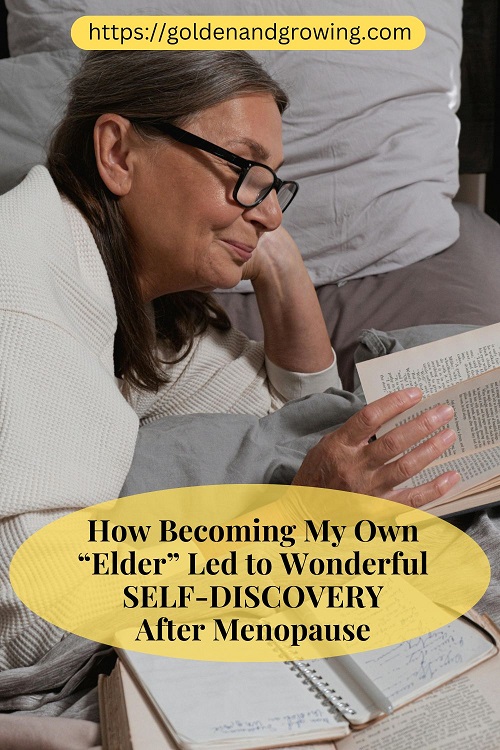
Self-discovery after menopause brings more fulfillment than ever, especially for neurodivergent women. Read on for how becoming your own Elder moves the process forward.
The story.
Slowly, with great care, I shifted my weight on the bed where I sat against pillows. I flinched as my injured left gluteus maximus muscle complain about the movement.
My laptop sat on the bed just to my right. I leaned toward it to read what was on the screen. After briefing two other chat-based AI’s about myself, I’d asked them to generate a daily schedule that would bring vibrancy and meaning to my life.
This was the third sample schedule. My eyebrows lifted as I realized that all three, with slight variations, recommended similar activities at similar times of day. They also all included a “gentle” wake-up period, a midday rest, and quiet activities about an hour before bed.
Prompting AI for these schedules was helping me forget about my multiple injuries for a few moments and enabling me to daydream about “normal” life again.
Except, these schedules didn’t reflect my current normal. They led me through days filled with slow living and unambitious creativity.
Completely the opposite to the way I’d been living, even though my husband and I were officially retired.
Yet, these AI-generated schedules resonated deep within me. They felt right.
A week or two later, I realized why. They reflected the needs of someone with a neurodivergent brain.
Needs I’d been ignorant of for most of my life.
Finding yourself after 50: a wild ride for the neurodivergent woman.
Many women go on a journey of self-discovery after menopause, because so much has changed in their lives. For autistic women as well as women with ADHD, the journey can be more intense because we’re having to navigate an increase in sensory sensitivities and a plummeting of executive function ability. Many of us don’t even realize we’re neurodivergent until we hit our forties or fifties, and we feel like we have to relearn everything.
What we feel and what is true don’t always mesh, however. The truth is that despite our brains often feeling like mush, the lights being too loud and sounds being too bright, and a frequent desire to sleep the rest of our lives away, we’ve never been wiser or more experienced. We’ve arrived at a point in our lives where we can not only mentor others, but mentor ourselves.
And in this mentoring, we discover new depths about our core being.
What “becoming your own Elder” means.
The role of an Elder in indigenous communities is to both teach and retain the customs and traditions of their particular tribe. In our context here, becoming your own elder equals both learning to guide yourself as a neurodivergent woman, and sharing your life experience with younger women.
Mentoring others is different than mentoring yourself, however. So I’m going to leave that side of it alone for now.
Speaking of “alone”….
…Becoming your own guide takes a village.
None of us wakes up one day and suddenly knows everything we want to know about something. Not even about ourselves.
It sounds contradictory, but becoming your own Elder requires not just your willpower and self-discipline, not just your life experience, but also many resources. No man is an island.
Neither is any woman.
The resources come from other people. Sometimes, are other people.
But they’re not gurus showing you “the way.” They are fellow travelers who happen to know a little bit more than you on a subject, or have more experience in a certain area of life.
You might have a five-minute encounter with them, but that encounter changes your life.
Or you might have a long-term friendship or acquaintance with them, and they drop nuggets of knowledge or wisdom that help you piece together a puzzle, encourage you to take a brave step, or show you a better way.
You might read a book or blog post they wrote, listen to a podcast episode they produced, or watch a video they made.
I know the use of AI is controversial, so take this next implied suggestion as you wish. ChatGPT taught me more about my needs as a postmenopausal neurodivergent women in a couple of hours than I could have discovered myself over several months of digging up information online.
Finally, as a Christian, I glean wisdom from the Bible. It helps me stay grounded and keep a more positive perspective on life. Also, often after having an internal conversation with my Creator over something, I get a sense of which direction to take or decision to make.
What else have I done on this self-discovery journey?
Other steps in becoming my own Elder.
Beyond encountering resources that have helped and are helping me to grow, there are a few other steps I’ve taken to become my own Elder.
#1: I’ve learned to relax.
Well, more than I used to. I’m not gonna lie: using progesterone cream has helped a lot with that, because for me, it reduces anxiety.
But I’m also finally seeing that I have no real reason to be in a hurry. That being in a hurry makes my life more complicated and frustrating, rather than simpler and more joyful.
For a postmenopausal neurodivergent woman, slow living rules.
#2: I’ve noticed.
Slowing down has enabled me to notice more about myself. This includes mood swing triggers, what I can accomplish at varying energy levels, and which hobbies and interests are true passions and which I’ve been forcing myself to work at for a past reason that’s no longer relevant.
#3: I document what I notice.
I don’t journal as much as I’d like (primarily because I forget), but I try to remember to write discoveries down as they come. They usually aren’t big revelations. More often, they’re realizations along the lines of, “Cherries may be healthy, but I think the digestive discomfort they cause neutralizes any health benefit.”
#4: I experiment.
I’ve discovered that if I make my guitar-playing time early in the morning rather the middle of the day, I’m much more likely to do it. And that I can write in the afternoon, after all, as long as I avoid trying to write during the midday slump.
You might experiment with choices related to your sensory sensitivities, communicating with family and friends, and the amount of relaxation time you need every day.
#5: I live.
If you’re perimenopausal and reading this, my heart goes out to you. All you want to do half the time is crawl into bed and never come out.
I get it.
I’ve been there.
For ten frickin’ years.
Do the best you can. Take as many naps as you need to. Go ahead and cry for no reason.
Cuddle with your favorite childhood stuffed animal or doll as you indulge in a couple of squares of dark chocolate.
For those of us who have crossed over the boundary into postmenopause, don’t let your hyperfocus brain stay stuck in research mode forever. Don’t let brain fog keep you from making a decision (this decision fatigue worksheet can help with that).
Begin to practice what you’ve learned. That’s how you’ll fine-tune your daily rhythms and activities in a way that fits your body and brain.
That’s how you reach self-discovery after menopause.
And it makes your life much simpler, much more fulfilling.
P.S. – If you’d like more encouragement on your journey toward self-discovery, you might want to check out my book, A Field Guide to Finding Yourself. Click here to take a look.
