Desperate to know how hormones affect ADHD and autism? What’s causing your suddenly wonky brain once you hit perimenopause? This article reveals all.
“Miss, you shouldn’t write on your hand. The ink isn’t good for your skin.”
My smart-as-a-whip and no-taller-than-a-pint fifth grader had noticed me writing a note to myself on my hand for the billionth time that school year. I had to; if I wrote it on paper, I would never look at the paper again and therefore forget what I had to do.
Fast forward about thirty years, and I’ve long since given up writing on my hand.
Because some days, I can’t even find my hand!
Okay, so I’m exaggerating. A little. But if you’re a woman with ADHD or autism (or both!) hurtling towards or smack-dab in the middle of perimenopause, you’re likely experiencing a special kind of “brain party.” And by “party,” I mean a houseful of people, half of them dazed, half of them having just drunk ten cups of coffee, none of whom know where they are and some of whom have forgotten their own names.
Navigating neurodivergence as an adult woman in and of itself requires a lot of jumping through executive function hoops. We’ve developed coping mechanisms, established routines, and – if our brain tends toward ADHD – plastered around enough Post-it notes to wallpaper a small mansion.
Then perimenopause saunters in, flicks a match into your carefully constructed order, and watches it all burn with a smirk.
The estrogen rollercoaster and neurodivergence.
The main culprit in this hormonal hooliganism is, of course, estrogen.
Our beloved, sometimes benevolent, sometimes utterly bewildering estrogen.
For most of us neurodivergent women, estrogen has been a quiet ally up until now. Being a neurosteroid, It plays a role in regulating neurotransmitters like dopamine and norepinephrine – the very ones that are often out of whack in ADHD brains.
But during perimenopause, estrogen loses its sense of identity. Its levels begin to fluctuate wildly, sometimes soaring, sometimes plummeting, like a kite on a gusty day. This hormonal seesaw can profoundly impact how hormones affect ADHD, and, to a lesser extent, autism. When estrogen dips, so does its supportive influence on those crucial neurotransmitters. The result? A magnified, turbocharged version of your everyday ADHD symptoms.
And increased sensory sensitivities brought on by autism.
Suddenly, your neurodivergence is on steroids (without the muscles).
So, what does this look like in real life? Imagine your already-present ADHD or autism traits getting an unsolicited upgrade.
- Brain fog so thick you need a machete: Remember those moments where you’d lose your train of thought? Now, you might lose the entire railway system. Words disappear mid-sentence, names vanish into the ether, and you find yourself staring blankly at the pantry, wondering what you came in for. This isn’t just “perimenopause brain”; for us, it’s a super-sized version of our cognitive disorganization.
I remember a few years ago my husband bringing up a household issue, and speaking in terms as if was supposed to know what he was talking about. It wasn’t a minor issue, either. I looked at him like he’d sprouted an extra ear on the tip of his nose. “What do you mean? You never told me that!”
His eyebrows furrowed. “We talked about it a couple of months ago. You even said XYZ!”
A machete? I don’t think so. My brain fog needed a chainsaw!
(Read about the difference between menopause brain fog and ADHD.)
- The Procrastination Olympics: You thought you were a gold medalist in that sport before? Now you’re training for the galaxy-wide tournament. Tasks that once felt manageable now seem insurmountable. The motivation well has run dry, and even simple things feel like swimming across the Atlantic Ocean wearing a wool skirt and winter boots.
- Emotional regulation? What’s that? If your emotional thermostat was already a bit wonky, prepare for it to completely break. Irritability, anxiety, and sudden bursts of tears over spilled milk (or just the thought of milk) become surprisingly common. The emotional dysregulation associated with ADHD and autism gets an extra kick from those fluctuating hormones. Perimenopause and anxiety can be a truly brutal combination, especially when intertwined with existing ADHD. (Read this article for tips for emotional regulation after age 50.)
- Executive dysfunction foes extreme: Organization, planning, time management – all the things we already struggle with are now operating at a whole new level of “nope.” You learn, with not a little chagrin, that if you can’t find your keys or the kitchen sponge, to look into the refrigerator for them.
- Louder lights and brighter sounds. Whatever sensory sensitivities you’ve been dealing with for your entire life get worse. Sometimes intermittently, sometimes constantly.
So you’ve figured out how hormones affect the neurodivergent brain in perimenopause. Now what?
First, breathe. And maybe have a good cry. Acknowledge that this isn’t “you getting worse” or “losing your mind.” It’s your brain reacting to a major physiological shift, and both estrogen and progesterone are significant pieces of that puzzle.
And it probably won’t always be this bad. I can’t speak for every neurodivergent menopausal woman, but for me, things got a little bit better a couple of years after I became officially menopausal.
So, cheer up! In the meantime…
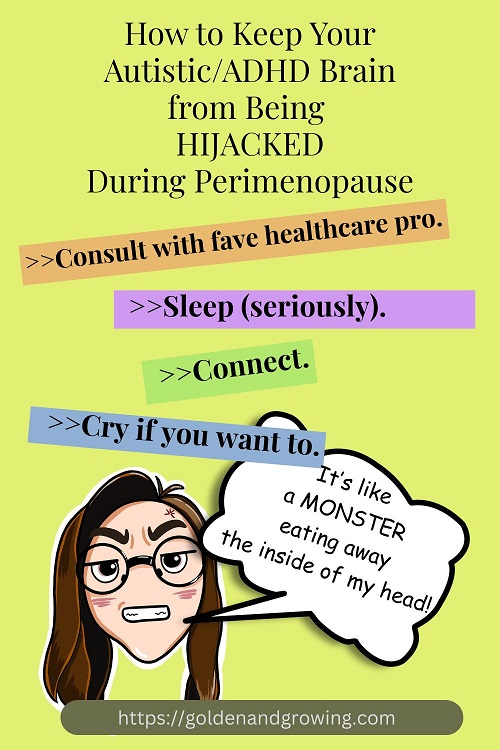
- Talk to your doctor: This is paramount. Find a doctor who is knowledgeable about both neurodivergence and perimenopause. Or at least one. Discuss your symptoms and explore options like Hormone Replacement Therapy (HRT) or progesterone cream. For some, HRT can be a game-changer in stabilizing those hormone levels and, in turn, calming some of the ADHD storm. Don’t let anyone dismiss your concerns as “just stress” or “part of aging.” Your experience is valid. (Want some scripts to help you communicate with your healthcare provider? Here are 50!)
- Double down on your coping strategies: Those systems you’ve built aren’t failing you. They just need an upgrade. Use external aids even more rigorously. Set more reminders, write more lists, and ask for help when you need it. Embrace your inner maximalist when it comes to organizational tools. Try this tool that supports executive function, this ridiculously simple one that helps increase your dopamine levels, or this one that helps prevent brain overload.
- Prioritize self care (seriously): Sleep, nutrition, and movement are always important, but during perimenopause with ADHD, they become non-negotiable. Even a short walk can help clear some of that brain fog. And try to protect your sleep like it’s a national treasure.
- Connect with others: You are not alone in this wild ride. Joining online forums or support groups for neurodivergent women in perimenopause can provide invaluable validation and practical tips. Sharing stories and knowing someone else also found their phone in the oven can be incredibly therapeutic.
- Read this post on mental health support for neurodivergent women.
Perimenopause might feel like your neurodivergent traits have been unleashed from a cage and given a megaphone, but understanding how hormones affect ADHD and autism during this phase is the first step toward regaining some control. It’s a challenging chapter, but with awareness, support, and the right strategies, you can navigate it without losing your keys (or your mind) too often.
Stay strong, fellow warriors!
(And if you’re interested in reading about how masking affects autistic women over 40, give this a read.)
*********
NOTE: I’m not a medical professional. This post reflects my personal experience and the research I’ve read. It’s not medical advice — please consult a qualified professional for personalized guidance.
