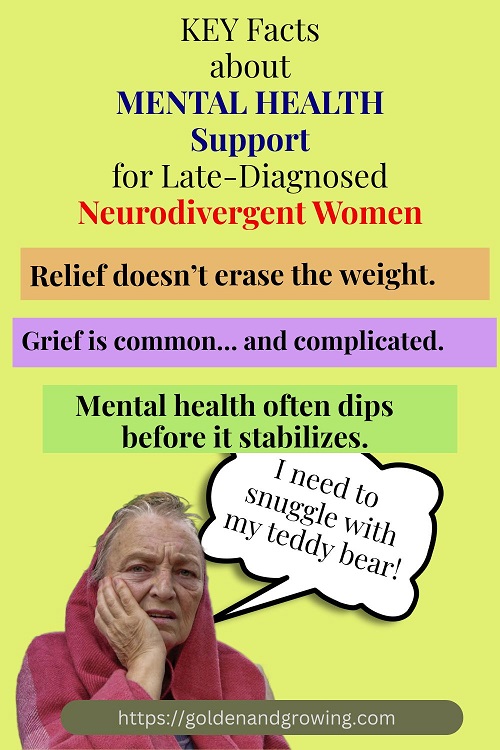
Whether it’s autism or ADHD, mental health support for neurodivergent women, especially those who aren’t diagnosed until midlife or older, is critical. Read on for the facts you need to know.
Getting a neurodivergent diagnosis after decades of questions can feel like finally solving a the most frustrating, obscure riddle in the entire galaxy. Then you start to learn about the diagnosis… and end up wanting to bury your head in a warm, soft, hundred-foot-deep pile of sand.
If you’re perimenopausal or post-menopausal, that pile can end up feeling like quicksand. I’ve already talked about how dropping estrogen levels can exacerbate certain neurodivergent traits and symptoms, so I’ll refrain from repeating myself. As happened to me, many women in midlife and older who learn they’re autistic or have ADHD find themselves holding a mixed bag of emotion. It brings relief, grief, and sometimes a slow unraveling. It also brings new mental health challenges that aren’t always addressed at the time of diagnosis.
You only THOUGHT hormone-induced anxiety and depression were the scariest things on the planet.
Following are the key facts to know as you navigate your new journey.
#1: Relief doesn’t erase the weight.
I’m guessing that a lot of, if not most, late-diagnosed women share my experience. I had a big “a-ha!” moment of realizing why I’m weird and why life seemed so much easier for most people I knew.
And I ain’t gonna lie – it was kinda fun to blame certain situations in my life on my neurodivergence.
But after relief, negative emotions pop up. Because relief doesn’t cancel out the weight of decades spent trying to conform, often without knowing why it was so exhausting. Relief doesn’t cancel out the realization that you may have made completely wrong choices and decisions for your highly sensitive or socially handicapped self. Anger, regret, and anxiety about what comes next in life follow on the heels of relief like a rabid terrier puppy.
#2: Grief is common… and complicated (a critical reason for mental health support for neurodivergent women).
After a late diagnosis, many women experience a delayed grief. Not just for missed accommodations or misunderstood behaviors, but for the lost time. For the relationships that suffered. For the constant self-blame that may have defined much of adulthood.
This grief may or may not be dramatic. You remember a difficult school year, a chaotic household, or a job that never quite fit, and you shed inward tears, or stomp around the house telling everyone within earshot about how much your life has sucked.
When grief is quiet, it often appears as a soft ache. That’s the most dangerous kind, because it can persist for months, even years, unless given room to be acknowledged.
Some women grieve a version of themselves they never got to be: the self that wasn’t burdened with constant masking or internalized shame.
Go ahead and have some snuggle time with that teddy bear you’ve had since you were three. It can take your tears.
#3: Mental health often dips before it stabilizes.
Even when the neurodivergent diagnosis is affirming, mental health support for neurodivergent women is important. The reason? Mental health symptoms may worsen before they improve. Common experiences include:
- heightened anxiety as past memories resurface,
- low mood from reprocessing old experiences through a new lens,
- shame for not recognizing the signs earlier,
- identity confusion: what’s real, what was masked, what now feels authentic.
Like, am I really the life of a party, or has my dancing on top of tables been a stim this whole time?
These are not signs of regression, but of recalibration. When the nervous system begins letting go of long-held performance habits, it takes time to adjust. The energy that you once spent managing appearance, tone, or behavior now has nowhere to go.
Unsure of how to handle this energy, you might have meltdowns, shutdowns, or both. A great tool at that time would be a simple menu of options to help your system to reset.
Having daily routines in place help stabilizes mental health, as well.
#4: Therapy can feel more frustrating than helpful.
Dude, I am not here to dis therapy. And it’s logical that you might think of it as the go-to for mental health support for neurodivergent women. Especially those who are late-diagnosed. However, many neurodivergent women over 50 have spent years in therapy without realizing they were being treated for the wrong thing.
I’ve said this before, and I’ll say it again: I believe that most people diagnosed with anxiety or depression – and at least some slapped with other labels, like “bipolar,” “OCD,” or “borderline personality” – are actually misdiagnosed neurodivergent people. And if you’re diagnosed with the wrong thing, or the thing isn’t at the root of your difficulties, you were undoubtedly taught coping strategies that never fully worked.
After diagnosis, some women seek therapy again, hoping for new insight. But traditional therapy may still fall short. When therapists aren’t trained in neurodivergent presentations, especially in late-diagnosed women, the result can be another layer of misunderstanding.
For therapy to help, it often needs to shift from behavior correction to nervous system support. It needs to address executive function, and possibly include trauma-informed approaches that acknowledge the impact of lifelong masking.
The good news is, there are online counseling services that provide an array of expertise among the therapists who participate in their network. Seek therapy if you know you need it, but be careful to vet the therapists to make sure they understand adult neurodivergence.

#5: Medication may help, but isn’t always the full answer for mental health support for neurodivergent women.
Some women pursue medication after diagnosis. These include ADHD stimulants, anti-anxiety meds, or mood stabilizers. For many, these offer needed relief. But others find that medication alone doesn’t resolve the sense of disorientation that follows a late diagnosis.
They need a regular dose of freshly baked brownies.
Okay, seriously. The herb St. John’s Wort works for many people, including me and my husband. As does magnesium supplementation.
But mental health after late neurodivergent diagnosis requires more than chemical adjustment. It often involves lifestyle rebalancing: changing sensory inputs, adjusting routines, setting new boundaries, and rethinking self-expectations that were based on a misunderstood brain.
In that sense, support becomes layered: biochemical, behavioral, environmental, and social.
#6: Quiet time is non-negotiable.
Once the internal narrative changes from “What’s wrong with me?” to “This is how my brain works,” mental fatigue may increase before it lessens. That’s because the brain is rerouting, often revisiting old experiences to reprocess them through a new lens.
Or it may just be your estrogen levels plummeting even further. But let’s say it’s the other thing, just to make you feel better about possibly having a future with more mental energy. (You’re welcome; I’m here to encourage.)
In this stage of mental health support for neurodivergent women, solitude matters. Not isolation, but time away from external demands. Even ten minutes of low-stimulus quiet can offer a reset. The mental health benefits of rest are especially strong for women who have spent decades overfunctioning and overmasking.
This is also where burnout often shows up. It may not be new. But without the mask to prop up social engagement or productivity, the nervous system starts demand for the rest and quiet it’s been needing for pretty much ever.
Lie down, close your eyes, and squeeze your teddy bear close.
#7: You might have to do some identity rebuilding.
When it comes to mental health support for neurodivergent women, most people don’t think “identity crisis.” However, a neurodivergent diagnosis shifts how women understand their strengths, preferences, and limits. This redefinition of self can be disorienting. We’ve spent years adapting to fit into jobs, relationships, or communities that didn’t leave space for difference.
Many women start to question long-standing patterns: the social groups they chose, the careers they pursued, the roles they adopted. Some quietly shift their boundaries. Others rediscover old hobbies or restructure their daily life to match their brain rather than fight against it. It’s a critical part of mental health support for late-diagnosed adults
Until recently, I used to push myself to go-go-go the entire day. Even though it’s been years since I’ve held down a job, I’d become so deeply ingrained with the neurotypical majority rule to “be productive,” I couldn’t feel like a worthy human being unless I stuck to a strict schedule and stayed busy most of the day.
Now, however, I have plenty of down-time built into my schedule. Not only that, but I’ve stopped forcing myself to work on hobbies for the sake of improving or meeting a goal, but only engage with them as a means of enjoying myself.
The nine-to-five grind was invented by a neurotypical person. That’s my story and I’m sticking to it.
Mental health support for neurodivergent women: in context, not in isolation.
Too often, late-diagnosed neurodivergent women are viewed through a clinical lens. That might be personally or via research papers. But our mental health doesn’t exist in a vacuum. It sits inside decades of accumulated expectations and the silent labor of camouflaging our true selves.
Recognizing this doesn’t undo the impact, but it can bring a layer of understanding and compassion for ourselves that’s long overdue. It also compels us to find supportive people who are willing to sit with us while we trudge, dig, and rake through all the accumulated junk.
There’s no linear path to healing from grief, regrets, and confusion for the late-diagnosed neurodivergent woman. But there is movement. And though it starts with grief and confusion, it works toward clarity and gentler self-understanding.
********
NOTE: I’m not a medical professional. This post reflects my personal experience and the research I’ve read. It’s not medical advice — please consult a qualified professional for personalized guidance.
