In this ultimate guide to menopause brain fog vs. ADHD, you’ll discover the difference between the two, as well as when to ask for help.
I stared into our bedroom, mind blank. What on earth had I gone in here to do? Or get? It was in my head five seconds ago. I racked my brain for an answer, but it did not comply. Apparently, my brain had gone on strike without giving notice.
Disheartened, I turned away from the door, yet another errand never to be completed. Somewhere, deep in the shadows of my mind, the thought was probably still there—sipping a margarita and laughing at me.
*******
Sound familiar? If you’re a woman in her late forties or her fifties and you’re finding it harder to concentrate, remember details, or stay organized, welcome to the world of plummeting levels of estrogen. It’s like your brain decided to take early retirement without consulting you first.
Or, is it estrogen?
You may have ADHD and not know it. Or maybe you do know it, but have no clue how to discern whether your forgetting words, losing track of time, or misplacing things is due to your neurodivergence or to menopause. Because apparently, life wasn’t complicated enough already.
In this post, I’m going to walk you through the key differences between menopause brain fog and ADHD, and why they sometimes overlap in ways that make them hard to separate. By the end, you should have a bit more understanding as to what to blame for your flighty brain. (Spoiler alert: it might be both, because, why not?)
(Read about how hormones affect both autism and ADHD during perimenopause.)
What is menopause brain fog?
When it comes to menopause brain fog vs. ADHD, it’s wise to begin with the first because it’s more common.
Menopause brain fog isn’t a medical term, but it’s a common and often under-discussed symptom of hormonal changes that occur during perimenopause and postmenopause. Because heaven forbid we acknowledge that women’s brains might be affected by the same hormones that control literally everything else in our bodies.
It could be:
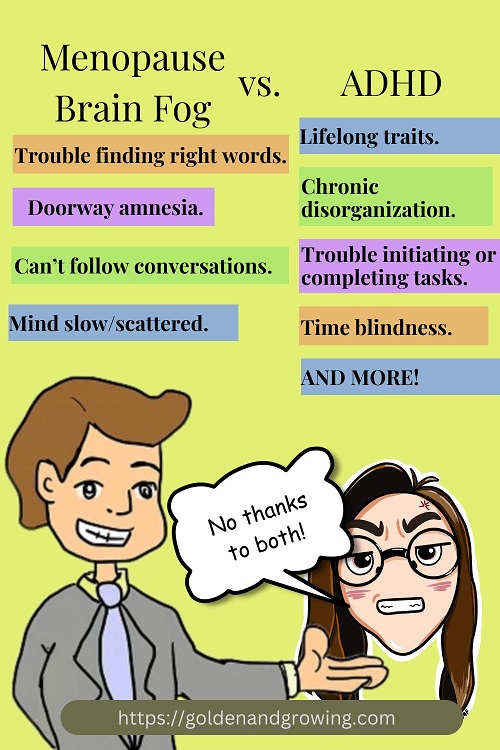
- trouble finding the right words (like having a word on the tip of your tongue, except the tongue has apparently forgotten how to work),
- forgetting why you walked into a room (the classic “doorway amnesia”),
- difficulty following conversations (especially when everyone else seems to be speaking in code), and/or
- feeling mentally slower or scattered (like your thoughts are wading through molasses).
For many women, this fog is tied to a drop in estrogen, which plays a role in brain function, especially in areas like memory and processing speed. Estrogen, it turns out, was doing a lot more heavy lifting than we realized.
It tends to fluctuate – some days are fine, others feel mentally “off.” It’s like playing cognitive roulette every morning when you wake up.
Sleep disruption, anxiety, and hot flashes can all make the fog worse. Because why have one miserable symptom when you can collect the whole set?
Hint: the misery becomes a lot less when you can track it and notice patterns.
What does ADHD look like in midlife women?
If you’re reading this article, you know that ADHD isn’t just about hyperactive children bouncing off classroom walls. You likely also know that if you have it, you were born with it. It’s not a disease you catch, or something that develops in childhood as a result of trauma, drug use, too much T.V., or bad parenting.
Despite what your mother-in-law might have told you.
If you suspect you might have it, at this point in your life it may show up as:
- chronic disorganization (your junk drawer has achieved sentience)
- trouble initiating or completing tasks (the number of half-finished projects in your house could populate a small craft store);
- time blindness (underestimating or losing track of time like you’re living in a parallel dimension where clocks work differently);
- forgetting details even when you’re trying to remember them (your brain: “Instructions unclear, forgot what we were trying to remember”); and/or
- intense focus on some things and total avoidance of others (hello, hyperfocus on organizing your spice rack while ignoring the pile of bills).
You would also be highly emotionally sensitive. Like having emotional weather that changes from sunny to hurricane-force winds in 0.3 seconds.
(Click here for more on the symptoms of ADHD in women.)
And these symptoms would have shown up early on in your childhood. They were likely less intense, because in women, the higher estrogen levels of our childbearing years are somewhat protective of our brain and cognition. But they would still have been present, lurking like cognitive ninjas.
However, estrogen may have made the symptoms much more manageable. Once you hit perimenopause, they would have amplified, perhaps even brought them to light for the first time. It’s like estrogen was the bouncer keeping your ADHD symptoms in check, and then it just quit without notice.
The key differences in discerning menopause brain fog vs. ADHD.
Menopause brain fog tends to begin when a woman is in her mid- to late-forties, feeling like it’s begun happening overnight. One day you’re sharp as a tack, the next you’re wondering if someone switched your brain with a bowl of pudding while you weren’t looking.
If you have ADHD, you should be able to look back and realize that you exhibited its traits even as a youngster. Though you probably called it “being creative” or “having character” back then.
With menopause brain fog, you may forget steps of a task or lose focus occasionally. With ADHD, you frequently struggle to finish tasks, even important ones. It’s the difference between occasionally misplacing your keys versus having a entire drawer dedicated to “mystery keys that probably open something important.”
Organization gets harder once perimenopause hits. If you have ADHD, it’s always been difficult, no matter how hard you’ve tried. You’ve been fighting an uphill organizational battle your entire life, while other people seem to have been born with some sort of tidiness superpower.
With brain fog, focus feels dull, slow, and foggy—like trying to think through cotton balls. With ADHD, it can shift between intense hyperfocus (suddenly it’s 3 AM and you’ve reorganized your entire digital photo library) and distraction (ooh, look, a squirrel).
As far as memory, brain fog leads to more trouble with names, words, and short-term recall. ADHD causes forgetfulness across multiple areas, even daily. It’s like having a personal assistant in your brain, except they’re consistently unreliable and possibly drunk.
If you’re like me and feel like you’d forget your head if it wasn’t fastened to the top of your neck, yeah. ADHD. Welcome to the club—we’d give you a membership card, but we’d probably lose it.
Menopause brain fog often improves with rest or better routines. But ADHD requires external systems, like visual reminders or audible phone notifications. Routine alone often doesn’t help much. It’s like trying to fix a leaky pipe with positive thinking—admirable, but ultimately ineffective.
Menopause brain fog vs. ADHD? Why choose one when you can have it all?
Well, join my club! (That’s here on this blog. We have t-shirts, but I can’t remember where I put them.) Like so many other middle-aged women during the past decade, I didn’t realize I was neurodivergent until I hit menopause. Why?
Low estrogen equals no filter. It’s like estrogen was the diplomatic translator between your brain and your mouth, and suddenly it’s gone on permanent vacation.
Chemical changes in your brain make masking more and more difficult, to the point where it’s exhausting to rein in your emotions, thoughts, and need for frequent movement. Specifically, the presence of estrogen encourages dopamine production and regulation. People with ADHD already have lower than typical levels of this feel-good chemical. And when women with ADHD hit perimenopause, dopamine levels drop even further.
And we feel like our brain has lost contact with the mother ship.
“Houston, we have a problem…” and that problem is everything.
If you’ve always struggled to some extent with focus, motivation, or follow-through, and menopause has made it worse, it’s worth exploring ADHD as a possible underlying factor. Think of it as finally getting the missing piece to a jigsaw puzzle you’ve been working on for 40+ years.
On the flip side, if your mental fog is new and came on during perimenopause, or after you went through menopause – and has been accompanied by hot flashes, mood swings, and/or previously unknown sleep disruption – it’s probably hormone driven. Your ovaries have basically decided to retire and are taking your cognitive function with them as a going-away present.
When to seek help for menopause brain fog or ADHD.
Sometimes, trying to figure out the puzzle of menopause brain fog vs. ADHD is less important than getting help. If your cognitive issues are interfering with daily life, such as managing work, relationships, or your health, you may consider seeking support. Revolutionary concept, I know—actually getting help when you need it.
Seek out a healthcare provider who is familiar with menopausal health and/or neurodivergence. This is like finding a unicorn, but slightly more achievable with the internet.
If the nearest one is two or more hours away, try to find one online (a woman functional medicine practitioner would be ideal) who will do telehealth appointments. There is nothing more frustrating than an M.D. or N.P. (a-hem, especially the male kind) who knows nothing about either one, and just wants to throw drugs at your symptoms like they’re playing pharmaceutical darts.
A provider who knows what they’re talking about might suggest:
- hormone testing (finally, some actual data instead of “it’s probably just stress”);
- ADHD screening (yes, this exists for adults, shocking);
- cognitive assessments (fancy tests to confirm what you already suspected); and/or
- supportive therapies or targeted strategies (actual solutions instead of “have you tried yoga?”).
You don’t need to figure everything out alone. Or suffer in silence thinking, “I’m just getting old.” Getting older doesn’t mean your brain has to turn into Swiss cheese.
If it’s just menopause, your solution may be as easy as using progesterone cream or wearing an estrogen patch. Sometimes the simplest fixes are the most effective—who knew?
Read here for more about perimenopause brain fog.
Read here about ADHD, menopause, and time management.
The bottom line in the issue of menopause brain fog vs. ADHD.
You now know how to tell the difference between ADHD and menopause brain fog. And I hope you realize that there are many, many other women out there dealing with the same issues – including both at the same time (this club, remember? We’re growing exponentially and our meetings are delightfully chaotic).
Whatever’s going on in that frazzled-yet-brilliant head of yours, you deserve support that matches your actual needs. One-size-fits-all solutions rarely work, especially for women in midlife with complex, overlapping symptoms. It’s like trying to fix a computer with a hammer. Technically you’re doing something, but it’s probably not helpful.
Understanding the source of your cognitive challenges is the first step toward managing it. And whether that means adapting your routines, exploring medication, or creating systems that reduce cognitive overload, the goal is the same:
Clarity, peace of mind, and a way forward that honors your unique brain. Because your brain—fog, ADHD, or both—deserves better than being told to “just try harder.”
(If you’ve enjoyed this post and really and truly want more clarity and peace of mind, I’ve created a bunch of inexpensive printable PDFs that are helpful for both brain fog and ADHD. Interested? Check out my Etsy store.)
********
NOTE: I’m not a medical professional. This post reflects my personal experience and the research I’ve read. It’s not medical advice — please consult a qualified professional for personalized guidance.

1 thought on “The Ultimate Guide To Menopause Brain Fog vs. ADHD”
Comments are closed.