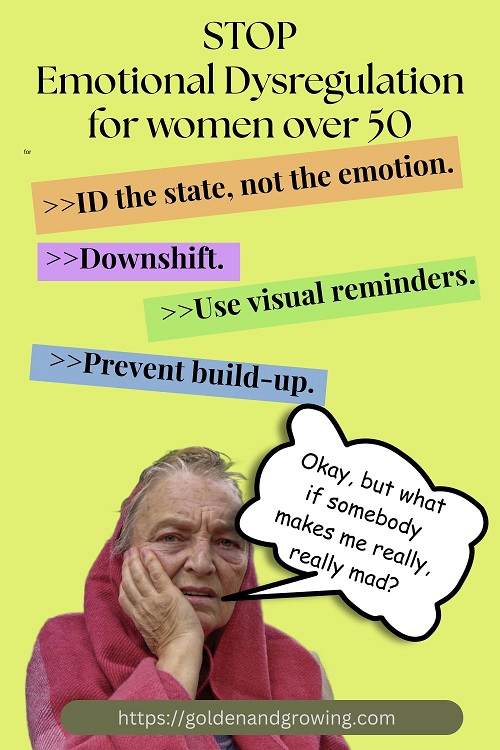
How to stop emotional dysregulation after 50 for women? If only I’d known then what I know now…
Somebody was being an idiot again. Not me, of course, I always get everything right.
So it was either my son or my husband, the only available victims perpetrators. What had they done? Who knows? But it must have been really important, because I was P.O.’d. Really P.O.’d. So much so that I lifted the headphones in my hand – the most comfortable pair of headphones I’ve ever had, which are no longer sold – and slammed them to the floor.
Promptly causing it to break.
Promptly causing me to burst into tears.
Wait, did I just brag about always getting everything right? Um…
Anyhow, does the above scenario ring even a faint bell? For many neurodivergent women at that age, a late diagnosis brings clarity about more than focus or sensory processing. It also reframes emotional patterns that never made sense until now: sudden outbursts, long internal build-ups, or feelings that came on too strong and lingered too long. We begin to learn that such behaviors, rather than being “overreactions,” were nervous system responses shaped by a brain that processes emotion differently.
Learning this doesn’t immediately fix the problem. But it offers a starting point for regulation—without shame, without force, and without expecting your body to work like everyone else’s.
It’s like finally getting the user manual for a complex piece of equipment you’ve been trying to operate for decades. Turns out you weren’t broken; you were just missing the instructions.
What emotional dysregulation looks like post-diagnosis.
After a lifetime of masking, many women don’t recognize what emotional dysregulation looks like in real time. Sometimes, like in my little tell-all story, it’s explosive. But it also may show up as silent spirals of anxious overthinking that won’t stop. Almost as if your brain got stuck on a hamster wheel and forgot how to get off.
Then there are emotional shutdowns—feeling numb or blank, as if someone unplugged your emotional circuit breaker. You might experience delayed anger that surfaces hours or days later, because apparently your nervous system has the timing of a slow-release aspirin. And don’t forget the tense physical symptoms: jaw clenching, stomach knots, lightheadedness. They are basically your body’s way of saying “I’m not okay” in a language you’re finally learning to speak.
These responses of emotional dysregulation after fifty are often interpreted as “stress” or “fatigue,” but they may be signs of underlying overwhelm. When a neurodivergent woman begins unmasking, these sensations can seemingly increase because she’s finally noticing what was there all along.
It’s like taking off noise-canceling headphones in a busy restaurant and suddenly realizing just how loud everything actually is. The noise was always there; you just couldn’t hear it before.
Why emotional dysregulation may be more intense after 50.
How many younger women think, “I wouldn’t mind if my estrogen and progesterone took a nice, long vacation. I’m sick of having my period”?
I used to think that way. Now I’ve reverted my stance. Can I have that monthly bleeding back for the rest of my life, please? Turns out those two hormones do a lot more than regulate a woman’s reproductive cycle. Among many other things, they support serotonin and dopamine production. So when the levels of these hormones decline during perimenopause and menopause, emotional regulation can take a hit—especially for those already managing ADHD or autistic traits.
Emotional volatility may worsen. Mood crashes can appear without warning. And coping strategies that used to work, such as powering through, start to break down.
Hormonal shifts reveal hidden ADHD symptoms as well as emotional patterns that were long dismissed or misunderstood. This intersection of brain chemistry and neurodivergence increases emotional dysregulation after fifty. Even after forty, if perimenopause symptoms hit you that early.
Your hormones and your neurodivergent brain are basically having a heated argument about who’s in charge, while you’re stuck in the middle like a referee at a particularly chaotic hockey game. The good news? Even referees learn to manage the chaos eventually. Let’s look at six strategies for controlling emotional dysregulation after fifty.
Strategy 1: Name the state, not the feeling.
Many regulation models focus on identifying emotions. For neurodivergent brains, this isn’t always helpful. Feelings may come without names, like trying to identify a song you’ve never heard but somehow know you don’t like. What’s more effective is identifying the state your body is in.
For example:
- Am I ramping up?
- Am I shutting down?
- Do I feel like fleeing, freezing, or fighting?
Once the state is known, you can respond accordingly without having to label the emotion or analyze why it’s happening.
This technique, adapted from polyvagal theory and neurodiversity-informed practices, reduces cognitive load and makes self-support more accessible in the moment.
Unless you find out that pair of headphones you just broke cost fifty dollars. In which case you run out of the house, screaming.
Strategy 2 for emotional dysregulation after fifty: Downshift before reasoning.
When the nervous system is dysregulated, it doesn’t process logic well. That’s because the limbic part of the brain takes over, at which point your frontal lobe sits down, crosses its legs, and sighs heavily as it wonders how long it’ll have to wait THIS time.
Trying to talk yourself out of distress or explain your way to calm usually fails about as effectively as trying to reason with a toddler who’s having a meltdown in the cereal aisle.
Or with a fifty-year-old woman who can’t believe she could do something as utterly stupid as breaking a pair of the best.
Headphones.
Ever.
Because she never does anything stupid.
If I’d known then what I know now, I would have dealt with my body first.
Simple body-first downshifts include changing temperature with cold water on wrists or a warm compress over chest. You can add pressure with a weighted blanket, pillow squeeze, or crossing arms tightly. Try resetting your vision by closing your eyes for 30 seconds or shifting your gaze to a single point. That basically gives your overstimulated brain a mini vacation.
Why do little actions like that help? They send safety cues to the brain without requiring conscious thought. They’re especially helpful when the emotional state is vague or delayed.
Strategy 3: Shorten the recovery window.
Recovery from emotional dysregulation often takes longer for late-diagnosed women. After masking for decades, the nervous system may have a lower baseline of resilience.
It’s like a phone battery that’s been overcharged for years and now seems to die before you’ve even had a chance to check the weather forecast.
Instead of pushing through, consider inserting “recovery anchors” into the day. These anchors are small, repeatable routines that help return to center. For example, five minutes of rhythmic movement, such as walking in place or rocking, can work wonders. Try one page of handwriting in a notebook, just to clear mental static, or create a low-stimulus space with predictable sounds. Those could include white noise, a soft fan, or meditation music with the same brief melody that repeats over and over.
The goal isn’t to avoid emotional dysregulation altogether. It’s to reduce how long it lasts. Think of it as emotional first aid rather than emotional surgery.
This printable PDF gives you an instantly available list of things to try.
Strategy 4 for emotional dysregulation after fifty: Use visual or tactile cues.
Verbal instructions may fall flat during dysregulation, even when self-directed.
Ever tried to talk yourself out of pain after slamming a car door on your finger?
Yeah. Like that.
On the other hand, visual or tactile tools can support re-regulation with less effort. Some possibilities include a small grounding object in your pocket—something you can touch without anyone noticing, like a worry stone or smooth piece of metal.
A one-word card near your workspace (like “pause” or “exhale”) can serve as a gentle reminder when your brain starts spinning. Color-coded to-do lists or schedules that signal pace or urgency can help you gauge whether you’re pushing too hard or moving at a sustainable speed.
All of these tools act as gentle nudges to keep your brain from spinning out or shutting down entirely. These days, when I start to feel anxiety get the better of me, I allow myself one of two lifelong stims: stroking my lip with a fingernail, or rocking in my rocking chair. If I’m feeling aggressive, I’ll go for a walk or squeeze a ball.
Strategy 5: Adjust your internal timeline.
Many women over 50 feel behind by the time they get a diagnosis. This sense of “lost years” can trigger urgency: to understand everything, fix everything, catch up fast. That pressure often leads to emotional exhaustion, which in turn leads to emotional dysregulation.
Regulation improves when pace is adjusted.
Take a deep breath.
Slow down.
Learn your body’s signals, tolerances, and rhythms organically, as life happens. Building emotional fluency after decades of suppression is possible, but it comes not by force, but by repetition.
And patience. Lots of patience.
Small improvements matter. Less reactivity, slightly faster recovery, fewer spirals—these are markers of growth, even if the nervous system still struggles. Progress isn’t always dramatic; sometimes it’s just noticing you didn’t completely lose your mind in the grocery store checkout line this week.
Or after you realized you broke a pair of headphones that can never, ever be replaced again.
(Hmm, wonder if I should bring this incident up with my therapist…)
Strategy 6 for emotional dysregulation after fifty: Expect variability.
Emotional regulation isn’t linear, especially for neurodivergent women navigating hormonal shifts, cognitive reframing, and unmasking all at once. Some days will feel more stable. Others may unravel without warning.
A common cue for me to go back to bed is that I start dropping things almost as soon as I get up. It rarely gets better from there.
Still, that variability is a combo of your body and brain trying to teach you something. They’re helping identify triggers, tolerances, and what works best when.
Tracking can help, but only if it’s used for information and not for self-judgment. A simple log of “rough mornings” or “calm evenings” builds awareness over time. Think of it as collecting data about your own personal weather patterns rather than keeping score of your emotional wins and losses.
Emotional dysregulation: whether from ADHD, menopause or autism, you can improve it.
Emotional regulation after a late neurodivergent diagnosis requires more than standard self-help advice. It asks for gentleness, pattern recognition, and enough space to hear the nervous system without silencing it.
Your goal is gradual alignment, building strategies that work with your brain instead of against it. Some days, regulation means movement. Other days, it means stillness.
I’ve found that most of the time it’s meant chucking out every single piece of advice I’ve ever heard or read from a self-help guru.
Regardless, over time the process of internal aligning becomes familiar. Less reactive. More grounded. And, eventually, less lonely.
Your emotional regulation journey is uniquely yours. It won’t look like anyone else’s, and that’s exactly as it should be.
*******
NOTE: I’m not a medical professional. This post reflects my personal experience and the research I’ve read. It’s not medical advice — please consult a qualified professional for personalized guidance.

1 thought on “Stop Emotional Dysregulation After 50: 6 Proven Strategies For Women”
Comments are closed.