Late diagnosis ADHD in women over 40, even over fifty, is becoming almost a trend online. Ditto for autism. Has to be people mistaking trauma issues for neurodivergence, right?
Perhaps in a fraction of the cases. But the truth is, both ADHD and autism in girls and women looks different to what they do in boys and men. And we smart girls who can make ourselves sit still and obey for the sake of not getting into trouble regularly fly under the radar of teachers and parents as far as having a neurological difference.
I’ve discussed autism in older women in this post. Here, I want to zero in on the badly-labeled issue of ADHD… as well as why so many middle-aged and older women are “coming out” with the challenge. (And yes, at this point it does feel a bit like coming out of a very confusing, very long closet.)
The traits for ADHD in women over 40? They’ve always been there.
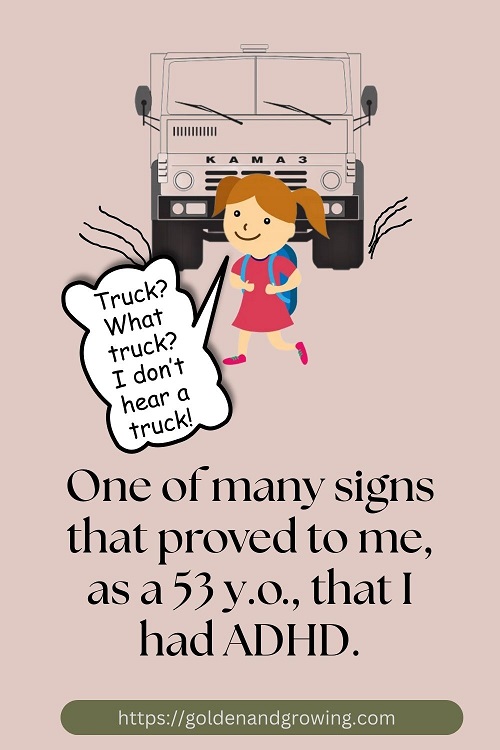
I was ten or eleven years old one day when I was walking down the shoulder of a country road from a neighbor’s back to my home with my mother. Suddenly, Mom was grabbing my arm and pulling me toward the ditch.
“Good heavens, Emily!” she exclaimed as a the sound of a dump truck approaching yards away filtered into my head. “You need to pay attention to the road!”
I looked around, a little confused. A moment earlier, I hadn’t heard the truck at all. It was like it had come out of nowhere.
As I grew older and homework became more onerous, I would get to the end of a chapter, read the questions, and have to get Mom to find some of the answers in the passage I’d just read. The answers would always be there in black and white.
I just didn’t have the patience either to read the text carefully the first time, or to wade through it a second time to find the answer. Textbooks were too boring to be worth my time. (A sentiment I maintain to this day, though now I can blame it on neurodivergence rather than just having standards.)
I could offer plenty of other examples of my scatter-brainedness, impatience, and impulsivity. Early on in my first year teaching, I resorted to writing notes on the back of my hand as reminders. I quickly learned that writing notes on a piece of paper would lead either to me losing the paper or forget it ever existed.
But none of this ever screamed “attention deficit” to me. By then I was a grown woman. I held down that teaching job for thirteen years, leaving it only to start a family with my husband. I was great at organizing my stuff and keeping my finances in line.
Besides all that, I grew up in a world where ADHD was strictly a male problem. Because apparently, only boys could have brains that worked differently. Girls just needed to try harder and stop being so dramatic.
Except… it’s not.
Why so many women over 40 are getting diagnosed with ADHD
ADHD doesn’t suddenly appear out of nowhere in midlife. Being a difference in brain structure, a person develops it in utero. But for most of us, it’s masked and/or misdiagnosed.
Because it’s been misunderstood even by the psychiatry powers-that-be for a long time.
You know, the same folks who once thought hysteria could be cured by removing women’s ovaries. Medical progress moves at a glacial pace, particularly when it comes to understanding women.
I did my student teaching with a second-grade classroom which included a boy who was on Ritalin for his hyperactivity. He was sweet, but always practically quivering with unexpressed energy. That’s what everybody believed ADHD looked like back in the 1990s and before.
Girls who zoned out were accused of daydreaming. Those who overachieved due to a fear-driven need for perfection (that’s me) were called “good students” and even “leaders.” Those who had meltdowns behind closed doors were “melodramatic” or “immature.”
No one ever referred us to the school psychologist. They referred to us, instead, as moody, lazy, or dramatic. Because nothing says quality education like writing off half the population as inherently defective.
But then, we hit perimenopause. And then menopause.
Bye-bye, estrogen and progesterone, the hormones that have been helping our brains cope our entire lives. Our ability to mask and adapt plummets in proportion to our hormone levels. It’s like losing your emotional training wheels at age 50—suddenly all those coping mechanisms that kept you upright come crashing down.
If you’ve been wondering whether ADHD might explain the struggles you’ve dealt with for years, you’re in the right place. Following are several signs that your brain fits with the diagnosis.
#1: Mental chaos that doesn’t match your external life.
A common experience among late-diagnosed ADHD women is this bizarre gap between how others see you and how you feel inside.
You may appear competent, but behind the scenes it’s another story:
- You’re constantly juggling tasks, with little to no memory of what you just accomplished.
- Important things – bills, appointments, deadlines – slip through the cracks.
- Messes and to-do lists paralyze you – sometimes literally.
That inner mental chaos – where your thoughts scatter in five directions before you’ve finished brushing your teeth – can very likely be attributed to executive dysfunction, a hallmark of ADHD. It’s like having a browser with 47 tabs open, half of them playing audio, and you can’t remember which ones are actually important.
(If that’s you, try my “Home Command Center” to aid your executive function. It’s an inexpensive, printable PDF that just might change your world.)
#2: Emotional reactivity, especially in relationships: a HUGE flag of ADHD in women over 40.
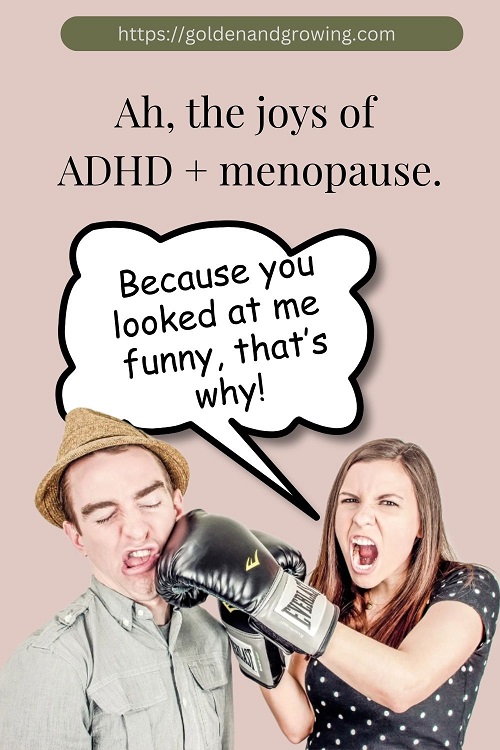
If you’ve ever been told you “overreact,” or if you find yourself going from calm to fury in 0.2 seconds, this one might sting a little. (Sorry in advance.)
Many women with ADHD—especially those undiagnosed for decades—experience rejection sensitivity, emotional flooding, and intense reactions to what others see as small triggers. We often internalize this as a personal failing, because clearly we’re just not trying hard enough to be reasonable human beings.
After 50, when estrogen begins to drop, these emotional swings can intensify. Combine that with decades of unrecognized neurodivergence and it’s no wonder so many women feel like they’re losing their grip.
If that’s you… you’re not. You’re just seeing the patterns more clearly. It’s like finally getting glasses after years of squinting—suddenly everything comes into focus, including how blurry it’s been all along.
#3: Lifelong Struggles With Time and Memory.
Have you always been:
- Frequently late, even when you really meant to be on time?
- Forgetful in strange, inconsistent ways? (Like remembering a childhood song but not what you walked into the kitchen for?)
- Chronically underestimating how long tasks will take?
This is classic ADHD time blindness. And after 50, the combo of aging + ADHD + hormonal changes can make this even worse. If you’ve found yourself asking, “What am I, developing early Alzheimer’s??!” the answer is, probably not. It’s much more likely to be ADHD. Though I understand the confusion—both involve forgetting where you put things and wondering why you walked into rooms.
#4: Burnout From a Lifetime of Masking.
One of the most overlooked signs of ADHD in older women is burnout—not from work or caregiving alone, but from decades of masking. That is when you force yourself to act “normal”: holding in your fidgets, tracking a conversation even when you’re zoning out, making endless lists to hide your forgetfulness.
Over time, this takes a toll. It’s like being an actor who’s been playing the same demanding role for 40+ years without ever getting a break or even knowing there was a script.
If you’re feeling exhausted by your own coping strategies, resentful of responsibilities you used to manage, or just plain tired of pretending, listen to these emotions. They’re a signal, one which many late-diagnosed ADHD women experience just before everything clicks.
#5. A History of “Too Much” and “Not Enough”: a Most Discouraging Trait of ADHD in Women Over 40
Too intense. Too sensitive. Too distracted. Too disorganized. Not focused enough. Not consistent enough. Not successful enough.
If you’ve lived your life swinging between these extremes, especially with a secret sense that something about you is “just off,” there’s a good chance you’ve been navigating a neurodivergent brain in a world not designed for it. Congratulations—you’ve been playing life on “expert” mode without realizing there were difficulty settings.
Getting an ADHD diagnosis after forty doesn’t erase the past. But it can give you language, tools, and most of all, self-compassion.
Why It Matters to Know—Even Later in Life
Some people ask, “What’s the point of a diagnosis this late?” As if there’s an expiration date on understanding yourself.
The point of a diagnosis of ADHD in women over forty is to know what your issue is, because until you have that in your hand, every strategy you try to get your life together will end up being like a bandage.
The point is to experience the tidal wave of relief which will wash away a lifetime of confusion and much of its stress.
The point is to begin to build systems that work for the brain you really have, not the one you’ve been pretending to have. Think of it as finally getting the user manual for a complicated appliance you’ve been trying to operate by guessing for decades.
And when I use the word “diagnose,” I include self-diagnosis, as well. That’s completely legitimate, as long as you do your due diligence.
Late-diagnosed ADHD in women, especially after forty years of age, often describe the experience as “everything finally making sense.” And that alone is worth pursuing. Because the more we understand ourselves, the more grace we can extend—for the forgotten birthdays, the hyperfocus spirals, the closets that never stay organized.
And maybe, for the first time, we can stop trying to fix ourselves and start building a life that actually fits.
********
NOTE: I’m not a medical professional. This post reflects my personal experience and the research I’ve read. It’s not medical advice — please consult a qualified professional for personalized guidance.
