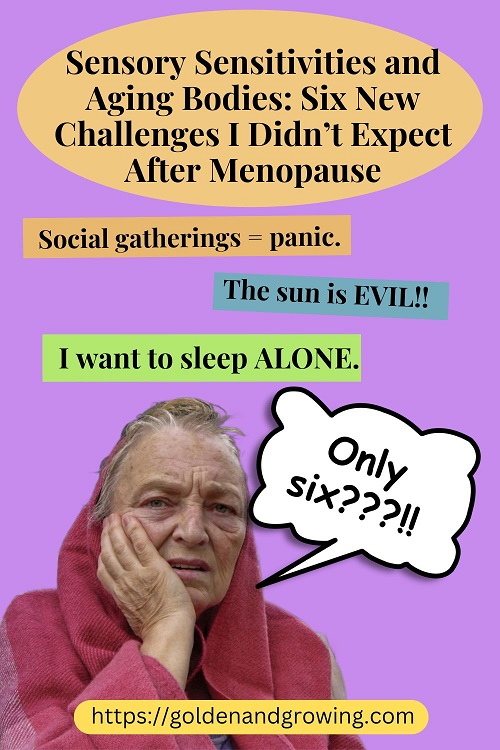
Are your sensory issues getting worse with age? As 45+ neurodivergent women, we face difficult challenges due to being highly sensitive. But they don’t have to ruin our lives. Here’s my story, and what I’m doing to thrive.
The story.
The sun warmed my back as I strolled along the road, enjoying the gentle rustling of the leaves all around. What a beautiful day! We’d been experiencing an unusual low humidity streak, and I’d been doing my best to take advantage of it.
Returning to our property, I made my way to the picnic table and sat for long minutes. Joy and peace settled deep inside, breeding a rare feeling of contentment.
Finally, I got up and walked inside the house. I needed to start getting things together for lunch. First, I reached for my stainless steel mug behind the sink to drink some water.
And promptly knocked it over.
A thrill of panic chased down my spine, quickly replaced by hot fury. It coursed through me, and in half a second, burned up the positive feelings.
I screamed a choice cuss word as I snatched the mug away and grabbed the sponge. Of course, water was already spilling over the edge of the sink cabinet.
My husband, who’d been sitting three feet away, got to his feet and hovered.
Annoyance dropped on top of the fury. I shoved the heel of my right hand into my mouth and bit down, not enough to draw blood, but enough to leave a mark for a few hours.
It was something I did when I was trying not to say something I would regret.
But my husband’s hovering was so annoying. My hand dropping from my mouth, I glared at him. “Leave me alone!”
He slunk away.
Mopping what mess up I could, I squeezed out the sponge, grabbed the mug, and stepped to where the containers of purified water sat on order to refill the mug. As I did, I scraped the top of my bare foot against the bottom corner of the sink cabinet.
Painfully.
A stream of curses thrust forth from my mouth.
Loudly.
Then I yelled at the ceiling, “I hate my life I hate my life I hate my life!”
I was fifty-four years old, and in full meltdown mode.
Aging and sensory processing: the truth most neurodivergent women don’t want to admit out loud.
I share the above story because, understandably, most autistic women and women with ADHD who have hit their mid-forties don’t want to admit similar behaviors to friends and loved ones. They also keep quiet about their increased sensitivities because for their entire lives, they’ve been told to “stop being a drama queen,” or, “You’re too sensitive.” They don’t want to rock the boat because they’re tired of being disregarded and disrespected for their very real sensory challenges.
Also understandable.
So somebody needs to say something. To convince the neurotypical world that our problems are real, that we’re not crazy but just coping. To encourage midlife and older neurodivergent women that they are not alone in these struggles.
So here I am, a neurodivergent woman over 50, saying something. I’m going to share how my sensory issues have become worse since I hit my mid-forties. I’m also going to share with you the things I’ve been doing to mitigate the increased sensitivities.
Can’t tolerate noise after menopause? Join the club!
Participating in large group activities where multiple conversations are happening at once has never been my favorite. But during the past few years, this kind of scenario brings me to the edge of a panic attack. And I’m talking twenty people, at least half of whom I have a strong acquaintance with.
I’m a lot more sensitive to machine noises as well. Even if the neighbor using a chainsaw is 800 feet down the road, my anxiety ramps up a little.
And when we have to run the dehumidifier inside our house? All bets are off. All I can think about is how stupid I was to want an earth-sheltered house built in an area where the average annual humidity is well over seventy percent.
How do I cope? The logical answer would be earplugs. Alas, I get dizzy when I wear them for longer than a few minutes. If there are machine noises outside, I go inside.
As far as the air conditioner and dehumidifier, by much experimenting I’ve figured out how to maintain a healthy-for-the-concrete humidity level and “cool enough” air in the summer with a minimum run-time of machines.
I rarely have social obligations anymore, and only because I’m married. My solution for that is to arrive as late as possible, and leave as early as possible.
FYI, even though it’s his family, my husband was the one who came up with the plan. He can’t stand all the people and noise, either.
Touch sensitivity worse with aging? Sort of.
This one comes and goes. At some point during my early to mid-fifties, I couldn’t stand it when my husband held my hand. I can’t explain it; the feeling of his skin against mine just felt wrong.
It’s better now as I write this article. However, I do notice now more than when I was younger the feeling of a seam on my clothing rubbing against my skin. I’m not positive, but I think I’m much less tolerant to cold now, as well. And if my husband touches my skin with cold fingers, I have to restrain myself from reacting with some violence.
Heck, if I accidentally brush one of my own cold fingertips against my belly, I come close to slapping myself!
The only remedy for this is to avoid annoying or distressing touches as much as I can.
Light sensitivity getting worse after menopause? Check.
I used to love the sight of unfiltered sunlight streaming into my home and puddling on the floor. It made me happy, probably because it was encouraging serotonin production.
Now, however, it gives me a headache. I have to have shades down or curtains drawn partially. Sheer curtains and Roman shades are great for muting natural light, as well.
In addition, I can no longer stand light bulbs with high wattage.
“Who farted??”
I’ve always had a strong sense of smell. I don’t think it’s become worse since menopause, but I no longer have the bandwidth to tolerate anything that makes me in any way uncomfortable.
Like when my husband releases a bubble of methane at night when I’m lying awake and fantasizing about finding a world where the temperature hovers between sixty-five and eighty degrees (Fahrenheit), allergies don’t exist, and I can sleep in my own bed.**
Oh, and where I don’t have a redneck neighbor next door who leaves dead fish and deer carcasses lying around in his yard. (Welcome to the rural South, y’all!)
Emotional lows that make Eeyore seem ecstatic.
Anxiety and depression, as well as mood swings, are common symptoms of perimenopause, often continuing after the pause occurs. However, many neurodivergent women find that in addition to those lovely symptoms, their meltdowns get worse than ever. If you think my story at the beginning was extreme, one woman admitted to stripping down to her underwear at work while undergoing an autistic meltdown. (And, no, she didn’t have THAT kind of job!)
None of us neurodivergent women are new to meltdowns. But when estrogen decides to go on a permanent vacation, it’s no longer present to coax our brains into producing the neurotransmitters that help us feel happy and balanced. Therefore, meltdowns become more frequent, and often stronger.
And sometimes they happen over much more minor incidents than spilling a glass of water.
My suggestion? Reduce your life load as much as possible.
That includes making your home as sensory-friendly as possible. And get to know your body’s signals for when your brain is overloading so that you can nip an acute reaction in the bud.
Sensory sensitive relief for older women: is it all in the hormones?
If lack of estrogen can lead to more frequent meltdowns, is its absence also the culprit in all the other increased sensitivities? Yes, according to this article. Our entire lives, estrogen has acted as “the middle woman” between our neurodivergent brain and our well-being. So when the levels of estrogen drop, so does our sense of well-being.
Because of that, hormone replacement therapy and/or progesterone cream might help, since the relief of menopause symptoms reduces stress all around. That is, unless the medication exacerbates conditions. In some women, research suggests, HRT causes side effects worse than the sensitivities. But that may be the delivery of the estrogen (e.g., patch vs. pill), so don’t let that stop you from considering it.
All in all, when you’re not experiencing things like hot flashes – especially the terrible anxiety that often precedes them – breast pain, and random aches throughout your body, you’re going to feel a lot better about life than otherwise.
I know my world changed when I started using progesterone cream.
Though I confess that it has done nothing for the meltdowns and increased sensitivities.
What have you noticed about your sensory sensitivities since hitting your mid-forties or fifties? Got any other advice on making life easier? Please share in the comments below!
*******
**The 576 square feet we currently live in does not allow for such luxuries.
PS – I’m not a medical professional. This post reflects my personal experience and the research I’ve read. It’s not medical advice — please consult a qualified professional for personalized guidance.
