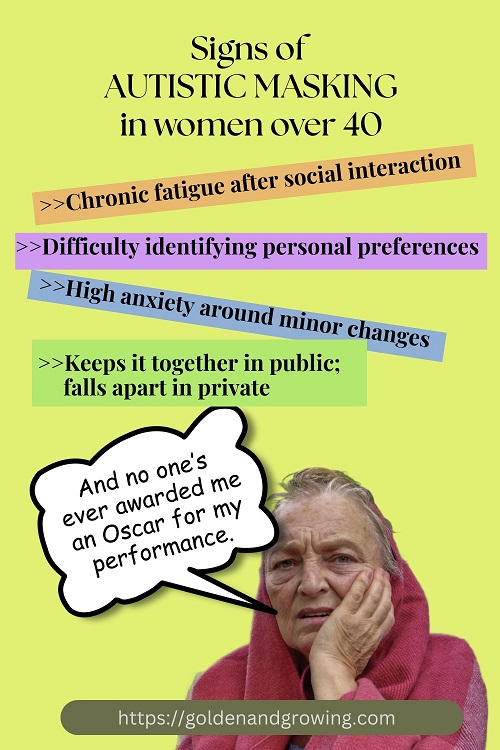
Autistic masking in women over 40 is more prevalent than even the experts realize. If you suspect you or a loved one is masking their neurodivergence, this article will help you reach a tentative conclusion.
Some women reach their forties and fifties feeling more confident and bold than ever. Buzz cut? Heck yeah! Tell that sister-in-law she’s despised for years to go jump in a lake? Done! Let a stinky one rip in public?
Go, baby, go!
But that’s not every woman. For some reaching menopause, the pressure to present a palatable version of themselves never fully lets up. It just becomes quieter and more practiced.
And more exhausting than trying to hold in a sneeze during a silent yoga class while wearing white leggings and a suspicious burrito belly.
This quiet performance is known as autistic masking, and it’s particularly common in neurodivergent women over 40. Think of it as method acting, except the role is “neurotypical person” and you never get to leave the stage.
The term “autistic masking” refers to the often unconscious effort to imitate neurotypical behavior. It can show up as suppressing stimming behaviors (goodbye, satisfying hand flapping or comforting swaying on your feet), mimicking facial expressions like you’re playing social charades, forcing eye contact even when it feels like staring into the sun, over-apologizing for existing, or mentally rehearsing every social interaction like you’re preparing for a one-person Broadway show.
In younger women and girls, autistic masking is often mistaken for shyness or social anxiety. But in women past midlife, the behavior becomes harder to detect, They’ve had decades to perfect it. They’ve basically earned a PhD in “appearing normal,” which is both impressive and deeply tragic.
Why autistic masking in older neurodivergent women is easy to miss.
Many older women aren’t identified as neurodivergent until later in life, if at all. The diagnostic criteria for conditions like autism and ADHD were developed around male presentations, because apparently the medical establishment thought neurodivergent women were just “quirky men” with better organizational skills. As a result, a significant number of us entered adulthood without language for what made them different.
We learned to watch and copy others like anthropologists studying an alien species. We studied how to laugh at the right moments (even when the joke wasn’t funny), how to dress appropriately (whatever that means), how to keep their hands still (because heaven forbid you show enthusiasm). Over time, these adjustments became second nature. But they also became as exhausting as running a marathon in heels while juggling flaming torches.
Even today, signs of autistic masking in women over 40 are frequently brushed off. Many people assume that by this stage of life, everyone has settled into who they are. But for neurodivergent women, midlife often brings a reckoning. The effort to conform – socially, professionally, even within families – can start to fray around the edges like a sweater that’s been washed too many times.
Late diagnosed autism in women often emerges during these years because the mask is literally falling apart. Your brain is too tired to hold it in place any longer.
Common signs of autistic masking.
Not all autistic masking looks the same, and some women don’t realize they’re doing it. Still, certain behaviors tend to cluster like unwanted relatives at a family reunion. These include:
- Chronic fatigue after social interaction: not just a preference for alone time, but a deep mental and physical crash after phone calls, events, or group settings. It’s like your social battery doesn’t just die; it explodes.
- Difficulty identifying personal preferences: the woman who says “I don’t know what I like anymore” might not be indecisive; she may have spent decades prioritizing others’ comfort over her own existence.
- High anxiety around minor changes: a strong need for routine that seems excessive to others could actually be a coping mechanism for sensory or cognitive overload. Yes, you do need to know exactly what time dinner will be served, and no, that doesn’t make you “controlling.”
- Well-controlled emotions in public, but deep distress in private: some women describe “holding it together” until they’re alone, then melting down in tears or irritability. It’s an emotional pressure cooker that only releases steam in the safety of your own home. Feel sorry for my husband.
Many neurodivergent women also report a constant internal narration during social situations. They review what they just said, try to decode others’ reactions, mentally check themselves against an invisible list of rules that apparently everyone else was born knowing.
This applies to men as well as women; ask my husband. And calling it “social awkwardness” is ableism. Because it feels like performance art, built from years of trial and error and probably some light trauma.
The toll of long-term autistic masking.
Autistic masking isn’t just draining. It can lead to misdiagnosis, burnout, depression, and even identity confusion. I have no proof of it, but I’m convinced that most women (and men) who are diagnosed with any kind of anxiety and/or depression are, in truth, neurodivergent.
By midlife, many neurodivergent women feel like strangers to themselves. Some are praised for being “easygoing” or “flexible,” when in reality, they’ve just stopped voicing their needs because nobody was listening anyway. Others appear hyper-competent but are quietly unraveling from the effort it takes to keep up the act.
The risk of autistic burnout in older women is especially high for those who’ve been masking most of their lives. Burnout isn’t just fatigue. That would be too simple. It can cause memory lapses, difficulty with speech, executive dysfunction, and a sharp drop in tolerance for sensory input. In some cases, it looks like depression but doesn’t respond to typical treatment, which is both confusing and infuriating for everyone involved.
Late diagnosed autism in women often comes with a side of grief for all the years spent thinking they were broken instead of just different. It’s like finding out you’ve been playing a video game on expert mode while everyone else was on easy, and nobody thought to mention it.
The end result, regardless of neurotype, is the same: disconnection from the self. You become so good at being what everyone else needs that you forget who you actually are. You might demand an Oscar for your performance, except you’re too dang tired and if you let people in on the truth, they might cancel you forever.
Why midlife may trigger awareness (plot twist: hormones strike again!).
Interestingly, the years after menopause often bring clarity. Hormonal shifts can reduce a woman’s capacity to mask effectively, or her tolerance for doing so. Think of estrogen as the stage manager of the play of your life: it’d been keeping the whole performance running, but suddenly packed up and left without notice.
During that period of a woman’s life, social expectations also begin to shift. Children grow up and stop needing you to be the perfect mom. Careers change or end. Some women finally have the space to reflect instead of constantly reacting to everyone else’s needs.
It’s during this period that many begin to notice long-standing patterns. They realize they’ve never truly felt “natural” in their own skin. They start reading about late diagnosed autism in women and find themselves in those checklists… and not just a little.
For some, this leads to a formal diagnosis and finally understanding why life felt so impossibly hard. For others, it’s simply a quiet confirmation of something they’ve always sensed but could never name.
Whether labeled or not, the recognition can be both liberating and painful. There’s grief for the years spent pretending to be someone else, but also relief in no longer needing to. It’s like taking off shoes that never quite fit after wearing them for forty years.
Beginning to unmask (warning: may cause temporary identity crisis).
Unmasking is not about abandoning social norms altogether. That would be chaos, and ain’t nobody got time for that. It’s about letting go of the unessential norms that harm you. It starts with noticing when and where you feel most drained, which might be everywhere at first because you’ve been running on empty for decades.
It involves asking what feels authentic, what feels like acting, and where the line is between the two. A heads up: the line might be invisible for a while because you’ve been performing for so long that you’ve forgotten what’s real.
Some women find it helpful to:
- Reduce exposure to overwhelming environments (yes, the grocery store counts).
- Build friendships where they can speak freely without filtering every word through seventeen different social acceptability algorithms.
- Reconnect with past interests and bodily cues (remember when you used to actually enjoy things?).
- Keep a journal to track patterns of overexertion or suppression (prepare for some uncomfortable revelations).
If self-identification leads to greater peace and self-understanding, it’s valid. Even without a formal label. You don’t need a doctor’s note to start treating yourself with compassion. Support yourself in this goal with gentle, inexpensive tools like this one and this one.
Time to stop pretending everything is fine.
Autistic masking in neurodivergent women over 40 is both common and complicated. It doesn’t always look like hiding. Sometimes it looks like overfunctioning. Sometimes it looks like being “the glue” for everyone else while quietly falling apart yourself. But beneath the surface, there’s often a quiet, weary disconnect. You want to stop performing and just be.
For women entering this season of life, recognizing these patterns can open the door to a more grounded, authentic version of themselves. And that’s a door worth opening, even if it’s scary as heck and you have no idea what’s on the other side.
Because after decades of being who everyone else needed you to be, don’t you think it’s time to find out who you actually are?
********
I’m not a medical professional. This post reflects my personal experience and the research I’ve read. It’s not medical advice — please consult a qualified professional for personalized guidance.
