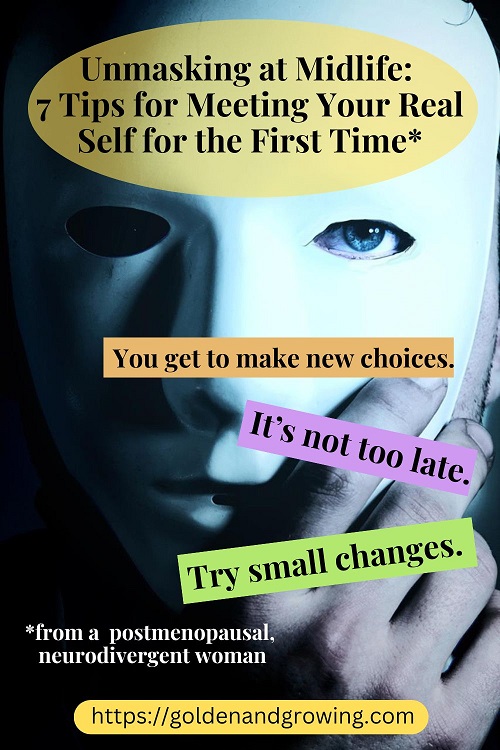
Unmasking at midlife leads neurodivergent women to feel as if they’re meeting themselves for the first time. Read on for the complicated factors at play, and tips to make the process go more smoothly.
The start of my unmasking story.
“What if we used our retirement funds?”
My question came after several long and grueling conversations with my husband about our financial situation, whether it would allow him to leave his job within the next few years so we could move out of the city.
He stared at me as he processed the question. “Well,” he replied slowly, “maybe.”
I asked him for numbers. Did some calculations, including having to pay the penalty for early withdrawal from an IRA.
When I showed him the results, his eyes widened. I couldn’t squelch the excitement that zipped through me. I had him. I knew I had him.
I would finally be able to move to a rural area, surrounded by nature. I’d been pretending for over fifteen years that I was okay with city life, but I couldn’t stand it anymore.
I was in my late thirties, and if the terms “masking” and “unmasking” had been in use in pop psychology, I’d never heard them. I certainly had no clue that I was neurodivergent and had spent my life ignoring some of my deepest needs.
But that was the day I can point to where I began to slowly, gradually unmask.
Two critical questions midlife neurodivergent women ask.
In this post, I’m going to more or less look objectively at two popular – and vital – questions that late-diagnosed neurodivergent women ask themselves.
- “How do I separate my true self from my masked self?”
- “Is it normal to feel like I’m meeting myself for the first time in my 40s/50s?”
While there’s no cut-and-dry answer to the first question, the resounding “Yes!” response to the second question gives us a solid starting point.
My sincere hope is that by the end of this article, you’re no longer feeling alone, and you have the means to move forward in this arduous but rewarding journey of midlife unmasking.
To get to the end, however, you need to take a look at the beginning to see how you arrived to where you are now.
Masking early life.
It’s no secret that many – probably most – neurodivergent women learn to mask at a young age. If you were like me, you spent a lot of time in Kindergarten and first grade watching other girls as they played together, trying to figure out how you were supposed to talk and behave in a way that would be accepted. Once you figured it out, you began to mask your autistic and ADHD traits.
- You suppressed stims or redirected them into socially acceptable behaviors.
- You scripted conversations and rehearsed social interactions (raise your hand if you still have to do this).
- You forced eye contact even when it felt physically painful.
- You hid your special interest or pretended they were “normal” hobbies.
- You downplayed your sensory sensitivities and pushed through the discomfort (and likely paid for it later in the day).
- You tried to match the emotional energy of the people around you, even when you felt nothing or felt everything.
- You memorized social rules as if you were studying for a test that never ended.
Eventually, you got so good at masking that no one realized you were neurodivergent. You might have realized that there was something different about you. Other people might have labeled you as “an odd duck,” “dramatic,” “sensitive,” or “painfully shy.”
But you were the only person who realized that you often felt either like you were slowly dying inside, or like you were constantly on the edge of a breakdown.
And you couldn’t help but wonder if everybody else was pretending to have it together, too.
But you kept going. Strived to fit in, follow the social rules.
And it worked.
Until it didn’t.
Why midlife breaks the mask.
I always knew I was different. A non-conformist. But I managed to have friends and keep a steady job for thirteen years (at which point I got pregnant and quit). I ignored the constant low-level of anxiety and thanked God my bouts of depression were short-lived and usually based on the weather or “that time of the month.”
Like most neurodivergent women, everything started falling apart in my forties.
Why?
Several factors converge that lead to not only unmasking in midlife, but also late diagnoses of autism and ADHD.
The hormonal shift.
I’ve discussed this in some detail in my post about perimenopause and neurodivergence, so I’ll keep it short and sweet here.
When a woman’s reproductive systems starts shutting down, her body says, “Oh, look at that. We don’t need much estrogen anymore because we’re no longer going to make babies.”
Apparently our bodies missed the memo that estrogen helps with everything nervous system and brain chemistry related. And when levels of that precious hormone drops, our already off-kilter brain chemistry and highly sensitive nervous systems become even more off-kilter and sensitive.
Therefore, our coping strategies making up “the mask” fail, sometimes completely.
The accumulation of burnout.
You’ve been running almost on empty for decades. By midlife, autistic burnout and ADHD burnout are real, physical experiences with a powerful psychological impact.
You don’t have the energy to maintain the performance anymore. Simple tasks feel insurmountable. Social interactions that you used to power through now require recovery time that you don’t have.
The pattern recognition kicks in.
You’ve lived long enough to see that neurotypical strategies – even though you haven’t labeled them as such – don’t work for you. You’ve tried every planner, every productivity system, every self-help book.
You’ve read How to Win Friends and Influence People but have never figured out the getting others to talk about themselves bit (or how to fake a smile).
You’ve wondered why “just do it” never works. Why you can’t “just calm down” or “just focus” or “just remember.”
You start googling things like, “why am I so sensitive to tags in clothes,” or, “why can’t I follow conversations at parties.”
And suddenly…
OOHH.
The mask becomes visible.
The day that I watched the video I’ve embedded at the end of this post is the day my mask began to show its ugly self.
You may have begun seeing your own traits in your children. Or maybe a friend’s diagnosis sounds eerily familiar (anyone else realize in hindsight that their best childhood friend was also neurodivergent?) Sometimes it’s a late-night TikTok that makes you cry because someone just described your entire internal life.
However it happens, you suddenly see the mask you’ve been wearing.
And realize how heavy it’s been.
At this point, you ask the question: “Is it normal for me to feel like I’m meeting myself for the first time?” Because you’re at least forty-five, for crying out loud. Shouldn’t you know yourself by now?
So then comes the first stage of peeling back the mask and trying to figure out who you really are…
The collision of relief and grief.
I’m apparently like most neurodivergent women who unmask at midlife, in that when I initially discovered my neurological difference, I experienced a mix of relief and grief.
The relief is profound.
You discover that:
- You’re not lazy.
- You’re not melodramatic.
- You’re not “too much” or “not enough.”
- There’s a reason for your social awkwardness.
- It’s not your fault you’ve struggled to make and keep friends.
- You realize that your brain works differently than the majority, and your struggles finally begin to make sense.
- You can name it.
- There are plenty of other people out there just like you.
The grief can be equally profound.
- Your mourn the decades you spent thinking you were a failure.
- You grieve the opportunities you missed because you didn’t have accommodations or understanding. Or because your rigid thinking kept you stuck where you were.
- You’re angry at God.
- You’re angry at every adult who saw you struggling and never once thought to look beneath the surface and find the reason.
- You regret choices you made out of fear, either fear of failing if you walked away from mainstream expectations, or fear of being ostracized for going your own way.
This contradictory mix of emotions is oh-so-common for late-diagnosed neurodivergent women, yet both are equally valid.
So we return to the first question: how do you separate your true self from the mask?
Unmasking isn’t as easy as “they” say.
In most articles you’ll find about unmasking in midlife, particularly for women, you’ll see the tired old list of:
- Stimming openly.
- Caring for sensory needs.
- Stopping forced eye contact.
- Blah, blah, blah.
The truth is, while those are steps you can take to feel more authentic, they are only a small part of the unmasking process, of discovering the real you. I’m going to go into much more detail about the complications of this issue in a future blog post (subscribe to my newsletter for updates or bookmark this blog). For now, I offer you two questions, and two gentle pieces of advice.
The questions.
- What parts of me did I build to please others?
- What feels true now, and what doesn’t?
Take some time to think about these questions. Jot down your thoughts in a journal.
You might check out my post of 100 journal prompts for neurodivergent women, as there are plenty prompts there that relate to the unmasking process.
Two pieces of advice.
- Try small changes and see what feels authentic.
- Give yourself time and compassion.
If that sounds horribly simplistic, well, sometimes the best approach to a complicated issue is a simple approach.
Speaking of complications…
Unmasking at midlife: it’s not just about you.
As you begin the journey to rediscover your identity after a late diagnosis, you’ll have to open up to those closest to you. You’ll also have to tread carefully when it comes to unmasking at work.
Either one can cause upheaval, even pain.
The best way to move forward is to be as kind, gentle, and compassionate toward those in your life as you wish them to be to you. For example, look at these two scenarios.
- You barge into your boss’s office and announce defiantly that from now on you’ll be flapping your hands a lot in order to regulate your stress, and she just has to deal with it.
- You take your boss out to lunch and calmly explain what you’ve learned, and how you think you can best deal with job stress.
Which scenario do you think will bring better results?
Another complication might be speaking with medical pros, especially male doctors.
Really, the best advice I can give here is to see a female N.P. or doc whenever possible. Even if they don’t understand neurodivergence, they don’t belittle emotions and hormonal mood swings.
You’re a lovely human being who deserves to exist.
If you’re a neurodivergent woman in midlife who’s just beginning to unmask, here’s what I want you to know.
#1. You are far from alone.
There are all kinds of online groups and forums where late-diagnosed neurodivergent women are conversing. There are blogs like this one, where you are welcome to share your story and ask questions in the comment section.
Connect with us. Even if your participation is light and occasional, it will do a lot for your mental health and well-being.
#2. You’re not imagining it.
Your struggles have been, and are, real. Your exhaustion is valid.
#3. It’s not too late.
Everyone has regrets. But everyone also has tomorrow. Take what you know now and make choices for the future to live according to your core self, not the self you’ve pretended to be.
#4. You don’t owe anyone your masked version.
That’s not permission to be rude or demanding. It is permission for you to take care of yourself without apology.
#5. You don’t have a weak character, just a brain different from most other people.
It’s okay to need quiet, routines, or accommodations at work.
#6. The mask isn’t you.
The mask you’ve been wearing is an external part of you that you still may occasionally use.
However, it doesn’t represent the core you, the internal you that holds your hopes and dreams and gifts, and which manifests in kindness, keen interest in the world, creativity, and the joy of just being.
#7. You get to choose.
Now that you know, you get to make choices that honor your sensitivities and support your executive function.
You get to build a life that works for your brain.
You get to decide whether to stay in your chosen career.
You get to choose friends who understand and support your needs.
You’ve spent the first half of your life trying to be like “everybody else.” The second half?
It belongs to the real you.
And she can’t wait to meet you.
