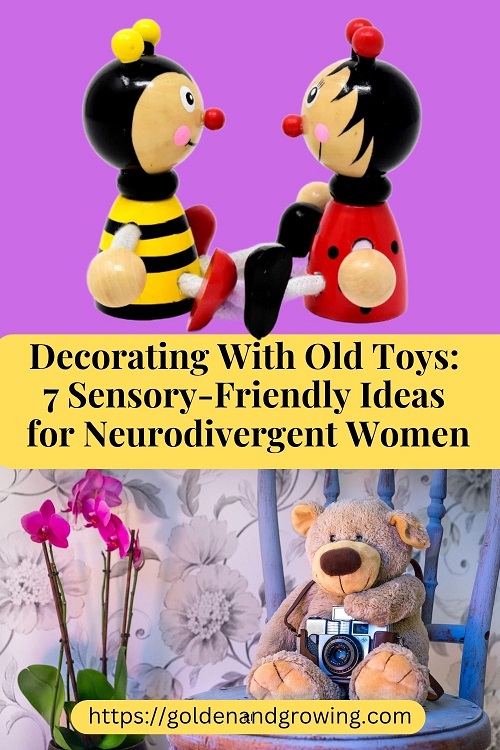
Decorating with old toys enables neurodivergent women to engage in creative expression while crafting a more sensory-friendly home. Read on for seven fun ideas.
My story of beginning to decorate with old toys.
The decorative box hiding coin change sat neatly behind the more decorative box housing my husband’s wallet and keys. What to put on the other side of the top shelf of the darkly varnished bookcase?
I tried a couple of hardcover books, standing up. Backed up and studied the effect.
I didn’t like it.
I put three books of varying sizes in a stack.
No. Something was just… wrong. The texture, I realized after a while. The space needed something soft to balance the hard boxes on the left side.
Soft, soft, soft… Of course!
Within minutes, the shelf decor was complete, the boxes on one side, and three small stuffed animals hugging the opposite corner. A perfect balance of hard and soft, cool and warm.
Decorating with old toys: a perfect frugal homemaking hack for neurodivergent women.
Neurodivergent women, more than anyone, are known for their attachment to childhood toys. Oh, we make excuses for hanging onto them, like one day we’ll need something to entertain our young grandchildren. But face it, ladies: to get rid of them would feel like cutting out our livers.
With a pair of dull scissors.
And no anesthetic.
Why? They’re familiar. And, they represent textures, colors, and memories that we love. So, why keep them in a box in a closet? Put them to good use by incorporating them into your home’s décor.
This blog is, after all, about living a simpler and therefore more fulfilling life as an aging neurodivergent woman. That includes frugal homemaking, and there’s nothing more frugal than using what you already have to spruce up your living space.
Also, many, if not most, of your toys represent your taste. As well as what your nervous system craves for both stimulation and stability.
Forget the current minimalist and neutral palette fad. BORING! Instead, create spaces that are visually engaging and sensory-regulating with those childhood friends. They carry familiar tactile feedback, predictable visual patterns, and the kind of stimming-friendly textures that expensive “wellness” decor tries – and fails – to replicate.
And, hey, they don’t necessarily need to have been your toys. If you’ve secretly enjoyed the feel and color of your children’s toys, and they’re just gathering dust in your grown children’s bedrooms, you can use them, too!
How can you integrate old toys into your home in ways that support your sensory needs, as well as provide aesthetic pleasure? Let’s look at seven ways.
#1: Create tactile stations with textured toys.
Having fidget-friendly objects within reach throughout your home provides grounding when your senses are overwhelmed.
How to do it.
Keep baskets or bowls of small toys in high-traffic areas. Mix and match, with things like:
- smooth wooden blocks,
- squishy rubber figures,
- textured plastic animals,
- cool metal cars, and of course,
- small stuffed animals.
They all offer different tactile experiences. Unlike expensive fidget toys marketed to neurodivergent adults, these childhood objects often provide better sensory feedback because they were designed for hands-on play.
Where to put them.
Place them near where you work, watch TV, or have conversations. Your hands know what to do with them, and that familiar motor pattern can be deeply calming.
Bonus: They’re conversation pieces that don’t require explaining why you need to touch things.
#2: Build visual regulation walls with repetitive patterns.
Predictable visual patterns can be focusing rather than overwhelming when you control the arrangement.
How to do it.
For this method of decorating with old toys, mount collections of similar toys in grids or graduated arrangements (think stairway shape). You might have:
- Rows of identical action figures in rainbow order.
- A wall of vintage toy cars sorted by color or size.
- Fisher-Price Little People arranged by family groupings.
Why this works for neurodivergent homemakers.
The repetition creates visual predictability, while the slight variations between items keep your eye engaged without overwhelming it. This is particularly effective for people who find busy patterns chaotic but blank walls understimulating.
You’re creating just enough visual interest in a controlled, organized way. And, you can rearrange such displays whenever your brain needs another pattern.
It’s also an awesome way to display your childhood (and adult) collections.
#3: Use weighted toys as functional décor.
The proprioceptive input from weighted objects can be grounding and organizing for your nervous system. “Proprioceptive” relates to our awareness of our physical selves in space.
How to do it.
Vintage metal toys offer significant weight. Cast iron banks, steel trucks, and tin robots can be used as bookends, doorstops, or paperweights.
So can that cute, smiley-face-painted rock that your mom bought you at a craft fair when you were seven.
The heft provides satisfying proprioceptive feedback when you move them. Simply seeing them can be calming because your body remembers how you feel.
Another option.
Consider placing heavier toys on lower shelves or surfaces that you pass frequently. If you’re experiencing a particularly bad bout of executive dysfunction or sensory overwhelm, picking them up and feeling their weight helps to ground you.
#4: Design low-visual clutter displays with building blocks.
This kind of simple geometric design reduces visual noise while providing structure and order. Wooden blocks, LEGO bricks, and vintage building sets offer clean lines and solid colors to a space. Unlike busy patterns or chaotic arrangements, block-based décor gives your eyes clear places to rest.
For those who experience visual overwhelm easily, blocks let you have color and personality without chaos. The straight edges and predictable shapes are organizing rather than depleting.
How to do it.
Build simple geometric sculptures, create color-blocked towers, or arrange blocks in satisfying gradients, staircase-style. You can unleash your creativity and build simple houses. Place a small vase with dried grass to improvise a tree. Or place a small stuffed animal “family” around it.
Rebuild your creations when you need to reset either the space or your brain.
#5: Incorporate sound-making toys intentionally.
When it comes to decorating with old toys, this idea ain’t my fave. Other than music boxes that may still be miraculously in tune after hundreds of hours of use and decades spent in storage, I find sounds that toys make to be jarring and annoying.
If you differ, then controlled auditory input that you initiate can be regulating rather than triggering. Besides music boxes, this can include wind-up toys, bells, and rattles.
How to do it.
A few ideas:
- Keep a music box on your desk for transition moments.
- Place a gentle wind-up toy where you need a timer for tasks.
- Use toys with satisfying clicking mechanisms as hand fidgets that provide both tactile and auditory feedback. These can include vintage Fisher-Price toys with rotating dials.
Why sound-makers can add to a sensory-friendly home.
Some of these toys may not be particularly decorative. However, they offer control. The sounds happen when you want them to happen, unlike the unpredictable sensory assaults of modern life.
Say, for example, like when your neighbor suddenly decides to target-practice with his hunting rifle.
The predictability makes the sounds from the toys soothing rather than startling.
But I still don’t like most of them. So there. 😉
#6: Create depth and dimension with familiar shapes.
Flat wall art on flat walls is ding-dang boring for those of us with ADHD traits. Three-dimensional objects, on the other hand, provide visual interest. They also help with depth perception and spatial awareness, two things that most autistic women, as well as many menopausal women, struggle with.
How to do it.
This is an awesome frugal decorating idea, because you don’t have to buy baskets or display cases.
Gather stuffed animals, plastic figures, and dolls. They create shadows, take up space, and give your eyes practice focusing at different depths. This is helpful not only for visual processing issues, but also for those who feel disoriented by flat walls.
Arrange the objects on shelves at varying heights, group them in corners, or create scenes on side tables. The dimensional quality helps your brain understand space better, and the familiar forms are easier to process than abstract sculptures or complicated décor.
#7: Design sensory corners with multi-textured collections.
When you have a few spaces dedicated to providing varying textures, you have instant emotion and nervous system regulation at hand.
How to do it.
Create a corner or shelf that is specifically a sensory collection:
- plush animals,
- rubber toys,
- wooden puzzles,
- plastic figures, and
- vintage tin toys.
This is one place where you have no concern for matching aesthetics, because it’s all about having a range of sensory inputs available when you need them.
The bonus.
Guests will see the space as a charming collection of vintage toys. You, however, will know that it’s your regulation toolkit disguised as interior design.
Practical considerations for decorating your home with toys.
Managing dust and cleaning: If the mere sight of a fleck of dust makes you want to run screaming into a hot lava flow, keep the toys in cabinets with glass fronts, or in display cases. If you need to touch them regularly, accept that they’ll need periodic cleaning and build that into your housecleaning routine.
Avoiding overwhelm: As usual, start small. Decorate one room or one shelf. Sometimes the project of decorating is organizing and regulating; sometimes it’s overwhelming. Follow your gut as to how much you can handle at once.
Permission to change it: This is for you autistic ladies who hate change, even when you feel like change is important. You can change out the toys for new ones, or mainstream décor, whenever your sensory needs shift. If you get into the habit of rotating the collections monthly or seasonally, that will become part of your autistic routine so that the change feels grounding rather than upsetting.
Explaining to others: You don’t owe anyone an explanation for your décor choices. But if someone asks, simply state something like, “I find these soothing,” or, “I like having things around that I can touch.”
Most people will just think you have an interesting and nostalgic aesthetic.
Decorating with toys for neurodivergent women = sensory authenticity.
We neurodivergent women, especially those of us who have traveled past menopause, don’t need to live in an interior design showroom. We need to live in an environment that will coddle us.
An environment that supports our precarious nervous systems.
Old toys were designed to be touched, held, manipulated, and enjoyed – exactly what we need when sensory overload and executive dysfunction are getting the better of us. These toys have weight, texture, color, and familiarity, inviting interaction, embracing us with warm memories.
We’ve spent decades learning to sit still, be quiet, and stop fidgeting, Now it’s time to fill our homes with objects that welcome our natural movement patterns.
So dig out those toys. That old, cast-iron piggy bank might be exactly the weighted fidget that your coffee table needs. A LEGO block tower might be just the thing to fill the small shelf underneath the side table.
Whatever you do, don’t forget your stuffed animals. You gave them a lot of love when you were little; now that you’re grown, let them love you back by way of being the softest, cuddliest regulation tool ever.
Do you decorate your home with toys, at least in part? Please share your creative genius in the comments!
