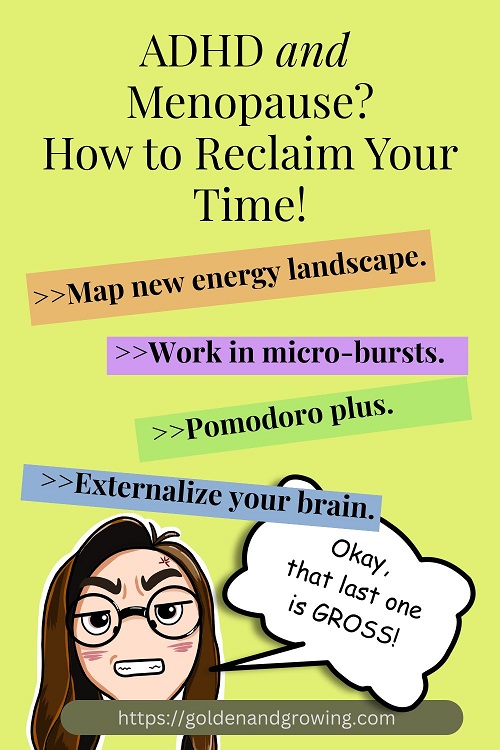
Mastering ADHD and menopause time management is essential if you’re experiencing both conditions. Here are tips to help you to do just that, making it an integral part of your self-care.
Ah, your forties. You’ve figured out how to handle your ADHD rollercoaster. You can sail through the day with sticky notes and reminder apps. Life is looking good, and the future’s so bright, you gotta wear —
BAM! Enter menopause, stage left, with a whole new cast of characters: hot flashes, brain fog so thick you could cut it with a knife, and the delightful sensation that your internal thermostat has officially gone rogue.
And everything that was working for you…
Comes.
To a screeching.
Halt.
Welcome to the glorious intersection of ADHD and menopause time management, where the rules of productivity are constantly being rewritten by an invisible, hormonal hand. If you’re nodding along, maybe rolling your eyes at the truth of it all, you’re in good company.
You’re also not destined for a life spent on the couch, staring at a Netflix show you despise because you’re too tired to figure out the new you. You just need to do a little observation and a little schedule tweaking.
The double whammy: why ADHD and menopause are like peanut butter and a really annoying jelly.
All by itself, ADHD presents its own unique set of challenges when it comes to time management. We’re talking executive dysfunction, dear friends: difficulty with planning, organizing, prioritizing, initiating tasks, and maintaining focus. Our brains are like a thousand open browser tabs, all demanding attention simultaneously.
Now, sprinkle in menopause. Um, that is, pour in menopause. Estrogen, that magical hormone that’s slowly (or not so slowly) making its graceful exit, plays a crucial role in cognitive function. It impacts memory, attention, and even mood. So, when your estrogen levels start dive, your brain fog intensifies and your focus wanes even further. Suddenly, those carefully constructed ADHD coping strategies feel like they’re made of tissue paper in a hurricane.
It’s not just “brain fog” – it’s often a legitimate cognitive shift. Many women report feeling like they’re losing their minds. I know I used to. Some days still do. The experience is incredibly disorienting. Combine that with the emotional rollercoaster of hormonal fluctuations, and you’ve got a recipe for a whole new level of time management exasperation. This is why focusing on ADHD and menopause time management is so critical for our well-being and productivity.
Ditching the “shoulds” and embracing the “coulds”: the foundation of our new ADHD and menopause time management strategy.
The first, and perhaps most important, step in mastering ADHD and menopause time management is to ditch the notion of “shoulds.” You should be able to do what you used to do. You should be able to focus for hours. You should be a productivity ninja.
STOP.
Your brain is different now. Your body is different now. Trying to force yourself into old patterns is like trying to fit a square peg into a round hole.
Impossible.
So forget the “should.” Let’s embrace the “coulds.” What could you do today? What could you achieve with the energy you have right now? This shift in perspective is revolutionary. It allows for flexibility, self-compassion, and most importantly, it acknowledges the fluctuating reality of your energy levels. This is the bedrock of effective ADHD and menopause time management.
Mapping your energy landscape: when are you a powerhouse, and when are you a puddle?
The key to successful ADHD and menopause time management is understanding your unique daily energy patterns. No two women will experience this journey exactly the same way.
- The Power Hour (or 15 Minutes): When are you at your sharpest? For many, it’s the morning, after that first cup of coffee (or two). For others, it might be late afternoon, once the initial brain fog has lifted. Identify these periods. These are your prime real estate for tasks that require deep focus, problem-solving, or anything that feels genuinely challenging. It’s also the time when you’re most creative.
- The “Meh” Zone: This is where you can handle routine tasks, emails, light organizing, or anything that doesn’t demand intense cognitive effort. These are your “admin” hours.
- The Puddle Phase: Some days (or parts of days), you’re just a puddle of exhaustion, brain fog, and perhaps a touch of existential dread. This is NOT the time to push yourself to write that report or tackle your taxes. This is the time for self-care, passive tasks, or – if it won’t mess up your nighttime sleep – a nap.
Actionable Tip: For a week or two, keep a simple journal or use a mood tracker app to record your energy levels throughout the day. Note what you were doing, how focused you felt, and any menopause symptoms (hot flashes, fatigue, etc.) that were particularly prominent. Look for patterns. This self-awareness is gold for ADHD and menopause time management.
I created a couple of inexpensive PDFs that fit the bill perfectly: a Menopause Mood Tracker and a Mental Energy Audit.
The art of the micro-burst: central to ADHD and menopause time management.
One of the biggest pitfalls for us ADHDers, especially when compounded by menopause, is the overwhelming nature of a large task. Our brains see “Clean the Entire House” and immediately trigger the “Nope” response. This often leads to paralysis for doing the tiniest task.
The solution? The micro-burst. Break everything down into ridiculously small, manageable steps.
- Instead of “Clean the Kitchen,” try: “Wipe down the counter.” “Load five dishes.” “Empty the trash.”
- Instead of “Make the graphic for Tuesday’s meeting,” try: “Open Canva.” “Find one relevant image.” “Brainstorm text.”
The beauty of the micro-burst is two-fold:
- Low barrier to entry: It feels so small, it’s hard to resist starting.
- Momentum building: Completing even a tiny task gives your brain a hit of dopamine, encouraging you to do the next tiny task. This is crucial for maintaining focus and fighting executive dysfunction, both key components of effective ADHD and menopause time management.
Actionable Tip: When you’re feeling overwhelmed, pick one micro-burst task. Just one. And allow yourself to stop after that if you need to. Chances are, you’ll gain enough momentum to do another.
The power of the Pomodoro (with a menopausal twist).
The Pomodoro Technique (25 minutes of focused work, 5 minutes break) is a classic for ADHDers. But for those of us navigating menopause, it might need a slight tweak.
- Adjust your timers: On “puddle” days, 25 minutes might feel like an eternity. Try 15 minutes of work, 10 minutes of break. Or even 10 minutes of work, 5 minutes of break. The goal is focused effort, not an arbitrary time limit.
- Breaks with purpose: Use your breaks to actively manage menopause symptoms. Drink some water. Stand up and stretch. Open a window if you’re feeling a hot flash. Do a quick mindfulness exercise. A purposeful break can refresh both your brain and your body.
- Embrace the hyperfocus (when it happens!): Occasionally, our ADHD brains bless us with a burst of hyperfocus. When that happens, ride the wave! Don’t interrupt it just because your Pomodoro timer went off. Just be sure to set a new, longer timer for when the hyperfocus might wane, so you don’t completely lose track of time. This adaptive approach is vital for successful ADHD and menopause time management.
Externalize your brain: because your internal GPS is on vacation.
Brain fog and memory issues are real. Don’t fight them; accommodate them. This means externalizing everything you possibly can.
- The Master List (or several master lists): Get everything out of your head and onto paper or a digital tool. Use a bullet journal, a whiteboard, Trello, Asana, whatever resonates with you. But the key is to use it. This helps offload the mental burden.
- Visual cues galore: Leave visual reminders everywhere. Post-it notes (use different colors for different categories!), a whiteboard by the door, a specific “launchpad” for your keys and wallet. The more visual, the better.
- Routines, routines, routines (with flexibility): While spontaneity is fun, routines provide a scaffolding for our ADHD brains, especially when compounded by menopausal brain fog. A morning routine, an evening wind-down routine, a “getting ready to leave the house” routine – these automate decision-making and conserve precious mental energy. However, be prepared to adjust them on days when your energy levels simply don’t cooperate. That’s where the flexibility comes in. This structured yet adaptable approach is at the core of effective ADHD and menopause time management.
- Embrace technology: Set alarms for everything. Use calendar reminders. Voice memos can be lifesavers for capturing fleeting thoughts or brilliant ideas before they vanish into the hormonal ether.
- Delegation and asking for help: This is a tough one for many of us, but it’s essential. Can your partner take on more? Can you hire someone for a task you truly dread (and can afford to delegate)? Release the superwoman cape, even if it’s just for a day.
The non-negotiables for ADHD and menopause time management: fueling your brain and body.
You can have the best ADHD and menopause time management strategies in the world, but if you’re not fueling your body and brain correctly, it’s an uphill battle.
- Sleep is NOT optional: This is paramount. Hot flashes, night sweats, and anxiety can wreak havoc on sleep. Prioritize sleep hygiene. Keep your bedroom cool and dark. Avoid screens before bed. If sleep continues to be an issue, talk to your doctor. Good sleep significantly impacts cognitive function and energy levels.
- Hydrate: Dehydration exacerbates brain fog and fatigue. Keep a water bottle with you at all times.
- Eat nourishing food: Focus on whole, unprocessed foods. Blood sugar crashes can trigger ADHD symptoms and worsen fatigue. Protein, healthy fats, and complex carbohydrates are your friends.
- Movement matters: Even a short walk can clear your head, boost your mood, and improve focus. You don’t need to become a gym rat, just move your body regularly.
- Stress management: Menopause can heighten anxiety, and ADHD already predisposes us to it. Incorporate stress-reducing activities like meditation, deep breathing, yoga, or spending time in nature. Chronic stress further impairs cognitive function.
Be your own best friend: self-compassion is key.
This journey of ADHD and menopause time management is not about achieving perfection. It’s about finding what works for you, right now, in this unique phase of your life. There will be days when you feel incredibly productive, and days when getting out of bed feels like climbing Everest.
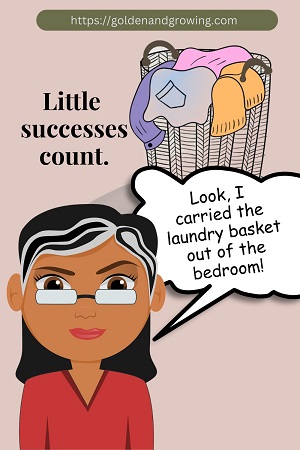
On those challenging days, practice self-compassion. Instead of beating yourself up, acknowledge that you’re doing your best with the resources (and hormones) you have. Remember that “good enough” is often truly good enough. Celebrate the small wins. Did you get one thing done today? Amazing! Did you manage to just exist and be kind to yourself? That’s a huge win too.
This journey isn’t a sprint, but a marathon with several unexpected hurdles and delightful detours. By understanding your unique energy patterns, breaking tasks into micro-bursts, externalizing your brain, and prioritizing self-care, you can master ADHD and menopause time management. With a little humor, a lot of grace, and some strategic planning, you can navigate this next chapter with confidence and effectiveness.
If that weren’t true, I wouldn’t be here with this blog. J
ADHD and menopause time management: you’ve got this!
Navigating ADHD and menopause time management is a journey, not a destination. There will be good days and challenging days. The key is to be adaptable, kind to yourself, and constantly experiment with what works best for your unique brain and body. You’ve already navigated the complexities of ADHD for years; you have an incredible capacity for resilience and creativity.
So, go forth, my brilliant, beautiful, and sometimes bewildered women! Embrace your power, harness your unique energy, forget fitting into a neurotypical, pre-menopausal mold. Instead, create a life that works for you, where you can thrive, achieve your goals, and still have time for that well-deserved nap (or chocolate). You’ve got this!

1 thought on “Mastering ADHD and Menopause Time Management (Or, How I Learned to Stop Fighting My Brain and Actually Get Stuff Done)”
Comments are closed.