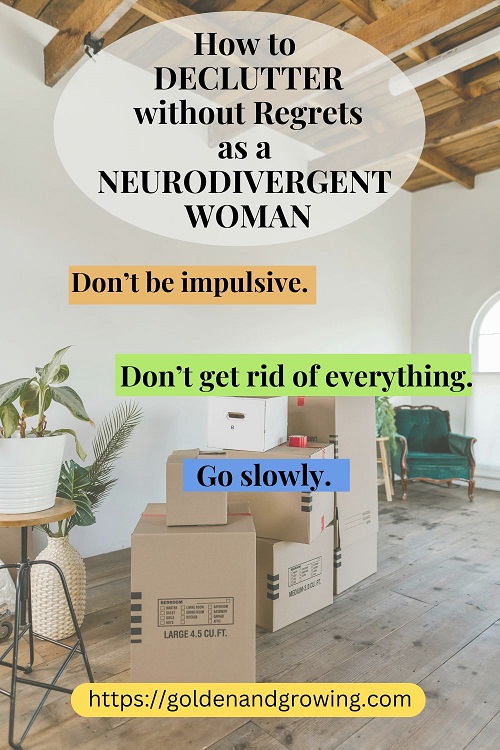
How to declutter without regrets is hard for neurodivergent women. Here are eight strategies that have worked for me.
The story.
With great care, I folded up my wedding dress and placed it inside a large garbage bag with other items we were donating to a local charity. The next morning, I watched as a truck pulled up to the curb and picked up the many boxes and bags we’d set out.
I clenched a fist, resisting the urge to run out and snatch away the bag containing the wedding dress. And as the truck drove away, I was sure I’d made a huge mistake. A wave of sadness overwhelmed me.
I turned back to the inside of the house, reminding myself that I didn’t need it anymore. That now, just as an unknown bride had put her dress for sale at a consignment shop for my enjoyment, I was going to allow yet another bride to obtain a beautiful dress for even less than what I’d paid.
For a few weeks, though, that knowledge was little comfort.
Letting go of clutter is hard.
The above true story represents the worst nightmare surrounding decluttering that many autistic women and women with ADHD hold. They’re afraid, if they give away a certain object, that they’ll miss it forever.
If that’s you, I get it. And it’s okay.
But our lives as neurodivergent women are be default filled with enough outside stress, that we don’t want our very homes to cause additional stress. So it’s important to get rid of clutter, to give our homes breathing room, to make space for what’s really important in our lives: loved ones, our special interests and hobbies, comfortable nooks, and beauty.
I’m not going to give you the mechanics of decluttering. There are a million books and blog posts already out there with the basic instructions. Instead, I, as a fellow neurodivergent woman, am going to provide some ideas on how to make the process a little easier on our particular brains.
Idea #1 to declutter without regrets: Don’t be impulsive.
I’m talking to YOU, my dear friend with ADHD whose hyperfocus sometimes seems to know no bounds. If you’re like me, you’ll read a book on decluttering, or watch a few videos, then get so gung-ho about it that you toss things into boxes with hardly any thought.
And realize a week or three later that you got rid of several items that you’re going to miss terribly. Or have to replace.
If you have ADHD, I beg you, start small, and go slow. Force yourself to put your energy into other things. Yes, it will mean that decluttering might take longer that you want it to.
But it will also mean you will make wiser and more thoughtful decisions.
Idea #2 for decluttering without regrets: Remember that emotions are fleeting.
This is particularly tricky for those of us who are autistic, thanks to our “now is forever” way of thinking. But the sadness I felt over giving away my wedding dress? It faded quickly, and was completely gone after a couple of years.
On the advice of a podcaster, I took photos of a few other items that had been part of my childhood, and either gave away or threw away. Thirteen years later, I now only remember one of the items and haven’t looked at the photos since.
That said, I know that we, as neurodivergent women, struggle with emotional attachment and possessions. So let’s look at the next couple of ideas.
Idea #3: If it’s trash, trash it!
I know you have a lot good memories about the wooden truck you and your favorite cousin played with during innumerable summers. But those black spots are bad news. It’s black mold, which can be a serious safety hazard.
And I know that stuffed elephant was your favorite. But it’s trunk is long gone, half the fur is missing, and its stuffing is falling out of the seam by the handful.
I’m mentioning toys here, but the same goes for any tool or kitchen item or any other household item: if it’s trash, throw it in the garbage where it belongs. Chances are high you haven’t looked at or used the item in years, anyway.
Idea #4 for decluttering without regret: Don’t get rid of everything you never use.
If an item is in at least fair condition and it’s something that has strong sentimental value to you, consider keeping it. I still have the teddy bear my grandmother gave me for my third birthday. He’s not in great shape, but throwing him away would feel like throwing away my right hand. On really, really, really bad days, I’ll sit on my bed, snuggle him against my chest, and have a good cry.
If you have an old toy like that, for your happiness’ sake, keep it!
On the other hand – and I say this with all the love I can – if you have a roomful (or more) of such items, and it’s not a carefully and intentionally curated collection, you have a problem. Please seek help.
That’s a good segue to…
Idea #5 for decluttering without regret: Declutter slowly.
To listen to the gurus, you would think decluttering has to be done within a short period of time.
No, it doesn’t. In fact, for a neurodivergent woman to declutter the conventional way is asking for more stress, as well as more strain on her limited executive function.
Doing the opposite has several benefits. First, it makes the process more enjoyable. Second, it provides more time for you to realize the best decision for an item you’re thinking of giving away.
Idea #6 for decluttering without regrets: Consider the future owner.
As was the case with my wedding dress, you may own items that are both in good condition and have sentimental value to you, but which you know you’ll never use again. Think of the joy that another person may gain because you gave the item up.
Idea #7: Do an intentional declutter on a regular basis.
If you schedule a decluttering session three to four times a year, focusing on a different section of your home each time, you can maintain a cleaner home with less work. You are also likely to obtain a more objective perspective on the items you no longer need. Whereas with a once-a-year binge declutter, you’re in greater danger of either getting rid of something you didn’t want to, or keeping too much for fear of doing the former.
Which reminds me of one last great idea…
Idea #8 for decluttering without regrets: You can usually buy another one.
Except for very old, discontinued toys, you can always buy another one of something you declutter now, but turn out to need later. Remind yourself of that when you’re struggling to decide whether to give away that breadmaker, convection oven, outfit, Precious Moments knick-knack, or extra set of dishes.
The true net result of decluttering.
When you eliminate things from your home that you no longer need or enjoy, the net result isn’t loss.
It’s gain.
- You gain more visual peace and soul peace.
- You gain more space for the things – and activities – you still enjoy.
- You gain more time in not having to clean or maintain the things you remove.
- You may even gain more money in not having to buy containers to store the things. Or in being able to live in a much smaller home, as was our case.
So, my neurodivergent friend, happy decluttering.
And happy freedom. 🙂
