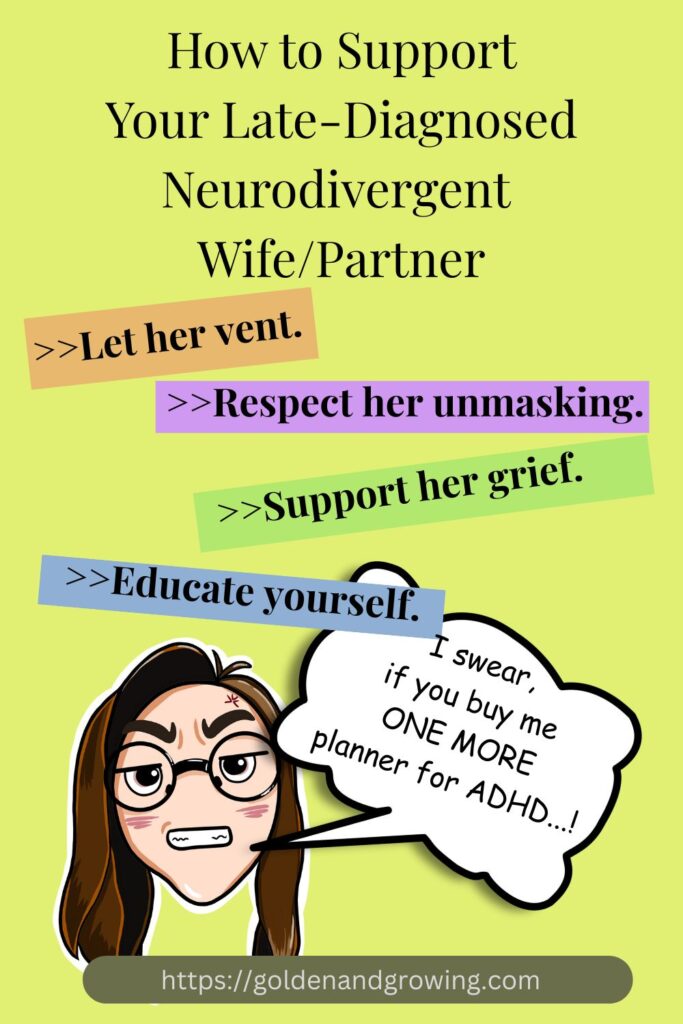
How to support a neurodivergent partner? Especially when her diagnosis comes late, and well into her marriage with you? This post addresses the key ways.
I sat at the picnic table under the shade of an old oak tree, staring at my computer screen. “Oh, look,” I cried with delight. “The tests came back positive! I’m autistic. And it looks like I have ADHD, too! How wonderful! All the mysteries of my life have been explained!”
I leaped up from the table into my laughing husband’s arms. I kissed him passionately, then broke away with my own giddy laugh. Running into the sunshiny meadow, I felt free, free as a bird…
And then my husband woke up from the beautiful dream into the harsh reality.
Because discovering the “whys” of my lifelong issues was the beginning of a long and arduous process of… well, processing. And it still continues to this day.
And my husband, bless his heart, has been forced to come along for the ride.
When a woman reaches her forties or fifties and suddenly begins questioning the shape of her inner life—her reactions, her overwhelm, the way she’s always had to work harder just to feel okay—it’s rarely a passing phase. For many, this kind of shift points to a late realization: she’s neurodivergent, and likely always has been.
Whether the identification is formal or informal, the emotional fallout is real. If you’re her partner, this realization may leave you unsure of how to respond. She seems the same, yet something feels different. The ground underneath may feel like it’s moving, even if she’s only now putting words to something that’s been true for decades.
The biggest struggle men have here is their innate need to fix anything that is broken. And men the world over view a crying, complaining, or whining wife as something that requires fixing.
Because if he can’t figure out how to stop it, he’ll have to keep hearing it.
Guys, I get it. Really, I do. But if you really want to learn how to support a neurodivergent partner, you have to drop every instinct to make things better. What she needs most is you offering your presence and patience, as well as giving her space while she begins to piece together a more honest version of her story.
That said, here are some of the most critical ways to support the late-diagnosed neurodivergent female partner in your life.
#1: Let her speak without correcting.
When someone starts unraveling years of internal confusion, the process isn’t linear. She might contradict herself or seem unusually emotional. She may downplay her struggles one moment, then describe them in fine detail the next.
Let her talk without trying to sort her experience into a box. Listen for what’s underneath the words. Ask questions gently. And when in doubt, just be quiet and be there.
#2: Respect that some behaviors might change.
My core self has not changed since I found out I have AuDHD. But some of my behaviors have. I allow myself to stim more, even if it’s one that looks odd from the outside. I let myself do more relaxing just-for-fun activities in between chores and intense tasks (like oh, say, writing a blog post).
My husband and I have agreed that from now on, we’re going to show up right at the start of Thanksgiving dinner so that we don’t have to be bombarded with relatives trying to engage us in small talk.
An easy win, since both my husband and son are also introverted autistics.
Other women might outright decline certain social events, wear noise-canceling headphones or earplugs in the house, or ask to dim the lights. They may give themselves permission to stop eating healthy foods whose texture makes them nauseous or flavor is too bitter.
These behaviors aren’t regressions or indulgence, but a form of alignment. By honoring her comfort in these subtle ways, you’re helping to reduce the strain she’s carried for years without realizing it.
#3: Support her occasional grief.
Discovering you’re neurodivergent later in life can stir up a lot—especially for women over 50, who may have spent much of their adult lives suppressing key parts of themselves. She might grieve the years lost to overcompensation, the energy spent pretending, or the identity she now sees as incomplete.
At the beginning, I grieved the mere fact that I was neurodivergent. Why me? (Answer: my mother’s entire side of the family, but that’s a story for another day.)
I also struggled with what-ifs: What if I’d chosen a career better aligned to my neurodivergence? What if I’d known how to take care of myself better?
Besides these issues, some women remember being misunderstood in childhood or dismissed in medical settings. These kinds of memories can bring up resentment or anger. How to support a neurodivergent partner in those moments is to let her process those moments. Don’t rush her toward silver linings.
#4. A biggie: Don’t take the unmasking personally.
My mask started falling off around age fifty. Three years before I found out my brain was… different.
Pro tip: Don’t be the property manager for the land next door and start a brush pile on fire on our property line. You think the Incredible Hulk is scary.
Moving on. My point is, for many women, dropping levels of estrogen is enough to make the masks fall like lead pellets into the Grand Canyon.
Other women begin to unmask intentionally after learning that they’ve been masking. As your begins to relax her mask, you may notice shifts in her tone, habits, or preferences. She might express sensory needs more directly. She may push back on things she used to accept silently.
Like a property manager allowing a big fire that sets the edge of your property on fire. Just sayin’.
Though your woman might seem to be growing more difficult, she’s actually becoming more real. And trying to figure out how to make her newfound knowledge about herself fit with the life she’s chosen.
Try not to interpret this as rejection. It’s not uncommon for partners to feel confused or even hurt during this stage. But if you can view the changes as part of her healing, rather than a withdrawal from the relationship, it becomes easier to support her.
#5. Encourage rest, not retreat.
The process of recognizing and unmasking neurodivergence can be draining. Some women experience what’s often described as autistic burnout in older women, especially after decades of camouflaging.
She may need more downtime than usual. Don’t assume she’s pulling away emotionally. If you really want to know how to support your neurodivergent partner here, offer her the option to step back from social obligations or overstimulating environments. Help reduce her load where you can, and be patient as she recalibrates.
At the same time, check in—without pressure. A simple, “Want me nearby while you rest?” gives her both agency and connection.
#6. Educate yourself, quietly.
You don’t have to become an expert overnight. But reading about masking in neurodivergent women over 50, late-diagnosed ADHD, or the female autism profile can help you better understand what she’s facing. You’ll be more equipped to recognize when something is a genuine need rather than a quirk or mood.
Watch YouTube videos created by adult neurodivergent individuals. Read books. Read other blogs than this one, but keep coming back here for the best info. 😉
Remember that every neurodivergent person is different. So while books and blogs can be helpful, they don’t replace listening to the specific ways your partner’s brain works.
#7. How to support a neurodivergent partner? Ask what support looks like for HER.
Neurodivergent women are often used to going it alone. They may not know how to ask for help, or even recognize what they need. Instead of assuming, try asking:
- “What helps you feel grounded when things get overwhelming?”
- “Is there anything I do that makes things harder, even if unintentionally?”
- “Are there parts of daily life where masking still feels necessary?”
Even if she doesn’t have clear answers, the questions themselves can build trust. Over time, she may start sharing more of her experience, because your support is helping diminish her fear of being dismissed.
Final thoughts on how to support a neurodivergent partner.
When a partner begins exploring neurodivergence in midlife, the relationship inevitably shifts. But it doesn’t have to suffer. In fact, many couples find that this season invites deeper honesty and compassion. The key is letting go of assumptions and staying present for the unfolding.
Walk beside her as she takes the tenuous, and sometimes arduous, journey.
That, more than anything, is what support looks like.
