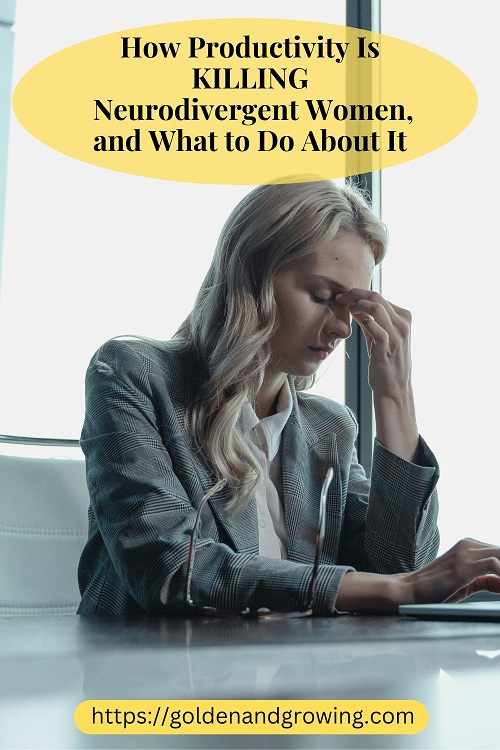
“Why can’t I keep up with everything?” is a common cry of neurodivergent women… and the emotions around it prevent us from feeling fulfilled and joyful. Read on for the reasons for ADHD/autism productivity shame, and what to do about it.
The story.
Meets expectations.
The two words glared up at me from the evaluation page. Really? I thought I’d done a lot better this year. My classroom management was a lot more effective. I taught the curriculum as expected while adding in creative bits to help keep my students engaged.
But, once again, the highest the principal would rate me was “meets expectations.”
What did she want from me?
A burst of insight made me cringe. In my tenth year of teaching, I no longer stayed at the school past four o’clock anymore to do any extras, including never changing out the activities in the learning centers. Furthermore, I was wiped out at the end of every school day and long since disillusioned with what I’d once thought was going to be a lifetime career. On top of that, I was tired of all the expectations that went waaay above and beyond teaching and managing a group of twenty-four students.
Literally tired.
That had to be it. I was no longer putting out 120% on my job, because I didn’t have it.
Sighing, I folded the papers up, shoved them into my book bag, and headed for the classroom door. I needed to get my butt home and churn out some more pages of the novel that was going to allow me to retire from this rodent exercise wheel of a job.
“Why can’t I keep up with everything???!”
In hindsight, I had it easier than a lot of my readers. At least I got the summers off, and two weeks at Christmas. Despite that, I loathed having to spend my precious free time catching up with household chores. How did the teachers with their own families manage?
You’ve probably wondered the same thing about your co-workers, whatever your job or career has been. Undiagnosed for decades, your neurodivergent self stared in awe at these superwomen who managed to “bring home the bacon, fry it up in a pan, and never ever let him forget he’s a man.”
Like me, you probably convinced yourself that there was something wrong with you. You dealt with ADHD or autism productivity shame, likely not having a clue that your brain was neurodivergent.
Therein lies the problem.
No, not with your brain.
With the fact that neurotypical people, being the majority, have established all the rules of society.
Rules like, “You have to work at least eight hours a day to earn a living.”
Rules like, “Two fifteen-minute breaks and a thirty-minute lunch is all anyone needs during those eight hours.”
And the worst one: “If you can’t cut it, you’re lazy/stupid/irresponsible/fired.”
People wonder why we have meltdowns and shutdowns.
Burnout in neurodivergent women: The hidden tax of being neurodivergent in a neurotypical world.
The accumulated stress which causes meltdowns and shutdowns almost always leads to burnout in neurodivergent women. This stress results because our brains are wired differently. Except for individuals who exhibit extreme traits, our brains not a problem in and of themselves. They simply don’t mesh with the neurotypical rules around productivity.
Our executive dysfunction makes planning, organizing, and remembering tantamount to a cat trying to balance a heavy plate of pancakes on the tip of its tail. Because of our easily irritated nervous systems and faulty filtering in our brain, our senses get overwhelmed. So do our emotions.
Those of us who have been “productive” members of society for years have used up a lot of energy covering up our needs to stim, to talk, to emote, to rest. Our expertise at masking has also provoked us to go places and do things that overwhelm our senses, all for the sake of appearing “normal.”
You can’t do it all anymore… so, don’t.
The Productivity Demon was by and large a male affliction until the 1970s. That’s when someone decided that being a wife and mother was a prison sentence for women. They needed to be a wife and mother and have a career. Oh, and continue to do all the cooking and cleaning in the home, as well.
On the heels of this movement came evangelical Christianity, which began teaching that everything in the Bible was to be taken literally, including the verses in Proverbs 31. The superwoman in that chapter is not only a perfect wife and mother, working her rear end off from sunup to sundown, but also gets up while it’s still dark in order to run a business!
Neurotypical women can’t live up to those standards. For us neurodivergent gals, this kind of productivity devastates us physically, emotionally, and mentally.
The real meaning of “productive.”
What does it mean to be productive, anyway? Does it really mean doing as much as you can, as fast as you can, as long as there’s daylight?
Merriam-Webster provides the following definitions of productive:
- Having the quality or power of producing, especially in abundance.
- Effective in bringing about.
- Yielding results, benefits, or profits.
- Yielding or devoted to the satisfaction of wants or the creation of utilities.
Those definitions are intimidating at first glance. But “abundance” is subjective. And there are no numbers attached to the “results, benefits, or profits.”
Ladies, we’ve been fed a line. And it’s choking us to death.
It’s long past time to reframe the concept of productivity. It’s time to put it in a context that works for our brains and nervous systems.
The Low-Demand Lifestyle.
In the ideal world, neurodivergent adults – especially those of us who are peri- and post-menopausal women – would lead tranquil lives in which we would get a ten- to fifteen-minute break for every hour to ninety minutes on the job, and the workplace environment would be peaceful. No bright lights, no loud sounds, no disgusting odors, no talkative co-workers.
Oh, and did I say that nobody would care about the quantity of work you got done?
If we didn’t have to work, we would focus our days on creativity and learning, with plenty of breaks in between. We’d have a light chore schedule, and any other household members would give us plenty of space and alone time.
But this isn’t the ideal world. So what you need to do as far as work is fulfill only your obligations and assigned duties, and work only the number of hours you’re getting paid to work.
Then go home and relax. Make sure your people know and respect your boundaries.
Following are more specific ideas for the workplace, which can be modified in the case you run a small business or are self-employed.
Communication & Meetings.
- Declining optional meetings without explanation beyond “I’m not available.”
- Asking for agendas in advance or saying “I’ll catch up via notes instead.”
- Using templates/canned responses for routine emails.
- Turning off communication apps for focused work blocks (if possible).
- Opting out of after-hours social events without guilt.
Task Management.
- Saying “I can do X or Y this week, which is priority?” instead of agreeing to both.
- Negotiating deadlines: “I can get you a draft Thursday or a polished version Monday.”
- Batching similar tasks (all calls on certain days, admin on Fridays).
- Using “good enough” standards for low-stakes work.
- Keeping a “not doing” list to park ideas without guilt.
Environment & Sensory.
- Working from home when possible, being honest that it’s for focus/energy.
- Headphones as a “do not disturb” signal.
- Declining lunch outings when you need quiet recharge time.
- Leaving video off in meetings to reduce masking fatigue.
- Taking walking meetings or standing breaks.
Boundary Setting.
- Not volunteering for extra committees/projects.
- Letting non-urgent emails wait until you have capacity.
- Using out-of-office messages that redirect people to resources.
- Saying “I’m at capacity” as a complete sentence.
- Protecting your most alert hours for difficult work.
Reducing Performance Pressure.
- Accepting you won’t be the “star performer”—steady and reliable is enough.
- Not staying late to prove dedication.
- Letting small mistakes go without over-apologizing.
- Asking for accommodations matter-of-factly (written instructions, quieter space).
For your health and well-being, you need to drop external demands and realize that “good enough” is better than pushing yourself into burnout – at which point you’re no good to anyone, including yourself.
Speaking of burnout…
Rest without guilt: the neurodivergent woman’s prerogative.
Without enough rest, we burn out. Period. End of story.
Taking a break to recalibrate and re-energize is not being lazy. It’s taking care of yourself. It’s assuring that the environmental stimulations won’t cause you to feel as though your head is about to explode. Finally, it’s giving your executive function a chance to untangle itself.
At home, schedule a few short breaks and two longer breaks (not including meals) throughout the day. And take them.
At work, take all the breaks that you are legally allowed. At other times that your brain starts threatening to implode, get up and walk to the water cooler, have a drink, and take a few deep breaths. Then visit the restroom. Don’t push through when you’re close to the edge, because you’ll end up falling and the canyon is a deep one.
Time to practice gentle productivity.
It’s not evil to try to be productive. But as a neurodivergent woman – especially if you’re in your forties or older – you need to follow the rhythms of your body. Whether at home or at work, start with small changes and build on them slowly.
Bow out of one non-obligatory meeting. Vacuum the living room carpet twice a week instead of four times a week. Create several email templates that cover most of the requests or questions you receive.
For you, productivity is about showing up, then doing the best job you can while periodically checking in with your neurological system.
Then… resting and resetting as necessary.
This will make your life both simpler, and more joyful.
