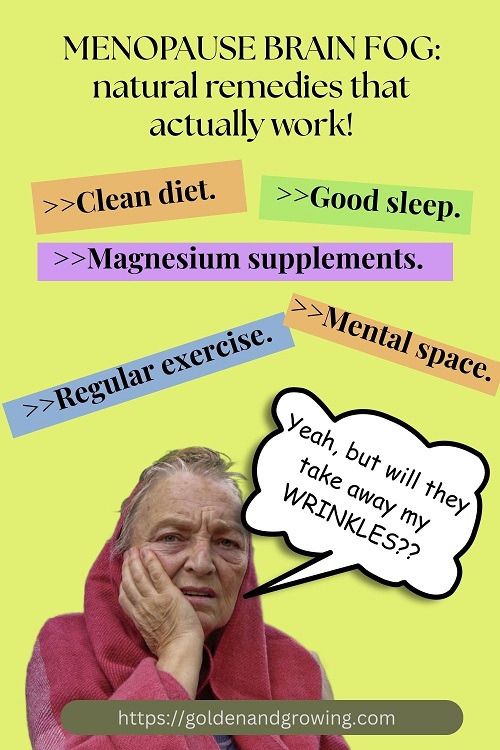
Are there natural remedies for menopause brain fog that really work? If you’re over the age of 45, you’ve certainly experienced the phenomenon of your keys sprouting legs and walking away from the spot you know you dropped them. Then there’s that beautiful feeling we’ve all come to know and love: the growing sense of dismay and frustration as we stand inside the room we’ve just entered, having lost the slightest clue as to why we came there.
And how about the hours lost while staring at our computer screen, unable to come up with – let alone type and send – a one-word reply to let our concerned loved one know we’re still alive?
In my mid-forties, I often felt exhausted by ten in the morning. I had to think super hard about each next step. And calling up the motivation to do the next step was like having a root canal and having your fingernails pulled out with a pair of pliers and biting down on a live wasp all at the same time.
Most women chalk brain fog up to being too busy or too stressed by their job or family life. But my husband and I had already retired. I didn’t have a job, and external stresses were few and far between.
(I know, I know. Feel sorry for me that I nevertheless had to suffer so. Moving on…)
For many of us women in our forties and fifties, brain fog isn’t just a bad day. It’s a symptom of perimenopause or postmenopause, and it can show up in ways that feel disorienting and sometimes even scary.
Especially if you’re like me, and have a parent who had (or has) some form of dementia.
If you’ve found yourself in a mental haze and want to try gentle, natural remedies for menopause brain fog before jumping to medication or resigning yourself to “this is just how it is now,” this post is for you.
Following are eight such remedies to try. I’ll put my personal favorite first.
Eight natural remedies for menopause brain fog.
#1: The best of all natural remedies for menopause brain fog: A clean diet brimming over with fruits and vegetables.
Whether it’s vegan or paleo, a whole-foods diet that focuses on greens and fruit for vitamins and minerals is essential. If you’re eating a lot of junk food, all of the other suggestions in this post will provide limited benefit.
Don’t shoot the messenger. All kinds of science backs me up on this.
If you’re not already eating clean and nutrient-dense, this might be the only remedy you need to get your mental energy back. One of the reasons is that the blood sugar spikes which processed grain and flour as well as processed sugar cause can mess up cognition. It’s even worse during hormonal shifts – which, if you’re over the age of forty, is likely happening far more often than you like.
I know, I know – telling someone to eat more vegetables when their brain feels like cotton candy isn’t exactly revolutionary advice. But think of it this way: your brain is basically a toddler throwing a tantrum, and vegetables are the equivalent of a really good nap and a juice box.
#2: Magnesium for focus and sleep.
Despite my healthy diet, I nevertheless need to take a magnesium supplement in order to stave off deficiency symptoms – namely restless legs and muscle twitching. As studies reveal that the mineral is essential for proper neurological and hormone functioning, it’s a great sleep aid, as well.
If you’ve been having trouble sleeping, after a week of taking magnesium glycinate in the evening you might begin sleeping more deeply and awakening feeling more refreshed. It’s one of the better known and researched natural remedies for menopause brain fog.
There are other types of magnesium; do your own research, but make sure you avoid the cheap magnesium that contain only, or primarily, oxides.
Think of magnesium as the chill pill your nervous system desperately wants to pop. It’s like giving your brain a spa day, except instead of cucumber slices over your eyes, you’re getting actual cellular repair.
Speaking of sleep…
#3: Get enough sleep.
Okay, okay – this probably should have been number one. But my brain was foggy because I ate potato chips all day yesterday, didn’t get to bed until two a.m., got up at six, and forgot my magnesium supplement.
So I go them out of order. SIGH.
Back to the subheading. Much easier said than done, right? And a topic worthy of its own article. For now, if magnesium doesn’t quite do it for you, determine to stick to a calming, screen-free bedtime routine, and stick to a regular sleeping schedule, even on the weekends.
Getting enough sleep is key to eliminating brain fog.
As a bonus, it also helps keep your twitchy hormones in balance.
Sleep is like that friend who always gives you the best advice, but you keep ignoring them until you’re crying in a parking lot at two a.m. wondering why your life is a mess. Your brain literally uses sleep time to take out the mental trash. If you’re not getting enough, you’re basically living in a cognitive garbage dump.
#4. Rhodiola rosea for mental stamina.
I’ve never used this herb myself, but other women claim that it’s helpful on days when you have a lot of mental work to do. It’s an adaptogenic herb that’s been studied for focus, stamina, and memory under stress.
No need to take it every day, just on those days when you feel that hormonal brain sludge creeping in.
This natural remedy for menopause brain fog doesn’t give a buzz like caffeine, but it does create a steady sense of alertness. For best results, use an alcohol tincture. And if you’re not used to such supplements, start with a dose that’s a quarter to a third of the recommended amount, and give it a few days to kick in.
Rhodiola sounds fancy and mysterious, like something a Viking warrior would chug before battle. Which is fitting, because some days, just trying to remember where you put your phone feels like going to war with your own brain.
#5: Omega 3 fatty acids.
Researchers have known for some time that omega-3 fatty acids, especially DHA, support brain health and reduce inflammation, two things that are tightly linked to cognitive function. That makes it one of the great natural remedies for menopause brain fog.
If you’re not a vegan, eating salmon two to three times a week will give you all the DHA you need. If you’re vegan, you can try chia seed puddings, soaked and blended-into-smoothie flax seeds, and/or a an algae-based DHA supplement.
If you’ve been deficient in this fatty acid, then start taking/eating it, you might just notice your word-finding and general memory issues clearing up.
Omega-3s are basically WD-40 for your brain. They keep all the mental gears from squeaking and seizing up. Plus, if you go the salmon route, you get to tell people you’re eating “brain food” like some kind of intellectual zombie. Delicious, sophisticated brain food.

#6: Forget paying money: Just get moving.
I don’t mean long workouts. In fact, I had to find workarounds during an injury recovery phase.
But even slow walks, stretching, or five minutes of dancing in place can boost circulation and oxygen to the brain, which improves clarity.
I started thinking of movement less as “exercise” and more as a natural remedy for mental fog. Ten minutes here, five minutes there—it adds up. Especially if I do it outside.
Being outdoors can be the perfect pick-me-up… unless it’s summer in the South. Then, only spend time outside if you want to lack even more energy.
The good news is that “exercise” can literally be dancing badly to one song in your living room. Your brain doesn’t care if you look like a confused chicken, it just wants the blood flowing. I like to think of it as giving my neurons a gentle massage, except with more flailing and questionable rhythm.
#7: Create a mental buffer in your schedule.
This is less about supplements and more about lifestyle.
Brain fog gets worse when I’m overscheduled or jumping from task to task with no pause. So I began building in a five to ten minute break between activities. No screens, no talking. Just standing outside, closing my eyes, breathing.
That little reset helps more than any productivity hack I’ve ever tried. And it doesn’t cost a dime.
This is revolutionary advice in our “hustle culture” world, but hear me out: your brain is not a computer that can just switch between forty-seven browser tabs without eventually crashing. Giving yourself permission to stand around and breathe like a normal human being is apparently a radical act of self-care these days.
#8: Progesterone cream: a bit controversial among the “natural” remedies for menopause brain fog.
Okay, so over-the-counter progesterone cream that works contains lab-synthesized progesterone. It’s not completely natural. I get that. But it’s helpful for a lot of women, so I felt it worth a mention here.
Full disclosure: I use progesterone cream like it’s candy for the skin on my thighs, but I still experience brain fog. However, most of that is due to trouble sleeping having little to do with menopause (a story that’s too long to get into here). What I can tell you for sure is that it alleviates, sometimes eliminates, most menopausal symptoms. I’m assuming if not for my sleep issues, I would have a lot less brain fog, thanks to the cream.
I slather this stuff on like I’m frosting a cake, which probably says something about both my hormone levels and my relationship with cake. The “natural vs. synthetic” debate feels a bit like arguing about whether a life preserver is “authentic” enough while you’re drowning – sometimes you just need something that works.
Natural remedies for menopause brain fog that may or may not work.
Many women try a plethora remedies, such as ginkgo, or cutting caffeine, or highly marketed menopausal supplements. They may work to an extent, or maybe not at all – particularly the latter, which tend to be full of low-quality, non-viable ingredients.
Just because something is labeled as “natural” doesn’t mean it’s going to be helpful.
The supplement industry has basically turned into the Wild West of wellness, complete with snake oil salesmen promising that their special blend of ground-up leaves will turn you into Einstein. The word “natural” on a label has about as much meaning as “artisanal” on a bag of potato chips.
But you’ll never go wrong with reducing inflammation and supporting blood flow and your nervous system.
When brain fog feels like something more.
If you’re struggling with memory loss that affects your ability to function, or if you’re feeling unusually depressed, anxious, or confused, don’t self-diagnose. Talk to a doctor. Menopause can cause temporary brain changes, but it’s important to rule out other causes like thyroid issues, nutrient deficiencies, or cognitive disorders.
There’s no shame in asking for support.
The bottom line.
Menopause brain fog is real. It’s frustrating. But it’s not permanent, and there are things you can do to feel clearer, more capable, and more like yourself again.
Even if your brain isn’t as sharp as it was in your thirties, it can still be strong and focused. The key is finding what your body and brain need now, as opposed to what worked ten years ago.
You’re not losing your mind. Your brain’s just asking for some new support.
******
(I’m not a medical professional. This post reflects my personal experience and the research I’ve read. It’s not medical advice — please consult a qualified professional for personalized guidance.)
