Wondering how to create a money system you can stick with as a neurodivergent woman navigating the lovely symptoms of menopause at the same time? Read on…
With meticulous care, I wrote down the amount of money I’d just spent on groceries, subtracting it from the total amount of money in my bank account. No, it wasn’t a checkbook, but a small tablet where I added every penny I earned and subtracted every penny I spent. It was simple, but I always knew how much money I had.
It worked for me because I was single, and because my autism is more prominent than my ADHD. But if you’re reading this, you might not be gifted in that way. (And yes, I just called obsessive penny-tracking a “gift” – because sometimes our quirks are actually superpowers in disguise.)
Likely as not, somewhere along the way, “money management” turned into a kind of moral test. If you paid bills on time and tracked your spending, you were responsible. If you forgot things, avoided paperwork, or ran out of energy midway through the month, you were irresponsible. Careless.
But for women with executive dysfunction, whether from a neurodivergent brain or from menopause, that narrative doesn’t hold up. (Neither does that judgmental voice in your head that sounds suspiciously like your third-grade teacher.)
The truth is, any system can fail regardless of how religiously a person sticks to it. And figuring out how to create a money system you can stick to can be tricky. Yet, it’s critical as part of your self-care.
Back in our late thirties, when my husband and I were trying to stick to a tight budget in order to reach certain financial goals, we were constantly having to shift money amounts from one category to another. For example, we would overspend on groceries and have to take money out of another category to make up for the lack.
That system simply didn’t work for us. (Turns out, budgets and grocery stores have about as much in common as cats and cooperation – they just don’t mix well.)
And for many neurodivergent women, their personal finance system is what needs to change. Not them.
That said, here are some ideas you can put into practice today in order to create a money system that works with your brain, rather than against it.
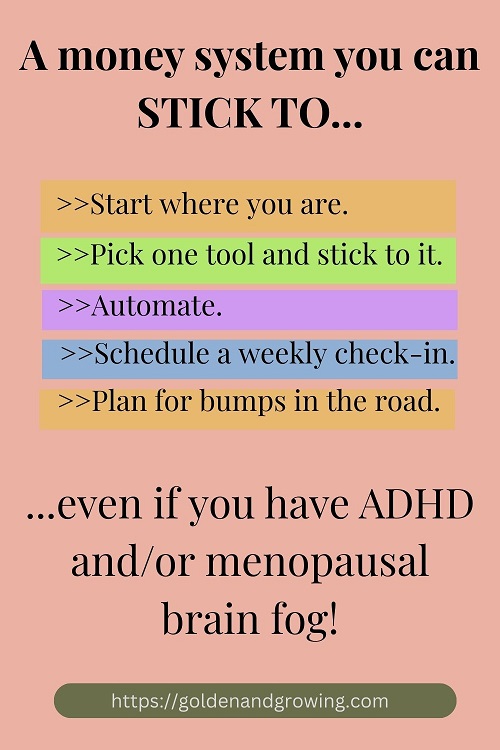
Most critical step in how to create a money system that you can stick to: start where you are.
We neurodivergent women are famous for guilt-tripping ourselves over not being as far along in life as we’d hoped. So your first line of attack is to give yourself grace.
You are where you are. You have to start from that place, not the place you imagine you should.
The problem is, most money advice assumes a baseline level of mental energy, memory, and task initiation. In other words, proper executive functioning. Which we don’t have. (It’s like assuming everyone has a personal assistant when half of us can’t even remember where we put our keys five minutes ago.)
So when we come to the place where we realize that our current system isn’t working, we need to back up, take stock of reality, and start smaller.
Don’t try to build a full budget on day one. Instead, try:
- Listing your monthly bills.
- Checking your bank balance every few days.
- Noting what tends to derail you spending.
“But my best friend/favorite YouTuber/sister can do XYZ while standing on her head and singing ‘The Star-Spangled Banner!'”
Good for them. But that’s where they are. You’re in a different place. And that is totally okay.
Besides, anyone who can balance a budget while doing gymnastics probably has some sort of magical powers we mere mortals don’t possess.
Start where you are, and slowly build a money management system that works for neurodivergent brains. Your differently-wired brain.
Pick one core tool, and stick with it.
A classic mistake that people with ADHD make is bouncing between systems. If you know or suspect you have the condition, you’re nodding your head sagely at these words. Your craving for variety, along with your impatient need for everything to work perfectly yesterday, tempts you to bounce from a budgeting app to a paper planner to a spreadsheet on your desktop to… nothing.
If that’s you, you need to choose one tool, then give yourself a small reward every time you use it. It may be a small pebble that you drop into a vitamin supplement jar. When the jar is full, you allow yourself to buy that new bestselling novel you’ve had your eye on, or go out to eat at your favorite restaurant, and so on. (Think of it as training yourself like a very intelligent golden retriever – except instead of treats, you get books and dinner.)
What kind of tools might you choose?
- A notebook.
- A whiteboard with fixed categories listed along the top.
- A cash-flow calendar stuck to the refrigerator.
- A spreadsheet that you update weekly.
- A super-simple PDF printable that keeps money management… well, manageable.
If you want to use a budget app, I recommend using it in conjunction with a more visible tool such as those listed above. They are visible and therefore automatic reminders to you to take care of your money.
Automate, automate, automate.
When I first saw David Bach’s book The Automatic Millionaire, I got excited. What secrets did it hole that would turn me into a millionaire automatically?
Turns out… none. The content of the book wasn’t nearly as sexy as the title, IMHO. I was too young at the time to realize that the content was exactly what many other people needed in order to get their financial lives in order. (Sometimes the most boring advice is also the most life-changing. Kind of like how vegetables are good for you but taste like sadness.)
What was the book about? Automatic bill pay and automatic retirement transferring.
Of course, today that’s a lot bigger no-brainer than it was in the early 2000s. Today, people take for granted that their streaming service or online magazine subscription is going to automatically, every month, deduct from your credit card or bank account what you owe for the service.
Nevertheless, there are still people who wait until their energy bill or utility bill shows up in the mail before they pay it. And not every service in every city or town allows for automatic bill pay.
But if your income allows it, set up autopay for every single monthly bill possible. This is perfect especially if you have ADHD, because then you never have to remember to write a check or go online and pay the bill. (Your future self will thank you for this gift – probably while doing a little happy dance.)
My husband and I are off the grid as far as water and sewage, but our electricity and phone bills are both on autopay. Our Internet service doesn’t even send out paper bills; every one of their customers has the monthly fee subtracted from their bank account without them having to lift a finger.
Many – if not most – companies allow for automatic deduction of retirement money from their employees’ paychecks as well. It’s sent right into their 401k or 403b account. If you work for someone else and you’re not sure whether your company does this, it won’t hurt to ask.
For bills that you can’t automatically pay, or that are too variable given your income, you can automate them in different ways. You might:
- Set up reminders to make small weekly transfers to savings.
- Create calendar reminders for when variable bills are due.
- Arrange for an email notification to be sent to you when payments post.
Automation is an awesome support structure for anyone, and it’s especially helpful when executive function is twitchy.
Think of automation as your personal money butler. The difference? It never judges you for buying that third exotic coffee this week. More, it’s an essential part of a money management system for ADHD and autism.
An oft-ignored key in starting a money system you can stick with: build a weekly check-in that you don’t dread.
A good system doesn’t require hours of maintenance. It just needs a consistent touchpoint.
Try setting a recurring ten-minute check-in once a week (have Siri or Google give you a verbal reminder). During that time:
- glance over your account balances,
- look over upcoming bills,
- cross off what’s already paid, and
- make any adjustments necessary.
If you skip a week here and there, no worries. The important thing to remember is consistency. Better to do it every other week than to go twelve weeks without doing it. Missing one week doesn’t mean you’ve failed. It just means you’re human, not a robot programmed for perfect financial compliance.
Expect disruptions – and plan for them.
Life happens. You’ll have “off” months. Surprise expenses. Moments when your system falls apart.
Because as you know by now, life doesn’t care about your systems. Life is basically that spontaneous, messy friend who shows up unannounced when you’ve finally got everything organized – charming, but has terrible timing.
So, plan for the mini-quakes.
- Keep a small buffer in checking, if at all possible.
- Build a “grace” category into your spending time – a small emergency fund.
- Don’t erase your whole system if one piece fails. Assess and reset.
Consistency doesn’t mean rigidity (hello, my fellow autistic women whose brains enjoy getting stuck on “the one right and perfect way!”). A good system is one you easily return to after a setback.
Let your money management system be quiet.
When considering how to create a money system that you can stick with, remember that your money system doesn’t have to elaborate, color-coded or impressive.
On the other hand, if you’re like me, having permission to color a document makes it all the more likely you’ll remain consistent with revisiting it. (Because apparently, rainbow spreadsheets are the secret to adult responsibility. Who knew?)
But your system can be as simple as a notebook filled with homemade grids and categories, a checklist taped to the fridge, or a once-a-week glance at your account. No one else who comes into your home may realize it’s there, but its presence will bring you a little more peace, a little more steadiness, and a lot less dread when the bills come due.
That’s the kind of money management system of ADHD and autism that works.
(Want more tips and support as you navigate your neurodivergent and/or menopausal journey beyond your mid-40s? Be sure to subscribe to my newsletter!)

2 thoughts on “How to Create a Money System You Can Stick With (for the frazzled or tired brain)”
Comments are closed.