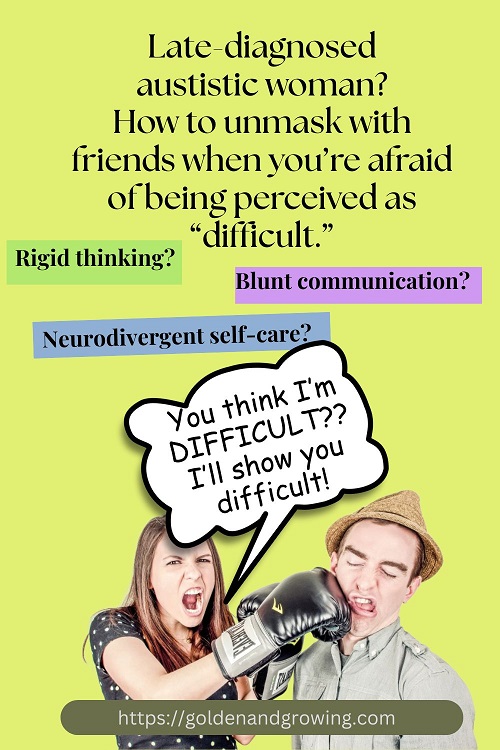
In the realm of neurodivergent women relationships, unmasking with friends can be scary. How to navigate this when your authentic self has been labeled “difficult.”
The story.
It was after my first year of college. I was home for the summer, lying in bed around midnight after waking up a few minutes earlier. I was trying to get back to sleep and failing. Just like had happened so many nights in the dorm this past year.
My sister, whose bedroom was just below mine on the first floor, wasn’t helping. I was really tired of having to hear her pounding out the beat of heavy metal music in the middle of the night. I couldn’t hear the music, as she wore headphones, but the pounding kept me awake.
Fighting the usual rising tide of anger, for the hundredth time I went downstairs and knocked on her bedroom door.
The door swung open, and a wild look of fury met my gaze. My sister inhaled deeply before screaming at the top of her lungs, “You wouldn’t keep waking up in the middle of the night if you didn’t go to bed so early!”
Long story short, she turned out to be right. I started going to bed at ten o’clock instead of nine, and it never happened again. But man, she could have been nicer about it. Why did she always have to be so difficult?
One finger pointing at my sister, three pointing back at me.
Neurodivergent women friendships and unmasking: why the prospect can be scary.
My middle sister never learned to mask. And since there were four undiagnosed neurodivergent children plus one undiagnosed neurodivergent adult in our home, tensions often ran high. Misunderstandings and wrong assumptions were the order of the day.
It took only one of us being unable to mask to make life even more, well, difficult.
In fact, a common question some undiagnosed autistic children hear is, “Why are you being so difficult?” Then when they grow up and converse with someone without their mask on, the someone throws up their hands and says, “Man, do you have to be so difficult?”
So the autistic individuals who can mask cover up their “difficultness.” At the same time, the idea gets ingrained in their psyche, and they convince themselves that they’re a “difficult” person.
I knew how to behave myself at school, and at home I tried to be the “good oldest sister.” So no adult ever accused me of being difficult or stubborn. However, the fact that I asserted myself with my sister and her middle-of-the-night metal jams pointed to the truth. That is, I wasn’t the best at masking, either.
I don’t mean that a neurodivergent person sticking up for their needs is wrong. (Read my post about neurodivergent women and setting boundaries). Part of not being masked includes taking care of your sensory sensitivity and executive function needs. But I could have gone about resolving the issue in a way other than interrupting my sister’s nightly stimming.
I’m sure she thought I was being the difficult one.
But that word. Is it a just and fair term to apply to autistic women? And what situations provoke others to apply that label to someone?
Let’s unpack what “difficult” might mean when used to describe a neurodivergent child or adult.
Autistic rigid thinking.
A common trait of autism is rigid thinking. It’s what causes girls to develop eating disorders, including orthorexia. It’s what makes them think that because they’ve gone to bed at nine o’clock their entire childhood, that’s the time they should go to bed for the rest of their lives. 😉
In addition, it’s what causes neurotypical people to call them “stubborn.”
Basically, rigid thinking is black-and-white thinking. “I eat lunch at one o’clock every day. Therefore, lunchtime is one o’clock.” Or, “Mom always cooked bell peppers with rice. So I have to cook bell peppers with rice, even though the peppers give me gas.”
Rigid thinking is not the same as having a strong opinion on an issue. Rather, it’s a set of beliefs that lends more predictability and stability to an otherwise unpredictable and unstable world. If a neurotypical person tries to argue against those beliefs (“Lunchtime can be anywhere between eleven and two”), the autistic person’s refusal to bend their own way of thinking might be construed as “difficult.”
Blunt, direct speech.
Beating around the bush and glossing facts over with white lies is contrary to the typical autistic person’s nature. We tend to come right out and say what we mean.
Thereby accidentally offending people once in a while.
Thereby earning the label, “difficult.”
Self-care.
Sometimes neurotypical people accuse autistic people of being difficult because the autistics are trying to set boundaries on their energy and sensitivities.
“No, I told you I won’t go to the party because I can’t stand the noise” is in fact a healthy statement for a highly sensitive person to make. But say such things often enough to non-HSPs, and they’ll call you “difficult.”
Too much stress strips away your ability to be kind.
A final reason a neurotypical person might consider an autistic person as “difficult” is because the autistic person has expended all of her energy on masking and/or fighting anxiety. She can’t keep the filter on her mouth that helps her to be polite.
I don’t mean a mask. Instead, I mean the filter we all use to keep from insulting or hurting others when we’re exasperated or frustrated with something they have nothing to do with. We filter the words we say because they don’t deserve a cutting or harsh response just because we’re upset. (That said, years of masking can lead to an inability to filter.)
Let’s say an autistic person has had a calm day engaging in her special interests. If a friend asks her if she wants to go out for ice cream, she’s likely to answer something like, “No, thanks. But if you want to come over and have tea and cookies with me, I’m up for it.”
If she’s had a rough day, however, she’s more likely to reply, “Are you kidding? Those places drive me crazy. They’re noisy with way too many people. You should know that by now.”
Such replies can cause their friend to refer to them as “difficult.”
All in all, unless you’re intentionally being hurtful or rude (which is NOT unmasking, it’s just being hurtful or rude), your perceived difficultness is a misunderstanding another person that you can resolve.
Time to Sherlock Holmes the label.
Masking long term is unhealthy. It leads to autistic burnout. It can mess with your physical health.
So once you realize you’re neurodivergent and have been masking, that mask needs to come off most of the time. And sooner rather than later. If you’re afraid doing so will cause others to perceive you as difficult, think about why.
What were the prior circumstances when someone was calling you “difficult”? If they involved:
- rigid thinking,
- blunt communication,
- or taking care of yourself,
then the answer is to have a calm conversation with your friends in which you explain your neurodivergence, how you’ve been masking and why, and that when you unmask, your speech patterns and way of thinking will come out.
For rigid thinking, the best you can do there is explain the disability and ask them to agree to disagree with you when necessary. You might even invite them to gently prod you into greater flexibility with a certain misconstrued belief (like the cooking peppers with rice example).
For blunt and direct communication, tell them that you never mean to offend, but that it’s almost impossible for autistic people to tell even “little white lies.”
As far as self-care, once you explain your limitations regarding socializing and sensory exposure, a real friend will understand.
Hopefully, now that you realize you’re neurodivergent and that you need to rest more and reduce your stress more, the issue of losing your verbal filter because you’re stressed out will no longer come up.
Neurodivergent unmasking and friendships: sometimes tricky; ultimately a good thing.
A mature and wise friend will take the time to understand the real you. They will realize that even neurotypical people have their quirks; your quirks just happen to be more obvious.
And that doesn’t make you “difficult.” It makes you a valuable human being with brain differences beyond your control.
Do you have a story about overcoming the “difficult” label? Or how you successfully unmasked among your friends? Please share in the comments below!
