Frugal home decorating is never a bad idea, but it’s a great idea for the menopausal/neurodivergent woman. Here are 7 reasons it can transform your life.
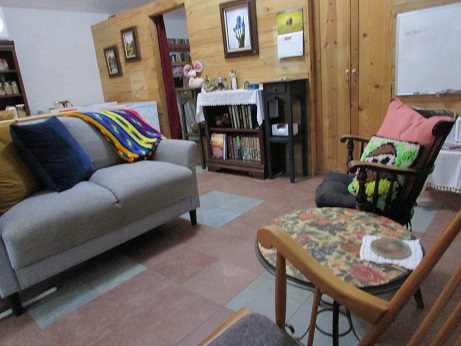
The rocking chair in the living room area has been with me since my early teaching days in the 1990s. Beside it stands an elegant side table, decorated decoupage-style with what looks like wallpaper with a flower-fruit design in muted reds and greens.
On the other side of the table is an old, black-varnished chair, ornate in its craftsmanship and much more comfortable to sit in than the hard, wooden seat appears.
Across from those three pieces is a loveseat that we purchased from Amazon, layered with an afghan that Jay’s grandmother knit long ago, plus two throw pillows that coordinate with it.
Near my son’s bedroom is a glass and metal side table, transformed from ugly to lovely with a white piece of fabric trimmed around the edges. Between our bedroom and the bathroom, two tall, narrow nightstands flank a short bookcase. One nightstand is green, the other blue. I bought them from a Dillard’s when I was in my late twenties and learning how to decorate.
The bookcase is one of four that my husband purchased as a set when he was single, back around the turn of this century.
Our entire small home is that kind of eclectic. Most of the furniture came from the house we lived in back in the ‘burbs. And when we purchased furniture to fill in the spaces in that much bigger house, we bought them on consignment.
Living beneath our means is a way of life for me and my husband.
As far as furnishings go, our home doesn’t follow anyone’s rules. And I improvised much of the décor from inexpensive, found, and childhood items.
It wouldn’t win any awards. Better Homes and Gardens won’t be coming by any day to take pictures.
But our imperfect home offers something much more valuable than approval from home decorating gurus and influencers: peace. How?
The seven reasons our home gifts us with more peace than a perfectly-decorated place ever would.
#1: It’s sensory-friendly and calming.
As a discuss in my post about neurodivergent couples and early retirement, moving here was a stressful change. However, we didn’t purchase any new furniture (at least not in the beginning), and I believe having familiar things around helped somewhat to mitigate the autistic anxiety.
For autistic brains, fond familiarity with something is by default both sensory-friendly and calming. We’ve associated the colors, shapes, and textures with positive feelings.
There’s another reason frugal home decorating brings more peace for neurodivergent individuals…
#2: The home stays predictable.
I grew up in a home where the furniture mostly stayed the same my entire childhood. With the exception of a new shelving unit one Christmas, the occasional additions came from auctions.
So I was flabbergasted when I grew up and discovered there were women who completely refurnished their homes every few years. The very idea made me quiver.
Still does.
Because, my butt knows how it’s going to feel when I sit in my rocking chair. My back and legs know what to expect when I sit on the loveseat. Why would I want to retrain all of my body parts?
The visual aspect is yet more compelling. Familiar furniture provides comfort amidst an unpredictable world.
I’ve got one more reason frugal home design brings peace to neurodivergent individuals. Then I’ve got four that apply to anyone.
#3: Being thrifty with furniture is easy on limited executive function.
This holds true for many menopausal women, as well, since low levels of estrogen often disrupt executive function. That means, in part, that planning, follow-through, making decisions, and organizing are difficult.
Even if you only want to change out your sofa, you have to figure out where to buy a new one, which kind you want, when to buy it, whether you have the money to pay for it in cash, and what to do with the old sofa.
Following the old adages of “If it ain’t broke, don’t fix it,” and, “Wear it out,” means you don’t tax your executive function for the sake of having a Pinterest-perfect home.
#4: It provides more money in the bank.
Most of life worries tend to revolve around money in some form or other. Worry and peace cannot co-exist.
When you refrain from buying new furniture, when you determine to keep on loving the old things, you automatically have more peace because you’re saving money.
And that amount becomes considerable over time.
Because you have more money in the bank…
#5: …you have less stress.
Less stress means more energy, mental bandwidth, and happiness. Which means better relationships and better decision-making abilities.
Less stress also means lower risk of disease.
#6: You have more freedom.
Because you have less stress, you have better health. That gives you more freedom to do whatever it is you feel like doing. Freedom to travel, to write a book, to help a neighbor.
In addition, having more money brings more freedom in the form of flexibility. If you need to relocate, you have more power to do so. If you want to start a new hobby that has an upfront cost, you can afford to do so. Finally, if you have to quit a job for wellness reasons, or you lose a job, saving money on home decorating means having a little more of a cushion that can provide for you while you seek different employment.
That brings us to another interesting aspect to the financial side of frugal living…
#7: It keeps greed down.
A contradictory part of human nature is that the more we get, the more we want. Something about the acquisition of more and better breeds a sense of entitlement and a craving to increase our wealth further.
Being thrifty with your home furnishings – and anything else – dampens the fire of greed. It dwindles into a pile of ashes and blows away, gentle and soft contentment swooping in to replace it.
Frugal home decorating: It’s about much more than saving money.
When it comes to furnishing and decorating your home, living beneath your means to do so is a wise choice. You not only gain peace from eliminating some of your money worries, but also the joy and contentment of being surrounded by the things you love.
Got any unique ways you’ve been saving money on your home? Or have any of the above reasons given you an “a-ha!” moment? Please share in the comments below!
(And if you need a simple tool to help keep your finances in line, I invite you to check out this affordable budget printable. I created it especially with menopausal and neurodivergent brains in mind.)
