Should neurodivergent couples retire early? A woman with AuDHD describes her and her husband’s precarious experience with early financial independence.
The beginning: when we accidentally joined the F.I.R.E. movement.
I think our son was four when I realized that I wouldn’t be able to take living in the city much longer. My husband (whom I shall refer to as “Jay” heretofore, though that’s not his real name) had long since left the honeymoon phase of his job. His discontentment with it weighed equally heavy on my mind. We wouldn’t hear about the “Financial Independence, Retire Early” movement until years after the fact. However, after having several discussions about it, we picked a monetary goal and went for it.
I’m sure there are more than a few neurodivergent couples out there wondering whether seeking early retirement would be worth the stress. So as a woman with AuDHD and a husband and son who tend mostly toward autism, I want to share what we experienced.
Fair warning: I won’t remember everything. And how much stress the process causes will be unique to every couple and family. However, I believe that giving you at least a glimpse into what we went through can help you to make the right decision for yourself.
Part 1: Budgeting and doubling down on frugal living.
Jay and I have always been frugal, have always lived well beneath our respective means. But only after we decided that we wanted to declare financial independence by the time he was forty (I’m slightly older) did we start to budget.
The budget I created was harsh, to say the least. And, as it turns out, somewhat unrealistic. Though it was imperfect, it did keep us from making large, unnecessary purchases – even small, unnecessary ones.
The problem was that it caused me stress. I think it’s safe to say that it became my “autistic special interest” for awhile, but not in a good way. My rigid thinking told me that if we didn’t follow the budget precisely, we wouldn’t meet our financial goal.
Oh how I wish I’d had a gentler kind of budget to keep track of things, like this one.
My nervous system was already in at least the beginning stages of autistic burnout, and following Dave Ramsey’s rigid method didn’t help.
The cost of being too strict with money.
In fact, even though I gave each of us some “fun” money every month, I could never get myself to spend mine. Part of it had to do with the poverty mentality I grew up with. Part had to do with that I really, really, REALLY wanted out of the city ASAP.
An aspect of having a too-strict budget that still gives me a twinge of guilt to this day is that we refrained from introducing our son to certain opportunities while we had the chance. My reasoning was that once we moved, he wouldn’t be able to participate in karate or music or whatever classes he might take anyway, so no use letting him get used to it.
In hindsight, as he turned out to be autistic, that wasn’t the worst decision I made. But we could have enriched his young life with one-off excursions and the like, activities that may have given him more joy and allowed him to find a hobby or special interest he could stick to.
I’m not saying that living frugally or budgeting your money is a bad thing. Not at all. And your family may need to buckle down and make painful sacrifices in order to be free from a life-draining job or bad neighborhood.
What I am saying is that if you’re highly sensitive, super-strict budgeting will do nothing to help you alleviate your stress. Try a more gentle approach, like this one.
Part 2: The stock market crash.
Chances are good that we would have declared financial independence two years earlier than we did, had the stock market not crashed in 2008.
The one time in my life that I’ve seen someone eyes look haunted was the day after the crash when my husband got online to see what had happened to our investment portfolio.
Gulp.
He was depressed for weeks. I had to keep reining in the urge to find a safer option than mutual funds for helping our money grow. I’d heard enough Dave Ramsey radio shows to know better.
Or so I thought. More on that in a second.
This incident taught us three major things:
- The stock market does eventually recover from extreme falls.
- Be flexible about your early retirement date.
- Be cautious about your “number.” We ultimately decided that ours was a bit too small, in light of a possible similar crash in the future.
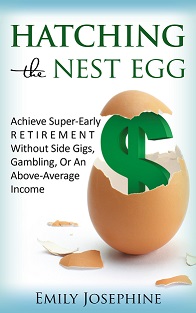
Another good thing about the temporary loss was that my subconscious continued seeking investment options. A year or two later I heard about “The Permanent Portfolio” on a prepper podcast. I detail how we now divide up our investments among mutual funds and “The Permanent Portfolio” method in my book, Hatching the Nest Egg.
Long story short: this additional investment method has done a lot for our financial peace.
Part 3: Searching for, finding, and buying land.
Not everyone who retires super-early will want to move. We may not have moved except for the overstimulation of city life.
However, as many people who retire in their forties and early fifties do want to move, I wanted to summarize our experience.
This process was mostly fun. Not wanting to drive long distances or fly to look at land, we decided to search for raw, rural properties just a few hours north of where we lived at the time. Jay wanted to stay relatively close to his brother. I wanted to live in a state that didn’t monitor homeschooling parents.
We were both stuck in the usual autistic mindsets of rigid thinking and “now is forever” thinking. I won’t go into all the bleak disadvantages we eventually discovered about living where we are now. It is a beautiful area and there are at least an equal number of advantages, especially for introverted people who need to be out in nature.
BUT…
However, neurodivergent couples who are planning to move when they retire need to think long and hard about not just what they want now, but what they might need in the future.
- A location low in allergens and/or smoke from wildfires.
- A climate where you’re not frequently sandwiched between cold fronts and warm fronts (it depletes the quality of life for highly sensitive people). In the U.S., it’s the area I’ve named “the Middle South.”
- How many neighbors you will potentially have.
- If you’re going to have neighbors, whether noise levels are at all policed.
- Your tolerance for bugs and wildlife.
- Your need for novelty (isolated rural areas offer little of that).
- Potential future medical needs.
- Your gut reactions to being “too close to” or “too far from” family and friends.
There is no “perfect place” for anyone. But think carefully through the major issues before making a decision to relocate.
Part 4: The day we declared financial independence: anxiety, excitement, and backlash.
The anxiety.
If I had realized our neurodivergences back then, and had Jay given me the slightest clue about the extent of anxiety that dogged him every day, I wouldn’t have been nearly as pushy about him quitting his job. It all turned out for the best, but both anxiety and depression dogged him in the early months after we declared financial independence.
Guys, take things slowly. Take baby steps. If you have ADHD traits, do your best to rein in your impulsivity, your need for change. Just because it’s exciting and feels right in the moment, doesn’t mean that it will last, or that moving fast will be the healthiest choice for your spouse. Or children, if there are any in the picture.
That said, I’m not sure my husband would have retired before his previous goal of fifty years old if I hadn’t prodded him. But you need to talk through your anxiety, fears, and expectations before taking the plunge. Have a session or two with a therapist, if that feels like it would be helpful.
Having a move on the horizon complicated things further for us. After Jay resigned from his job, we should have spent a little more time in our suburban house to learn more about the area we were moving to, as well as what kind of house we were going to have built. We should have talked more to our seven-year-old son about the enormity of our decision, gotten him used to the idea of leaving the only home he’d ever known.
The backlash.
If you’re nowhere near traditional retirement age when you leave the rat race, you need to steel yourself for friends and relatives hinting at your lack of sanity. We got more skeptical looks than anything, but I’m sure family members talked about us behind our backs, worrying that we were going to end up homeless.
It might be better, if you can get away with it, to go through with your plans quietly. Don’t tell anyone of your new situation until you’ve been out of employ for at least a year and still have a healthy financial cushion.
Dealing with the autistic resistance to change.
If you tend more toward autism than ADHD, the prospect of leaving a job – even one that’s stressful – might ramp up your anxiety. Moving to a completely different location? Even more so.
The idea of living off investments instead of a steady income is a huge paradigm shift to make, as well.
I really can’t tell you how we did it, except we had multiple strong motivations to leave the city. And we couldn’t do that as long as Jay had his job.
What I can tell you is that I did it all wrong. I did not allow for any transition time once we landed at our new place. It was go-go-go from the beginning.
Which only served to increase the severity of the burnout I was experiencing.
Also, each of the three of us, in his or her own way, was freaking out from the huge change. Though Jay and I tried to hide the fact from each other.
All I know is that gradually, eventually, we found a rhythm. Gradually, eventually, I released expectations and began learning to enjoy each day, each moment, as it passed. Gradually, eventually, I began loosening the lifetime noose around my neck labeled “the need to achieve.”
What I want neurodivergent couples seeking early retirement to know.
Everyone’s situation is unique. But if you want to achieve financial freedom, I recommend that you do it:
- Slowly.
- Carefully.
- After a lot of research.
- With your sensory sensitivities and emotional limits in mind.
- With many heart-to-heart, calm conversations with your spouse.
- Determined to be flexible.
Walking away from what mainstream society (and likely most of your family members and friends) tells you what you’re “supposed to” do is scary. Intimidating.
But keep in mind that mainstream society was by and large created by neurotypical people. Your true safety zone might be outside of that stream.
Are you on a journey to early retirement? Please share your encouragement and tips in the comments below!
And if you’d like a step-by-step guide on the basics of getting out of debt, investing, and determining your “magic number,” remember to check out my book, Hatching the Nest Egg.