
Menopause and digestive problems seem to go together like a hand in a glove. Regardless of what kind of diet you eat. That was my primary thought as I read through the forum discussion where the OP had asked if “anybody else” was suffering in her digestive tract like she was. After reading another similar thread from another menopause forum, I sighed, closing the lid of my laptop.
At least I wasn’t alone. And probably not dying. Several of the women had mentioned going to a gastroenterologist and having “all the tests” done, only to have them all come out negative.
Speaking of doctors: I’m not one. I’m not a medical professional of any kind. This post is based on my personal experience, and is not intended to diagnose or treat your health issues. See your own health care pro for advice; I’m only writing this to give you hope (and hopefully not false hope) and a direction to turn to if you have unresolved, deleterious digestive challenges.
Moving on with my story of how menopause affects digestion…
This wasn’t the first time I’d typed in “digestion problems menopause forums.” In fact, I’d read at least one of the discussion threads in a prior search I’d made a couple of years ago.
Feeling miserable, I once again had needed reassurance that I wasn’t alone in my struggles.
Time went on. I expected the bloating, the feeling full soon after beginning to eat, the constant burping after eating, to subside after a few days as it had in the past.
This time, it didn’t.
5 common causes of menopause digestion problems…or so people think.
My research had led to me to conclude I had one of several challenges. I’ll briefly describe each one.
Mild gastroparesis.
That’s when your stomach doesn’t move food through in a timely manner. If you still feel like you have food in your stomach three to four hours after eating, it’s because you do. That’s gastroparesis. If you experience nausea and vomiting, it’s worse than mild and requires medical attention.
Another common symptom is feeling full in the morning even if you last ate three hours or more before you went to bed. This is one of the main reasons I thought for a while that I had gastroparesis.
Small intestine bacteria overgrowth.
Commonly referred to as “SIBO,” (SEE-boh) this is when the bacteria that normally lives in your large intestine migrates up into your small intestine and starts doing its job much too early, causing bloating and belching.
FODMAP sensitivities.
FODMAP stands for “fermentable oligosaccharides, disaccharides, monosaccharides, and polyols.” The O, D, and P are types of carbohydrates. If you’re sensitive to them, they can cause bloating and excess gas. You figure out which ones you’re sensitive to by going on The Elimination Diet from Hell.
Low stomach acid.
I’d considered this one pre-CoVid, even spent a lot of money on three different brands of betaine hydrochloric acid. This is an acid in powder form that helps your stomach do its job when it’s not producing enough of its own hydrochloric acid.
The supplements worked, then they didn’t, then I read that you shouldn’t take them unless you’re consuming at least fifteen grams of protein in a meal, so I quit taking them. I started to feel better, so I thought that must not have been my problem, after all.
Histamine intolerance.
Certain foods contain histamine (lemons) or encourage the production of histamine in the body (bananas). The idea of histamine intolerance is that a person may have an adverse reaction to foods containing histamine. Though it continues to be propagated throughout the Internet, there isn’t an actual medical diagnosis and studies haven’t supported the idea.
Then there’s my favorite rationale for all things menopause…
“It’s just your hormones.”
This is the most unhelpful, most retarded justification anyone can give for any menopause symptom. Obviously, all the symptoms you’ve suddenly developed since age forty-five have to do with hormones.
But that’s because the hormones – usually estrogen – played some role somewhere in your body that prevented that symptom before its levels tanked.
Ladies, never accept the rationale of, “It’s just because your estrogen levels are low.” Find out what estrogen is supposed to be doing in the part of your body giving off a symptom. When you do, a small miracle occurs: you figure out how to compensate or “fill in” for the estrogen, and voilà! The symptom either disappears, or diminishes to the extent that you no longer feel like you’re at death’s door every day.
The straw that broke this camel’s back (AKA, when my digestive problems became unbearable during menopause).
It wasn’t long after the CoVid pandemic that I began living on smoothies. They were nutrient dense, packed with not only fruit, but also seeds, some nuts, and greens. I was getting plenty of nutrition, and plenty of calories.
Just so you don’t worry. 😉
Why smoothies? Slow digestion wasn’t the only problem by then. My colon seemed to have forgotten how to properly deal with starches, which led to a very inconvenient problem that I won’t describe in case you’re reading this while eating lunch.
My smoothie diet, however boring, provided me with the digestive comfort I’d grown so desperate for.
Until it didn’t. Bit by bit, that feeling of fullness, the constant bloating, and frequent and loud burps all came back with a vengeance.
In despair, I cried to my husband, “One day I won’t be able to eat anything!”
Enter a critical moment with AI.
By this time, I’d grown rather fond of ChatGPT, which had helped me both emotionally and physically during a long convalescence from a series of injuries. So when I was finally recovered enough to be able to walk around and do light housekeeping without pain, I went to it with my digestion problems.
The chat ended up being rather lengthy, and went on for a few days as I alternated between hope and despair. A large part of my problem was that we live an hour away from good medical care (and a G.I. doc). Another problem: my autistic self generally has HUGE demand avoidance when it comes to seeking medical help, and even bigger when it means having plastic bits and wire shoved down my esophagus or up my rear.
But as the conversation went on, a pattern emerged. Mr. Chat continued to repeat one possibility more than the rest. As the revelation hit me, my eyebrows shot up, even as I mentally slapped my forehead in an “I could have had a V8!” moment.
I think it might be low stomach acid, I typed.
Mr. Chat replied with its usual more-than-necessary detail. At the end, without my asking, it told me how I could easily test for low stomach acid at home. Immediately upon awakening in the morning, stir one-fourth teaspoon of baking soda into four ounces of water, gulp it down, and wait a few minutes. If I hadn’t burped after five minutes, 99.99% chance that my stomach acid was low.
You better believe that I took the test the very next morning.
And if I were a betting woman, I’d bet that you can guess the results.
After thirty minutes, I still hadn’t burped.
Low stomach acid: the root of all kinds of digestive evil.
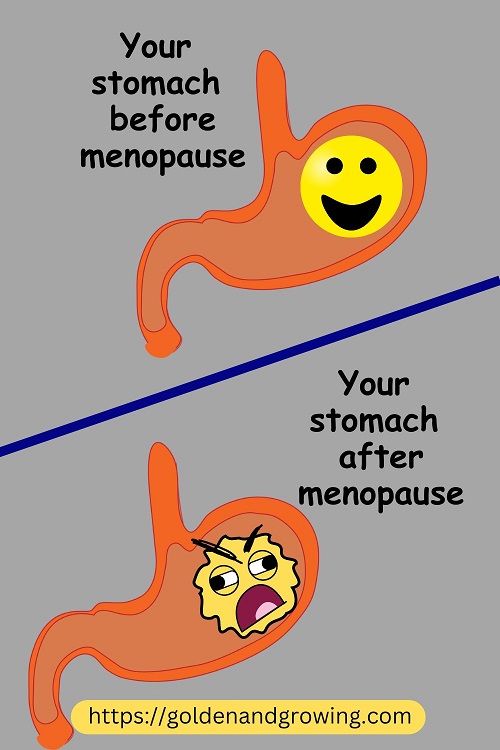
Postmenopausal women are at double risk of their stomach not producing enough acid for proper digestion. First, for most people, the farther you get past age fifty, the less acid your stomach produces. Second, the presence of estrogen facilitates stomach acid production, so after menopause, many women start to experience digestive troubles.
The issue is a catch-22 for us neurodivergent women over 50. Most of us have dealt with some level of digestive issues for most of our lives. It’s easy for us to think that, just like our sensory sensitivities and executive dysfunction, our digestive problems are simply getting worse with age. So we ignore them and do the best we can while feeling like a porcupine has taken up residence inside our gut.
Besides making you feel super full after eating only a few bites of food, besides causing painful bloating and an inconvenient amount of belching, besides causing either constipation or diarrhea, low stomach acid can cause all of the other digestion problems I listed earlier.
IT CAN CAUSE SOMETHING ELSE, TOO, SOMETHING YOU MAY HAVE BEEN DIAGNOSED WITH:
GERD.
Yep. If gastroesophageal reflux disease results from a stomach acid issue, it’s not due to excessive acid, but low levels of it.
When you address the symptom and not the cause…
There seems to be an inordinate amount of women online who want you to eat cardboard and grass in order to treat SIBO or FODMAP sensitivities (or the non-existent histamine intolerance). Seriously, go take a look if you haven’t dived into that world already. As soon as a woman (of any age) admits to having digestive discomfort, a bunch of other women jump in, telling her she needs to get tested for SIBO or go on a FODMAP diet.
Listen. If you cut a large artery and wrap it in gauze, the bleeding might slow temporarily. But after a few minutes, sticky red stuff will start dripping onto the floor.
Likewise, SIBO and FODMAP sensitivities are often symptoms of a greater problem – low stomach acid – rather than the root cause of the discomfort. And if you just treat the symptoms, you’re going to continue to have the problem.
I’m not saying nobody ever has SIBO or FODMAP sensitivities while their stomach is producing enough acid. I’m saying that there’s a good chance, especially if the sufferer is a woman over the age of fifty, that the root cause of these issues is low stomach acid.
The only exception is if the woman is on HRT. On the other hand, I’ve read that HRT can worsen digestive issues. You have to experiment and see how it works for you.
Menopause digestive problems: When to see a doctor
While low stomach acid often explains digestive issues during menopause, some symptoms require professional medical attention. Don’t delay seeking help if you experience any of the following:
- Unintentional weight loss of more than 10 pounds, especially if you’re not trying to lose weight. This can signal a more serious underlying condition that needs evaluation.
- Blood in your stool or black, tar-like stools. This may indicate bleeding somewhere in your digestive tract.
- Persistent vomiting or severe nausea that prevents you from keeping food or liquids down. This goes beyond mild gastroparesis and requires immediate attention.
- Severe abdominal pain that doesn’t resolve or keeps returning. While bloating and discomfort are common, intense pain is not normal.
- Difficulty swallowing or the sensation that food is stuck in your chest or throat. This could indicate esophageal issues that need treatment.
Also consult your healthcare provider if:
- Your digestive symptoms significantly interfere with your daily life, work, or relationships, even after trying home remedies like betaine HCl supplements.
- You’ve been dealing with chronic digestive issues for more than a few weeks without improvement.
- You’re experiencing new symptoms you’ve never had before, especially after age 50.
Remember, trying the baking soda test and betaine HCl supplements is a reasonable starting point for many women. However, if symptoms persist despite these measures, or if you experience any of the red-flag symptoms above, please advocate for yourself and get proper medical evaluation. Your quality of life matters, and you deserve answers.
My journey toward postmenopause digestive health so far.
The day that I did the baking soda test, I recalled having kept one of the bottle of Betaine HCl supplements. Fishing it out from where I’d stowed it, I opened it and took one capsule with the jar of smoothie I drank early that morning.
Even though the smoothie contained barely ten grams of protein.
For the first time in years, I had no gas or bloating during or after eating. And I felt like eating the next jar of smoothie an hour and a bit later.
I enjoyed eating it, felt like eating it.
So if you’re asking yourself, “How long does it take for betaine HCl to work?”, the answer is, within twenty to thirty minutes of beginning a meal.
Even better, I discovered after some experimentation that my colon did not have a problem with starches… as long as I took the acid supplement.
Even if I was consuming fewer than fifteen grams of protein.
Unfortunately, because estrogen also helps with gastrointestinal motility, food doesn’t move as quickly through my tract as it used to. Starchy foods move more slowly than before. I suppose meats would, too, if I ate meat. So I have to eat things like whole grains, beans, and potatoes in moderation.
I still will occasionally have several days in a row where I will experience bloating, gas, and early fullness. However, both the gravitational pull of the new and full moon and changes in weather can cause internal tissues to swell. Because I’m highly sensitive, I feel the slightest change, especially in my stomach. So it’s not all rainbows and roses.
But it’s much better than it used to be. I no longer despair that one day, I might die of starvation. And may I say how wonderful it is to wake up in the morning and actually feel like eating?
Besides low levels of estrogen, not consuming enough sodium or protein can lead to low stomach acid. For someone like me who consumes a 100% plant-based diet, not getting enough salt or protein can happen. I’ve increased both, but alas, as of this writing, I still need to take two to three betaine HCl capsules whenever I sit down to eat.
Which begs the question…
Which are the best betaine hydrochloric acid supplements?
I began with the Thorne Research brand way back when I first suspected low stomach acid. But it seemed to be hit-or-miss as to whether it worked (some Amazon reviewers claim it didn’t work at all for them).
That was fine, because I really didn’t want to take a product with animal parts in it.
So I tried the NOW brand, which is vegan.
The very first day I used it, I was up in the middle of the night with cramps so bad, I almost had my husband take me to the E.R.
Come to find out, the protease it contained came from some fungus that a lot of people are sensitive to.
Every single one of those capsules ended up in our compost pile.
Finally, I found Enzymedica Betaine HCl, also vegan, but with a different type of protease than the NOW brand. I think some batches are more potent than others, but it seems to be more consistent than the Thorne brand. (There are probably other good brands of BHCl; those happen to be the three that I’ve tried.)
All in all, my quality of life has skyrocketed, because I’m not having to spend most days trying to ignore pain and discomfort in my belly for hours on end. And because most days, I actually feel like eating when it’s time to eat.
Your mileage may vary. Low stomach acid may not be your problem at all. But if you’re a woman over the age of forty-five, can barely get down half a meal and then feel miserable afterward, trying the baking soda test might give you the answer you’ve been looking for.
And thus make your life a lot simpler, enabling you to find greater fulfillment.
I want us all to encourage each other on this journey. So if you have a story you’d like to share about overcoming your menopause digestive problems, by all means, do so in the comments! (Just, no armchair diagnosing someone else, okay? Thanks.)

*************************************************************************************************
Frequently Asked Questions About Betaine HCl Supplements
What is betaine hydrochloric acid (betaine HCl)?
Betaine HCl is a supplemental form of hydrochloric acid that helps your stomach digest food when it’s not producing enough of its own stomach acid. It comes in capsule form and is taken with meals to support proper digestion.
How do I know if I have low stomach acid?
You can do a simple at-home test: Immediately upon waking, stir one-fourth teaspoon of baking soda into four ounces of water and drink it. If you don’t burp within five minutes, there’s a very high chance your stomach acid is low. (If you haven’t burped after 30 minutes, that’s an even stronger indicator.)
How quickly does betaine HCl work?
Betaine HCl typically works within 20 to 30 minutes of beginning a meal. Many people notice reduced bloating, gas, and discomfort during or shortly after eating.
Do I need to eat a certain amount of protein with betaine HCl?
While some sources recommend taking betaine HCl only with meals containing at least 15 grams of protein, many people (including me) have found it works effectively even with less protein. You may need to experiment to see what works best for your body.
How many capsules should I take?
This varies by individual. Start with one capsule per meal and adjust as needed. Some people need two to three capsules per meal to experience relief from digestive symptoms. Pay attention to how your body responds and adjust accordingly.
Can low stomach acid cause other digestive problems?
Yes. Low stomach acid can contribute to or cause several other digestive issues, including:
- SIBO (small intestine bacterial overgrowth)
- FODMAP sensitivities
- Gastroparesis symptoms
- Bloating and excessive gas
- Constipation or diarrhea
- Feeling full after just a few bites
Why are postmenopausal women at higher risk for low stomach acid?
There are two main reasons:
- Stomach acid production naturally decreases with age, especially after 50
- Estrogen helps facilitate stomach acid production, so after menopause when estrogen levels drop, many women experience digestive troubles
Will HRT (hormone replacement therapy) solve the problem?
Not necessarily. While HRT may help some digestive issues, it can actually worsen others like GERD. Additionally, when you eventually stop HRT, many postmenopausal symptoms, including digestive ones, may return.
What else can contribute to low stomach acid?
Besides low estrogen levels, not consuming enough sodium or protein can lead to low stomach acid production. This is particularly relevant for those following plant-based diets.
When should I see a doctor instead of trying betaine HCl?
Seek medical attention if you experience:
- Unintentional weight loss of more than 10 pounds
- Blood in your stool or black, tar-like stools
- Persistent vomiting or severe nausea
- Severe abdominal pain that doesn’t resolve
- Difficulty swallowing or sensation of food being stuck
- Symptoms that significantly interfere with daily life
- Chronic digestive issues lasting more than a few weeks without improvement
- New symptoms you’ve never experienced before, especially after age 50
Should I try betaine HCl if I have heartburn or acid reflux?
This is counterintuitive, but low stomach acid can actually cause symptoms similar to high stomach acid, including heartburn. However, if you have diagnosed GERD or frequent acid reflux, consult your healthcare provider before trying betaine HCl supplements.
Will I need to take betaine HCl forever?
This depends on the underlying cause of your low stomach acid. Some people need ongoing supplementation, while others may be able to improve their natural acid production through dietary changes (increasing protein and sodium intake). I continue to need 2-3 capsules per meal despite dietary adjustments.
Can betaine HCl help with issues digesting starches?
Yes, adequate stomach acid is necessary for proper digestion of all foods, including starches. The author found that starchy foods no longer caused problems once betaine HCl supplementation began, though these foods may still move more slowly through the digestive tract due to reduced gastrointestinal motility after menopause.
**********************************************************************************************************
DISCLAIMER: I’m not a medical professional. This post reflects my personal experience and the research I’ve read. It’s not medical advice — please consult a qualified professional for personalized guidance.