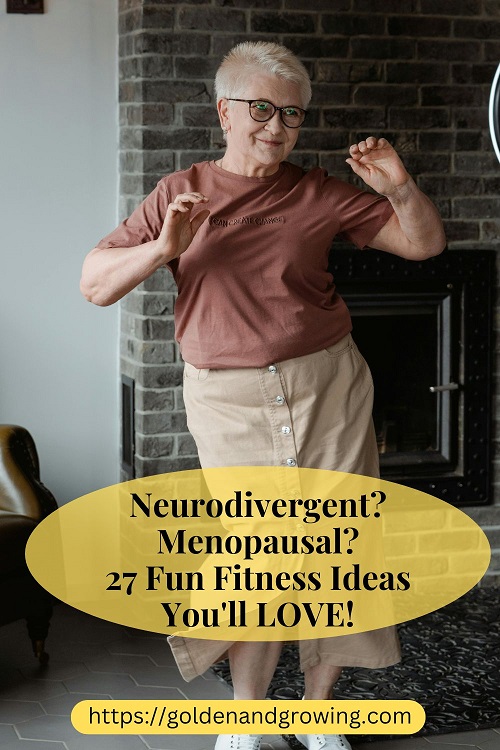
Discover 27 sensory-friendly, low-pressure movement activities perfect for neurodivergent women over 45. No gym required – just 10-15 minutes of joyful, purposeful exercise.
The story: Sensory-friendly workouts, where are you?
Ugh. It was drizzling. For the third day in a row. And if it was like the other two days, it would continue non-stop from morning until night.
I wouldn’t have minded it so much if it weren’t so chilly. Getting even a little wet when it’s 100% humidity and forty degrees is miserable.
But I was supposed to have done a fifteen-minute power walk yesterday, and didn’t because of the weather. Not that I enjoyed power-walking. But I needed to get my heart moving, right?
Another problem with this kind of weather is that it always makes me sleepy. The last thing I wanted to do was exercise. But exercise might give me more energy.
I stared out the window for a few moments longer. Then, I had an idea.
Ten minutes later I was inside the finished-out shed, headphones over my ears, mp3 player in my hand, lightly dancing to upbeat music.
Movement for autistic women and ADHD-friendly exercise, revisited.
Exercise for neurodivergent women over 45 should, above all, be fun. For us, it’s not sustainable if it’s not. It’s also best done in short bursts, for the sake of our touchy nervous systems.
But sometimes, our hyperfocus gets in the way of making room for healthy movement in our lives. Sometimes, demand avoidance tugs us away from the mere thought of exercise with the force of a freight train engine moving at full speed.
What we need then is a menu to choose from, a menu of movements that will feed not only our physiological needs, but our neurodivergent needs, as well. It should include dopamine-boosting movement, non-gym workouts, and proprioceptive activities to improve awareness of our own bodies.
What follows is such a menu. I begin with the basics that everybody knows. But hey, on a really poor executive function day, you barely know your name, let alone can think of a basic exercise. So I’m including them, as well.
Then I move onto a list of more creative options. You don’t have to follow them exactly. Instead, you can use them to come up with creative ways to incorporate movement into whatever you’re doing. You just want to engage in movement without pressure.
First, three rules.
There are three rules to follow when choosing a movement activity from the list.
- Keep it under fifteen minutes.
- Keep it low-impact.
- Check with a healthcare professional if you have any back pain, injuries, or known muscular-skeletal issues before starting any new kind of movement. (Don’t skip this important over 45 neurodiverse fitness tip!)
Ready? Here we go, twenty-seven 10-minute movement ideas for ADHD, sensory processing, and general midlife neurodivergent wellness.
Basic exercise.
- Lightweight strength training, either body training or free weights up to ten pounds.
- Walking.
- Low-impact dancing to your favorite music.
- Gentle stretching.
- Chair yoga.
- Swimming.
- Bicycling. The caveat with these last two is that as a woman over 45, you’re prone to osteoporosis. Neither swimming nor biking help to build bone mass, so make sure to incorporate impactful movements (walking, weight-lifting, etc.) as well.
Sensory-focused movements.
Rebounder mini-trampoline sessions. The movement on a rebounder is rhythmic and provides your brain with proprioceptive input. You can do it while watching T.V. or listening to a podcast.
Floor puzzle rolling. If you enjoy jigsaw puzzles, sit or lie on the floor while putting one together. Each time you pick up a piece, move in a different way – rolling, crabwalk, etc. – as you search for where the piece goes. Do the same each time you successfully click a piece into place.
Texture walking. Walk barefoot on different surfaces such as grass, gravel, carpet, and tile in a circuit.
Water play movement. Wash dishes with exaggerated reaching, hip movements, and leg movements. Do your outdoor plant watering with full-body involvement.
Balloon volleyball. This moves so slowly, you can play by yourself if you don’t have a partner. The activity necessitates slow-motion tracking, and is great for balance and coordination.
Pattern and rhythm-based movements.
Sort coins or beads while squatting or dancing in place. This combines fidget-friendly tasks with movement.
Mirror videos. With this one, you copy someone’s movements from a vlog or cooking show. You can make the movements bigger or smaller, or repeat them when the person you’re mirroring goes still. Don’t use exercise content for this one.
Conduct classical music. Put on some classical music and play “conductor.” Use big arm movements. Incorporate your legs as well, by occasionally stretching out or kicking one or the other as if attempting to conduct with it, too.
Slow-normal walk. Alternate thirty seconds of slow motion walking with thirty seconds of normal paced walking.
Low-pressure exploratory movements.
Take thrift store laps. Continually walk while browsing in your favorite thrift store. The activity adds the bonus of a dopamine kick from treasure-hunting.
Go on a photo safari walk. Take pictures of specific colors or textures to turn the walk into a hunt.
Have a geocaching micro-adventure. This combines navigation puzzles with movement.
Follow animals. If you have pets, wait until one is in an active phase. Then mimic their stretches and movements.
Rearrange things. If you’re physically able, move furniture around. Turn reorganizing a space into a light workout by adding in bends, stretches, and dance moves.
Stimming-compatible movement.
Do rocking chair intervals: Five vigorous rocks, spring up from the chair, sit back down, repeat.
Try stair sitting sequences. For example, sit down on the bottom step, then push yourself up two stairs, then down one. Repeat. This kind of movement is great if you enjoy patterns.
Do wall pushes in different rooms. This is an isometric activity. If you enjoy it, it can become a ritual you practice when you go from one room to another.
Perform upper body dancing. While seated, dance with your arms and upper body to upbeat music.
Exercise when you hate exercise: gentle, innovative, fun!
I hope these ideas have sparked an interest in getting out of your chair and giving your body the movement it craves. Try a few and tell us how it went. Or, share with us your own creative ideas to stay fit without getting bored or overwhelmed.
Happy moving. 🙂
