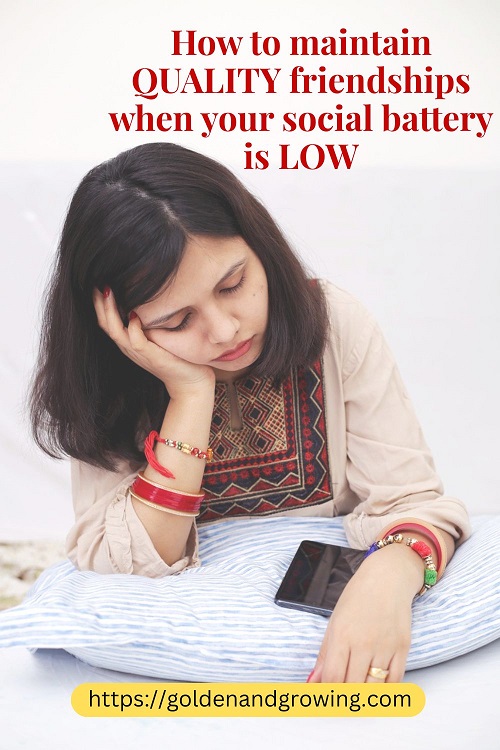
Quality over quantity in friendships is essential for both neurodivergent and menopausal women. Here are some ideas to help you gain and maintain the connections you crave.
The story.
“This was good, thank you.” My friend beamed at me as she complimented the simple meal I’d fixed for her in my home.
I returned the smile, then walked her to the front door. As I watched her get into her car, I released a contented sigh.
The lunch had been perfect. I didn’t talk much when we were with others, so it had been wonderful to chat, just the two of us.
I felt more connected to her than ever.
The myth of many friends.
To see it on social media or television, you’d think that everybody had a million real-life friends and that they’d all lose their purpose in life if they weren’t constantly hanging out together. It’s a slap in the face to both neurodivergent women, as well as women in midlife who have lost a lot of their energy and therefore don’t feel like socializing as much as they used to. Though some of us have managed to ignore the cultural messages around relationships, others of us have always carried a little bit of guilt for not being able to live up to the picture of social perfection that mainstream culture has painted.
If that’s you, or if you’ve hit that age when socializing feels more like chore than a joy, keep reading.
Because connection is less about quantity, and more about resonance.
The hidden cost of social clutter.
Even for neurotypical extroverts, too many surface-level relationships can drain a woman’s focus and joy. Life becomes more about making others happy and less about living your own authentic life.
And a lot of neurodivergent women are introverted like me. Not only do we have trouble with social cues, but being around more than one or two other people at a time is exhausting.
Even then, we can only be around that one or those two other people for a limited amount of minutes or hours before we have to return to our “introvert cave” in order to re-energize.
Whether you’re neurodivergent, menopausal, or both, it’s time to stop feeling guilty for not being the social butterfly you’ve been taught you should be.
Quality over quantity in friendships leads to deeper connection.
Crafting out an intentional social life is what leads to meaningful connections.
And it doesn’t have to mean conversation or sharing meals together.
It might mean a shared walk where both of you are mostly quiet.
Or working side by side in a soup kitchen.
It might mean sending an email once a week with a quote or meme that relates to your friendship.
Or watching your friend’s grandbaby in the kitchen while your friend bakes desserts for a church or school fundraiser.
In the fall of 2014, I broke my left arm to the extent that the bones required screws to be put back together. A friend from the suburb we’d recently moved away from sent me an email every three or so days for the first couple of weeks to ask me how I was doing.
That was it. And it was all I could handle during that time. But it was enough for me to know that she cared.
Small, intentional connections often carry more peace and meaning than frequent social activity. That’s good news for those of us for whom “frequent social activity” sounds like a prison sentence!
Quality over quantity in friendships: what does that mean, exactly?
Small social choices have as much power as large, noisy ones. When it comes to neurodivergence and relationships, they’re vital.
Whether you’re an autistic woman, a woman with ADHD, a woman over the age of forty-five, or a combination, there are several micro-decisions you can make to shape relational well-being. They include, but aren’t limited to:
- Saying no to a gathering which your gut tells you will deplete what little energy you have.
- Going to a gathering, but arriving as late as you dare and leaving early. (Should you do that, have an excuse ready in case anyone needs one.)
- Texting one thoughtful message to one friend, instead of “liking” the social media posts of twenty different friends.
- Choosing one friendship to nurture instead of several acquaintances to maintain.
- Setting boundaries on any extroverted friends around how often you want to engage. (Yeah, this is hard. But a true friend won’t ditch you for trying to take care of yourself.)
- Scheduling texts, emails, phone calls, coffee dates so you don’t forget.
- Showing you care in small ways: a birthday card, an offer to bring over soup when they’re sick, etc.
Making shifts to have a small but intentional social life conserves your energy and creates room for genuine warmth in your relationships.
The happy result of pursuing quality over quantity in friendships.
Basically, I’ve just instructed you how to declutter your social calendar. When you do so, you end up with more time for self-reflection, creativity, stillness, and better listening.
You also end with richer relationships. Though they may be fewer, your attention and care is no longer scattered among a bunch of people that you don’t feel a strong connection to.
And a bonus: you might start to recognize the sound of your own thoughts again!
Meaningful connection = quiet abundance.
For many women past their mid-forties, and those with neurodivergent brains, abundance in their social life comes from genuine connection rather than a large company. This abundance include peace that comes from aligning your social world with your energy levels and values, rather than those of others.
It also includes a simpler life, the kind of life we of waning social batteries need in order to keep our equilibrium.
If you’ve worked on creating an intentional social life, or have further wisdom to share on quality over quantity in friendships, we’d love to hear from you in the comments!
