A neurodivergent marriage doesn’t always feel like a match made in heaven. Here are six things my husband and I have done to overcome relationship challenges.
The story.
I wanted to die.
No, I just wish I’d never been born.
No, that wasn’t true, either. I wanted out of my marriage. This had been a big mistake, and I knew it.
On top of it, I had to go and agree to have a baby. Big Mistake Number Two.
No, no. It was all my fault. I should have never…
The negative mental downward spiral continued as I fumed. Back and forth went my rocking chair, faster and faster. Volatile, hateful words tapped against the top of my tongue, begging to be released toward my husband. He sat placidly at the kitchen table, watching a video on his computer, clueless about the volcano erupting inside me.
I bit back the words. Swallowed them. I tasted their bitterness all the way down to my gut, where they congealed and sat like a lump of clay.
Finally, I leaped up, grabbed my sunglasses, and stomped out the door.
Three hours later, my mind was once again calm. And once again, I was happy I’d managed to keep my mouth shut during the episode.
What on this green and blue planet was that, anyway??!
It’s worse when you don’t know.
The above scenario has repeated multiple times in various iterations since our son was very young. Most of that time, I had no idea that I’d unwittingly entered into a neurodivergent marriage, that both of us were autistic (I have a minor in ADHD, as well).
I knew nothing about autistic meltdown, shutdowns, or burnouts. Or that my highly sensitive nervous system made me feel emotions ten times more intensely than most of the rest of the world.
Being perimenopausal for most of those years didn’t help, either.
Not knowing that I and my husband were both neurodivergent, and how that affects relationships, made me more anxious and depressed than I’d ever been.
On top of the usual difficulties between any man and woman trying to make a go of marriage, every autistic person is unique in how they think. This can make misunderstandings more profound than those between a neurotypical couple, especially when one or both has times when they struggle for the right words to come out of their mouths.
If any words can come out at all.
Then there are the variable sensory sensitivities, special interests, and love languages.
All marriages require work in order to last. But when two neurodivergent people get married? It can feel like trying to jackhammer through three feet of granite in order to survive, let alone thrive.
As I write this post, my husband and I have somehow made it to twenty years so far. I have a good idea as to what that “somehow” means, and want to share them with you. After all, my primary goal is to help neurodivergent women to live more simply and find greater fulfillment.
Unhappy relationships, separation, and divorce make life more complicated. And rather than helping you find fulfillment, they make you feel torn into a thousand pieces.
Thriving neurodivergent marriage tip #1: Communicate with kindness.
As you see in my introductory story, communication can be a double-edged sword. What I’ve wanted to communicate to my husband during those times of high emotion would have ended up hurting him and damaging our relationship.
Communication must be done with kindness. That includes respecting your spouse’s needs when it comes to communication.
For example, my impulses can get the better of me if I’m not careful. I need to make sure I’m calm and have given thought to the healthy way to express my needs, concerns, and frustrations.
On the other hand, my husband struggles to express his emotions. One of his autistic traits is that he often can’t name what he’s feeling. He also automatically mentally withdraws from anything that feels like conflict, rendering him even more mute.
If I approach him with what I perceive to be a problem, I have to give him hours, if not days, to think through to an answer.
Women in general – especially we menopausal women – tend to believe there’s a problem in a relationship when our partner thinks everything is perfectly fine. So another big part of kind communication is to plan our words carefully so that our “other halfs” don’t feel like we’re attacking them.
The next one is closely related to communication, but bears its own discussion.
Thriving neurodivergent marriage tip #2: Don’t make assumptions.
I know, I know – neurotypical people make wrong assumptions, too. But the reason I emphasize it for neurodivergent couples is due to autistic rigid thinking.
At some point in the past, we experienced something or heard or read something that convinced us that if X happens, Y must be true.
Once an autistic person makes that sort of connection in her head, it takes wrecking-ball force to get it out.
Thus, without meaning to, we make wrong assumptions about our spouse’s behavior. They didn’t answer me because they’re angry. They didn’t take the trash out to get back at me for nagging them yesterday. I can’t say ABC because five years ago when I made a similar remark, they blew up at me.
If you want to thrive as a neurodivergent couple, listen to me carefully.
Do not.
Make.
Assumptions.
Assumptions are the stuff that misunderstandings are made of, and misunderstandings are the stuff that hurt feelings and divorce are made of.
Communicate gently. Ask questions to find out how your spouse is really feeling, or what they really think about what’s on your mind.
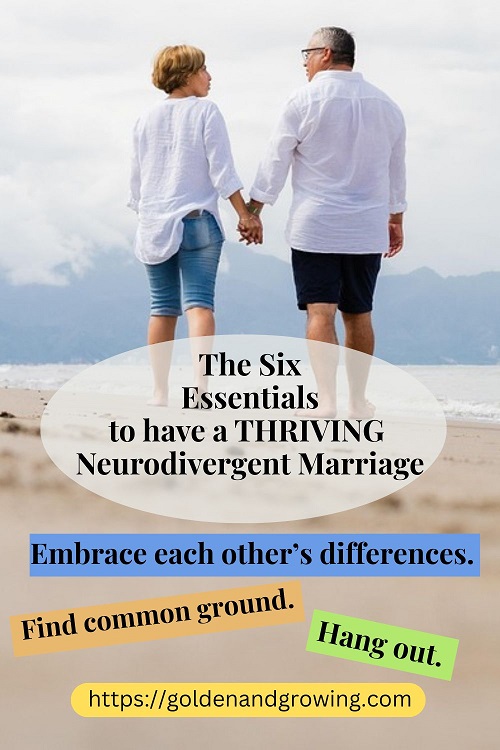
Thriving neurodivergent marriage tip #3: Hang out together, but take breathers.
Since even Level One autistic people often have some sort of difficulty with verbal communication, hanging out together without pressure to talk is important. Especially when both spouses are neurodivergent.
If one or both of you works out of the house, find time you can be together before and after hours. It might be:
- Quiet meals together.
- Watching a movie.
- Parallel activities; i.e., each of you engages in a different activity, but you do it in proximity to each other.
- Quiet walks together.
On the flip side, most autistic people are also introverts. We need time and space to ourselves. Married neurodivergent couples need to decide how to handle this. Do you want to set up specific periods of time during the day when you both spend time alone? Or do you want to play it by ear, just tell each other when either one needs some “introvert time”?
Whichever you decide, do agree on time to yourselves. The last thing you want is to cause each other burnout because you’re not getting enough rejuvenation time.
Thriving neurodivergent marriage tip #4: Show affection early and often.
Autistic people may be sensitive to touch. While I enjoy big hugs and kisses and broad strokes to my back, smaller touches annoy me.
So you and your spouse need to define “show affection” for yourselves. It may be brief hand-holding throughout the day, or a peck on the cheek when you’re coming or going, or a nice, long hug a few times per day.
Whatever you decide, this is important, especially if one or both spouses is highly sensitive. Acknowledging our love and affection for each other in small ways prevents me and my husband (a-hem, mostly me) from feeling isolated.
Neurodivergent people already feel like outsiders looking in with the rest of the world; we don’t want to feel like that with our loved ones. We crave connection to someone who gets us on a deep level.
Thriving neurodivergent marriage tip #5: Find common ground and connect there at least occasionally.
As neurodivergent people, our special interests (even if an ADHD “flavor of the month”) mean more to us than we can explain. They are both our way of showing up in the world, and escaping from it. Our skills and talents around a particular hobby, area of study, or career bring us a sense of self-confidence and purpose that often drains away the instant we find ourselves in a social situation.
My husband and I both enjoy reading, writing fiction, and watching romance movies. I’ve helped him edit his novels; he’s helped me edit mine. We like to make fun of the unrealistic aspects and character behaviors in the movies we watch… and talk about the screenwriters who did an awesome job with a story.
If you and your spouse have the same special interests, so much the easier it will be for you to feel connected. If not, find something that you both enjoy and talk about it, even if it’s only once a month.
Thriving neurodivergent marriage tip #6: Embrace each other’s needs and quirks.
This should go without saying. However, just as many neurodivergent spouses as neurotypical ones get married, knowing full well the other person’s quirks and personality.Then, a few months or a few years down the line, these quirks become annoying rather than endearing.
For neurotypical people, the quirks might be – might be – bad habits they can train themselves out of.
But in the case of autistic people, their quirks are usually traits that result from the way their brains are wired. They might learn to mask them, as autistic children are forced to do in special ed. classes, but masking adds even more stress than we’re already carrying, increasing our risk of developing anxiety and depression further.
Neurodivergent couples need to not just accept, not just tolerate each other’s unique expressions and behavior, but embrace them. This includes the way the other spouse talks, the way they give eye contact (or don’t), the way they stim, they way they organize their personal space.
When something my husband does irks me, I make myself remember all the odd things I say and do.
And realize that I’m the half of our couple that has it easy. 😉
A thriving neurodivergent marriage: You can do it!
There are other aspects of marriage that apply to both neurotypical and neurodivergent couples. But I believe the six that I’ve touched on represent the most important tips for neurodivergent married couples.
Feel free to add what’s working for you and your spouse in the comments!

2 thoughts on “My Six Best Tips for a Thriving Neurodivergent Marriage”
Comments are closed.