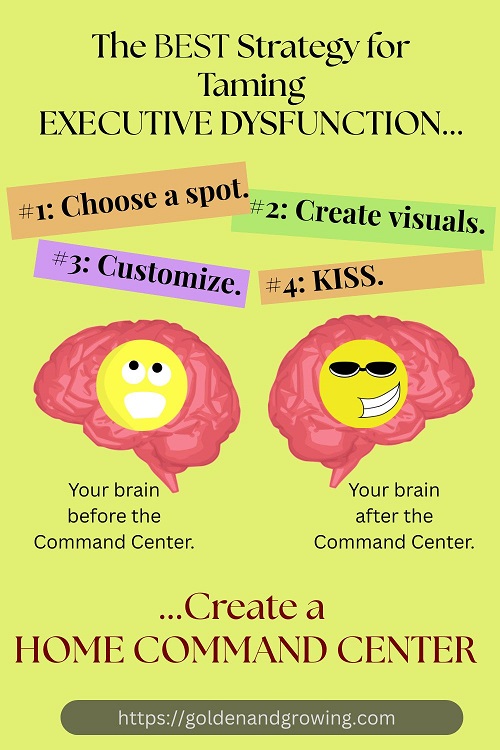
The best strategy for taming executive dysfunction is within easy reach. If you’ve been struggling with how to improve your executive function, read on.
“Your lucky suit? You never told me to pick up your lucky suit!” Kate glared at her husband, Dan, who had a critical business dinner in an hour. “I would have written it down on a sticky note!”
Dan rolled his eyes, sighed, and walked past the kitchen counter, coffee table in the living room, and side table in the hallway… all of which were dotted with at least a half dozen sticky notes.
Forty-five minutes later, head hanging in despondency, he left in the suit he reserved for weddings and funerals. An hour after that, a blur of pink caught Kate’s eye from under the recliner. She leaned over and grabbed at it.
A sticky note.
“Pick up John’s suit today before 5,” it read.
Kate groaned, closed her eyes, and slapped her forehead with her palm.
**********
If you can relate even in the slightest, you experience executive dysfunction at least occasionally. If you’re peri- or post-menopausal or have a neurodivergent brain, you probably experience it frequently. Those of us dealing with both? Juggling all of our responsibilities – work, caregiving, home maintenance, medical routines – feels like running a marathon with no map, guideposts, or cheering teenagers on the sidelines offering bottles of water.
We try. Like Kate, we write everything out on sticky notes. We set reminders on our phones. We train our dog to bark out a series of sounds eerily resembling, “Check your calendar” every day at 7:30 sharp.
Still, some days – too many days – we’re happy if we remember to get out of bed.
What we need is a better strategy. I’ve found that the best strategy for executive dysfunction offers a visual, centralized structure. That kind of tool offloads working memory and helps my brain to track my priorities.
Even on foggy days.
Enter the Home Command Center.
How the Command Center becomes the best strategy for executive dysfunction.
Besides working memory, the executive function part of the brain helps with planning, organization, transitions, and emotional regulation. This part of the brain is underdeveloped in those with ADHD and autism, and frequently compromised in women over the age of forty due to dropping estrogen levels. This makes the above-listed tasks feel insurmountable. Your thoughts scatter into dark corners, like a family of cockroaches when someone turns on the light.
Ever been able to find a cockroach after it’s scampered away?
Uh-huh. That’s what I thought. That’s why you need a command center. It puts reminders, schedules, and important tasks in your face.
Kind of like a fortress that holds all of your task-related thoughts captive.
A Home Command Center, with its easy visual access, supports brain clarity. That’s it. The way it works reduces cognitive friction. Instead of your brain constantly asking, “Did I forget something?”, it finds the answer at the command center.
The steps in building your Command Center.
The steps for setting up a Home Command Center are as few as the concept is simple. They are:
- Choose a dedicated space.
- Set up a calendar and checklists.
- Customize and adapt.
- Keep it simple.
- Review it monthly.
Let’s look at each step in detail.
#1: Choose a dedicated space.
When you take this step, remember that visibility is everything. Pick one spot that’s part of your daily routine: by the front door, near the kitchen, or at your desk. That way, you’re likely to pass it often—interacting with it incidentally, not forcing attention. It’s reliability through placement.
Kind of like how a cat always manages to sit on the one thing you need.
#2: Setting up the visuals in this best strategy for executive dysfunction.
Think of each element as a cognitive offload:
- Central calendar: mark appointments, deadlines, and reminders within one quick view.
- Top-three daily checklist: reinforce focus with three daily priorities; others remain optional.
- Key tray / docking zone: designate a surface for keys, wallet, glasses, medications—consistent placement reduces lost-and-found cycles. This is optional, as it’s best to have the key tray on the spot where you habitually set your keys and purse when you come home. That won’t necessarily be near the Command Center.
- Charging station: for your phone and devices so alerts stay visible and accessible.
- Visual trigger zones: sticky notes, magnets, or cue cards that remind you of repeating habits (e.g. “Med time,” “Hydrate,” “Walk”).
These pieces become anchor points—support tools for working memory rather than internal strain.
Customize for sensory and neurodivergent needs.
When creating your Home Command Center, take stock of what you know about your sensory needs. You want to avoid overwhelming your senses while maximizing usefulness. Here are a few ideas:
- Use muted sticky-note colors or icons rather than neon sheets.
- Include tactile reminder objects—a paperclip, a small fidget toy—that signal transitions or task prompts.
- Keep high-contrast pens for important blocks; leave jewelry or visual clutter off the board.
- If your space is noisy, locate the center where visual access is clear but auditory distraction minimal.
These tweaks align with executive function tools for autism and ADHD by respecting sensory thresholds while offering support.
Build habit with body doubling.
This step is optional. However, pairing with another person—even virtually—while using the command center helps with initiation and follow-through. Having a buddy anchors intention and reduces avoidance. It doesn’t require much conversation, mostly just simultaneous action. This body doubling technique increases accountability on foggy or low-energy days.
For executive function-challenged days, you can say: “I’m going to check my command center for 10 minutes—care to join?” and let presence do the rest.
But if you’re like me and have a serious demand avoidance toward accountability partners because they inevitably end up feeling like that sixth-grade teacher who hovered over you in disapproval when you were doodling in math class… well, skip this idea.
Adapt the Command Center for kitchen, entryway, or shared spaces.
My Home Command Center is on my desk. But you don’t have to limit it to being at your official home office space.
Especially if you don’t have one. That would be skis-through-a-revolving-door hard, dontcha think?
Many neurodivergent homes benefit from a visual organizer in the kitchen. It might consist of a dry-erase board on the fridge or just the refrigerator door itself with shopping lists, meal plans, and sticky reminders. You may have an entry nook with hooks, keys, mail folder, and evening checklist. The point is to centralize transitions, the places where your tasks and energy shifts intersect.
Think of it like an air traffic control tower—except instead of planes, you’re coordinating snacks, lost keys, incoming bills, and the existential dread of making dinner again.
Maintain simplicity: the key to making the best strategy for executive dysfunction work.
When executive function systems are too complex, they collapse. Use this rule as your guide: include just what’s helpful.
Use minimalist accountability tools over flashy planners. If a section gets dusty or outdated, refresh by removing it. Reuse daily templates, like that top-three list, in a wipe-able format or reusable notepad.
Software or apps can supplement, but tangible visibility often works better than buried digital reminders for neurodivergent minds.
Review and refine monthly.
Executive function needs evolve. So should executive function systems. Schedule a monthly check-in: What’s still working? What feels ignored or stale? Remove parts that you ignore regularly; add a new prompt if things feel missing.
This approach treats your command center as living infrastructure, not static judgment. It listens to patterns and flexes as needed.
Common pitfalls of the Home Command Center.
The best strategy for executive dysfunction won’t work if you fall into any of the following pitfalls.
- Overfilled boards: If every empty wall is cluttered, you lose visibility. Keep visuals tight and consistent.
- Out of sight, out of mind: Everything included must be visible within daily path—not tucked behind cabinet doors.
- No recharge zone: If your command center seems like another to-do trap, integrate small reward cues. A comfortable chair nearby, water, or a soft timer chime will do nicely.
- Single-use sign-up: If you fall off using it, restart: remove one element, reuse daily prompts, reset assumptions. A command center isn’t failure if abandoned temporarily. It’s design just needs adjustment.
Why this approach matters.
I thought I had it pretty together in my life. And I did.
Until I hit my late forties. Then, my working memory packed up, flipped me the birdie, and disappeared into the great unknown.
Probably the same place where missing socks end up when you do a load of laundry.
The frustrating fact of the matter is that executive function challenges among ADHD and autistic women often intensify midlife due to the hormonal shifts. Strategies built for neurotypical brains often fail. But a functional command center bridges intention with execution. Not by forcing discipline, but by offering structure you can see, feel, and interact with. It reclaims agency.
My DIY Command Center consists of a page from a large photo album which acts as a small dry erase board, as well as a sheet proclaiming “Em’s Daily Schedule.” They are both easily visible, and contain a list of things I need to remember every day, as well as space to jot down tasks for that particular day.
It’s reduced my anxiety considerably. Made me feel like I can do this crazy thing called the postmenopausal, neurodivergent life. Probably has saved my marriage.
No, seriously.
You may want to check out this pre-made Home Command Center. Put it into action, and stop struggling with how to improve your executive function.
Because let’s be honest—if sticky notes on the microwave were a working system, I’d already be President.
Final thoughts on the best strategy for executive dysfunction.
An executive function command center at home isn’t a magical fix, but a supportive environment upgrade: external systems crafted to offload, remind, and cue. When designed for visibility, simplicity, and tactile presence, it turns mental clutter into manageable flow. Over time, that provides clarity—and relief.
You don’t need elaborate planners or a huge color-coded calendar. Just a space that meets your brain where it is and allows it to work less hard to find what matters.

1 thought on “The BEST Strategy for Taming Executive Dysfunction”