A simple diet helps to simplify your life, thereby reduce your stress. Here are my best tips on figuring out a simple and healthy diet for yourself that is also tasty and satisfying.
The story.
The dim twilight outside the patio door slowly brightened as I put the last pieces of carrot into the juicer. With all of my strength, I pushed down on the plastic pusher-thingy, trying and failing to ignore the obnoxious grinding sound the juicer made as it pulverized the carrot and spat out orange liquid from its spout.
Irritation clawed inside my chest. I was going to be later to my job than I wanted. And I still had to clean the stupid appliance, a tedious, ten-minute job that would have me clenching my fists with anxiety by the time I was finished. Sipping on the juice while I scrubbed off the one hundred moving parts helped to get me out the door sooner, but not that much sooner. And what I really wanted – needed – to be doing this early in the morning, before going off to my teaching job, was enjoying breakfast while reading a book.
As the last of the carrot juice spattered into the jar below the juicer’s spout, I made a decision.
I was done juicing. I didn’t care what health benefits I was giving up. The stress of going through the process every morning had to be more detrimental to my health than drinking the juice was helpful to it.
I didn’t know it at the time, but the decision was a healthy step in taking care of myself.
Why a simple and healthy diet matters.
Face it, ladies: ain’t nobody got time for that kind of mess like I just described. We’re busy. We have jobs. We take care of children and husbands. We take care of aging parents. We take care of the house.
If you have a neurodivergent brain, it doesn’t matter whether you have a job or people to care for. Every small complication you add to your eating lifestyle makes life more difficult due to your executive dysfunction.
Regardless of your “brain type,” the simpler you can make your eating lifestyle, the simpler your overall life will become.
And the simpler life is, the less stress you have, and the easier it is to work on your priorities. So, let’s get on with the seven steps to a simple and healthy diet that you can enjoy.
Step #1 in finding a simple and healthy diet: forego all fad diets.
Autistic women tend to go to extremes when it comes to eating. If they’re like me, it has a lot to do with trying to avoid digestive discomfort. If they’re also like me, they’ve developed eating disorders and/or jumped on a variety of eating lifestyle bandwagons (people with ADHD have the latter tendency as well, though possibly for different reasons).
Most of these diets are ultimately unhealthy. Or, if you can make them healthy (like Raw Food Veganism), it takes a lot of work.
No one will ever convince me that FullyRawKristina eats simply. I’m guessing her diet causes her a lot more stress than she’s willing to admit, and that she has zero hobbies because she spends most of the day in food prep.
This is a good place for me to vent a particular pet peeve.
When you see a squirrel running along a fence or up a tree, or a rabbit munching in your neighbor’s yard, do you begin to salivate? Do you rush outside your door, stomach growling, and chase after the prey on swift legs? When you get close to it, do you pounce on it, rip into it with your sharp claws, then open your mouth and bite into its neck to kill it? Then do you proceed, with your powerful jaws and knife-like teeth, to crunch down into the fur and flesh, chomping the bones as you consume the animal, relishing the blood dripping down your chin?
You don’t?
Then, don’t ever call yourself a carnivore. You have neither the instincts nor anatomy to be one.
Veganism is a philosophy, not a fad. And a primarily whole foods, plant-based diet is what we are primarily designed to eat. Do your own research and study what the vast majority of nutrition experts and researchers say.
Those clarifications made, there are a lot of fad diets based in both vegetarian and non-vegetarian type diets, and they’re usually not healthy long-term.
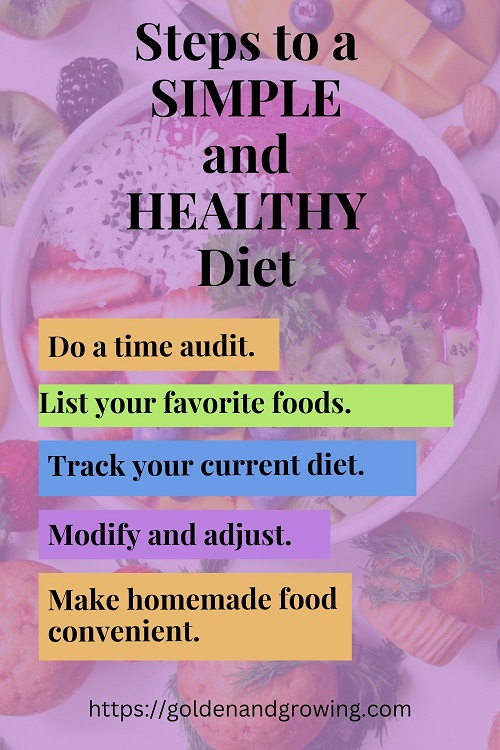
Step #2: Do a time audit.
Figure out how much time you want to spend on food prep for each meal (HINT: zero minutes is not an option, lol) and how much time you actually have. The less time you have and/or want to spend on meal prep, the simpler your choices need to be.
Please don’t skip this step. It’s important for your simple, healthy eating for self-care journey.
Step #3: Make a list of your favorite foods.
Include comfort foods, however unhealthy they might be. If you’re neurodivergent, include your “safe” foods.
Study the list. Are you willing to relegate the unhealthy items to a once- or twice-a-week treat? Or is there a healthier option you can live with (for example, unsugared dates instead of candy, or Nice Cream instead of dairy ice cream)?
Step #4 in working toward a simple and healthy diet: Make a list of what you eat over a three-day period.
This is your baseline, as well as a reality check. Which foods or meals on your list are healthy and easy to prepare? Which take longer to prep than you prefer? Do you eat fast food on a regular basis?
Most of us don’t force-feed ourselves foods that we don’t like. Are there certain healthy foods you usually ignore because you can’t figure out how to prepare them in a way that appeals to you? Do a search online and see if you can get inspiration on new ways to try them.
Step #5: Modify and adjust.
To get to a simple and healthy diet that also tastes delicious, you’re going to have to do some thinking and experimenting. Look at the results in step four and write down alternatives to fast food or other convenient meals (frozen dinners, high-fat deli meat, etc.). Replace some of the highly processed foods, such as chips, white bread, or sugary snacks, with fruit and vegetables. Research healthy alternatives to your favorite unhealthy indulgences.
Remember: your goal is to reduce stress with your diet!

Step #6 for a simple and healthy diet: Make home-cooked food convenient.
Most people who stop at fast food restaurants or pick up meals at the local deli don’t feel they have time to cook or prepare large, gourmet salads.
Following is a list of ways to save time on cooking or meal prep that will rival the convenience of fast foods.
- Use a slow cooker for one-pot meals.
- Buy pre-cut veggies and fruit.
- Use frozen veggies. They are almost always fresher and therefore more nutritious than the “fresh” vegetables in the produce aisle.
- Experiment with simple meals, such as quinoa and beans mixed with romaine lettuce; almond butter lettuce wraps dipped into salsa; smoothies; fruit and pre-soaked nuts; salmon baked with potatoes and asparagus; gluten-free pasta topped with low-fat cheese, pasta sauce, and thawed-out frozen broccoli; stir-fries.
- Batch cook ahead of time. Not every food (such as grains or potatoes) have as nice a flavor or texture when frozen and thawed out. However, you may be able to batch cook certain foods that you can then divide and freeze in small containers, then add to meals over the next week or two as you want them. If you love to bake and have a large enough freezer, once- or twice-a-month baking can save a lot of time.
Step #7: Plan, plan, plan plan plan!
If you fail to plan (everybody say it with me), you plan to fail.
Create a two-week rotation menu. Write grocery lists the evening before you’re going to go shopping. Have extras of all the non-perishables on hand in case of power outages.
Eventually, eating simply will become a habit and planning will take only a few minutes a week. In the meantime, discipline yourself to stick to a meal plan and grocery list. Otherwise, this process will make your life more complicated, not less!
Simple and healthy diet meal examples.
DAY 1
Breakfast: Smoothie with bananas, frozen strawberries and blueberries, and low-fat Greek yogurt.
Lunch: Almond butter-romaine lettuce “wraps” dipped in salsa; apple for dessert.
Dinner: Canned beans over white rice topped with olive oil, salt, and chili powder; thawed out frozen cauliflower-broccoli-carrot mix on the side.
DAY 2
Breakfast: Pre-cut melon and pineapple followed by toast with nut butter.
Lunch: Veggie sticks with ketchup-mustard dip; homemade low-sugar and lowish-oil blueberry muffin.
Dinner: Small chicken breast with heaping side of steamed red potatoes and green beans. Dates for dessert.
DAY 3
Breakfast: Whole grain pre-made pancakes topped with sliced banana.
Lunch: Spring green mix topped with avocado, frozen corn, chopped pecans, and healthy dressing. Fruit for dessert (or appetizer).
Dinner: Lentil stew that you started in the slow cooker that morning (and assembled the ingredients for the evening before), a couple of dinner rolls.
Life made SIMPLER with a simple and healthy diet!
Yes, indulge in your favorite treat once in a while. And if you have sensory sensitivities, always plan to have your “safe” foods available, just in case. This journey is supposed to be flexible and fun, not rigid and unrewarding.
Work on your new eating lifestyle one meal, one grocery list, one day at a time. Within sixty days you’ll be wondering at all the extra time you have – and you won’t feel one bit deprived!
Your life will also feel all the more simple.

1 thought on “Seven Steps to a Simple and Healthy Diet You Will Enjoy!”