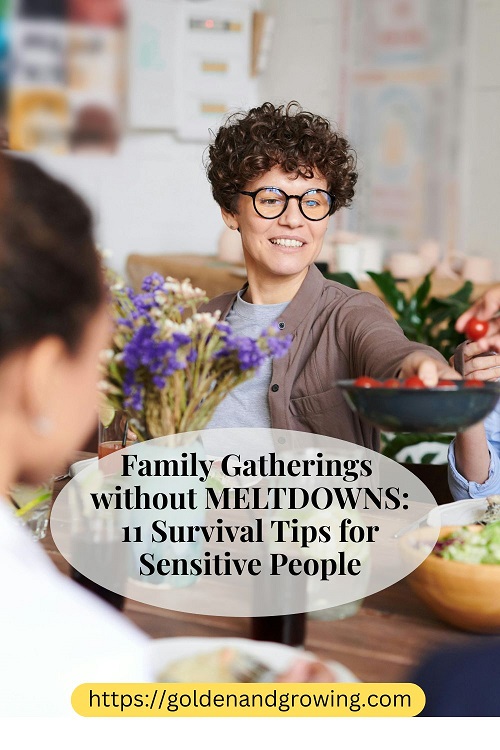
Surviving large family events is a delicate dance for neurodivergent adults and children alike. Following are 11 sensory overwhelm tips to help make holiday gatherings easier.
The story.
Closing the front door of my brother-in-law’s house behind me, I was a picture of calm. But what I really wanted to do was go running down the street, screaming my head off.
I felt like I was about to explode.
Letting out a heavy breath, I began walking toward where my husband had parked the car. So many conversations going on at once, so much conflicting energy.
Too much.
If I could find a valid excuse not to attend Thanksgiving dinner with my husband’s family without hurting anyone’s feelings, I’d do it in a heartbeat.
I slowed my steps. If I took my own sweet time in retrieving my sweater, maybe I’d be recovered by the time I returned to the house.
I scoffed at myself. As if. Would anyone notice if I took a long walk?
Yes. Our son, in his early teens, would. And what a terrible mother I would be, leaving him to the wolves.
I sighed again, grabbed the sweater from my car, and reluctantly headed back into the chaos.
“Do I have to?”
In his early teens, my brother stopped attending the large family gatherings that happened once or twice a year. I always volunteered to wash dishes at those events, because I knew in the kitchen there would be few people and a lot less noise.
Large social gatherings are hard for those of us with sensory sensitivities, especially with people we don’t know that well. Many “Level 2” autistics avoid them altogether. Many others, along with most of us at “Level 1,” go to family gatherings either out of a sense of guilt or duty, or because we want to reconnect with family members we haven’t seen for a while.
When we do, we need to be prepared, to have some tools in our neurodivergent tool belt, so to speak. Following are eleven sensory overwhelm tips for surviving large family events.
Sensory overwhelm tip #1: Consider the family dynamics.
Friends are the people you get to choose to hang out with. Family are the people you’re forced to hang out with.
Not all family members get along with each other.
So before you even get in the car to drive to a family gathering, think about the people who might be there with whom you regularly (or always) clash. Or with whom you have a tenuous truce at such events.
If you want to avoid them as much as possible, plan on seeking out other attendees whose company you enjoy. Otherwise, think of two or three neutral conversation topics you know you can bring up with your least favorite relative.
Sensory overwhelm tip #2: Take your meds, medical or otherwise.
If you’re on a prescription for ADHD or anything to help you with emotional regulation, make a point to remember to take your medication the night before or the morning of.
If you use natural remedies such as St. John’s Wort or essential oils, take or use them at a time when their benefits would kick in around your arrival to the family gathering.
Sensory overwhelm tip #3: Meditate beforehand.
For us neurodivergent people, surviving large family events takes extra effort. So even if you don’t usually meditate, do so as soon as you can before your arrival. Even five minutes can make a difference, if only for the first hour of the gathering.
Sensory overwhelm tip #4: Bring along food and drink.
If you even slightly suspect that you’ll have issues with much of the food your host will be serving, bring a dish to pass consisting of something you know you’ll enjoy.
As far as drinks, just tote enough for yourself.
Sensory overwhelm tip #5: Bring your favorite small fidget items.
If doodling helps you stay calm and focused, bring along a pen and small notepad. Or a small fidget toy. Or a ball to squeeze. Something that can help you stim in a way that doesn’t distract other people.
Sensory overwhelm tip #6: Scout out a way of escape.
If you end up in a large house with multiple bathrooms available to the guests, perfect! Otherwise, look around. Will the backyard be relatively clear of people? Is everyone mostly in the kitchen and living room, leaving the dining room empty until eating time?
Figure out someplace you can go if you start to feel overwhelmed. Having these brain overload signal cards handy can help you determine if you’re close to the edge.
Sensory overwhelm tip #7: Keep conversation intimate.
Instead of trying to mingle with large circles of people, coax one or two “safe” family members to a quiet corner where you can catch up. As you rotate through, perhaps you can feel out another family member who would prefer quiet conversation at the meal, rather than having to engage with all of the people seated around them.
Sensory overwhelm tip #8: Find a furry friend.
If the host has a friendly cat or dog walking around, stroke it and talk to it as much as you can get away with. It will help keep your nervous system regulated.
Sensory overwhelm tip #9: Ask your spouse or grown child to help.
Pre-arrange a signal or code phrase to send to an immediate family member that indicates you’re nearing overwhelm. Decide ahead of time that the other family will intervene, suggesting that they’d like to go for a walk with you – or talk to you in private, if the weather isn’t conducive to going outside.
They should also check to make sure you’re not hungry or in need of a drink of water. Both low blood sugar and thirst can exacerbate sensory overwhelm.
Sensory overwhelm tip #10: Mitigate sensory overwhelm.
- If you can tolerate earplugs, take along a pair that blocks out environmental noise but still allows you to hear conversation with a friend. These Loop earplugs do nicely for that.
- Avoid facing sunny windows.
- If strong smells from the kitchen might bother you, stay away from the kitchen.
- If the T.V. is on, ask if the volume could be turned down. Or if the thing could be turned off altogether. If the family event has nothing to do with watching a game or movie together, there’s no reason other than boredom for it to be on. The bored people in question can mess around on their phones instead of interfering with everyone else’s attempts to be social.
Not that I’ve ever experienced something like that or have an opinion about it. We wouldn’t want that to happen.
Moving on…
Sensory overwhelm tip #11: Arrive late, leave early.
Of the three people living in my household, zero of us care for family gatherings (or gatherings of any kind) larger than ten people – including us. After our last Thanksgiving fiasco with my husband’s family, my husband and I talked it over and decided we would no longer show up early out of guilt for not visiting more often. Moving forward, we would show up just before the scheduled mealtime.
Arriving as late as you can get away with, then leaving before you feel a meltdown or shutdown coming on, is a prime way of surviving large family events for neurodivergent adults.
Take care of yourself.
Since you’re neurodivergent, chances are high that someone else at any family gathering will be neurodivergent, as well. And hopefully stand in solidarity with you.
But there will always be family members who refuse to understand your needs. Who will judge you for your stimming or leaving early or odd way of talking or whatever.
Forgive them, then avoid them as much as possible.
And be thankful you only have to see them once a year.
Family dynamics can sometimes be a roller coaster ride. I hope the above sensory overwhelm tips will help you through future family get-togethers.
And you know, if you can get away with not going and it’s the best thing for your psyche, I’ll try not to envy you. 😉

1 thought on “The Ultimate “Family Gathering Survival Guide” for Sensitive People”
Comments are closed.