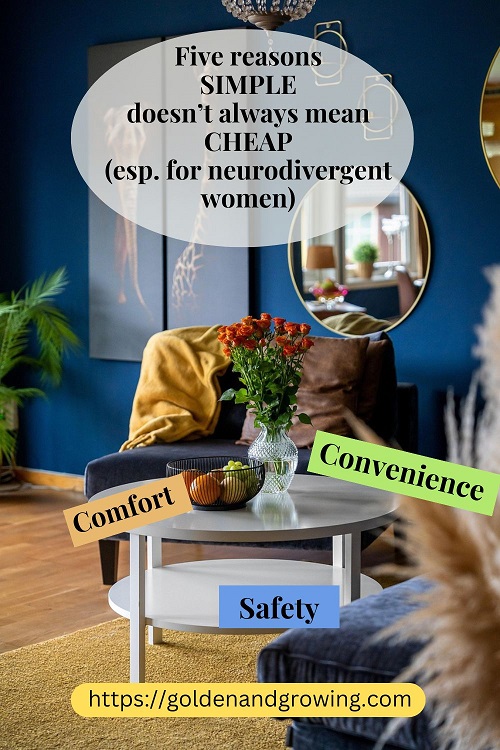
Simple living and cheap living aren’t always the same… especially for us neurodivergent women. Read on to find out why spending money is sometimes the better choice.
The story.
I looked around the space, dismay and frustration playing tug-of-war inside my chest. Something was missing, but what?
I thought back to all the videos of tiny houses I’d watched over the past few years. Considered the ones that had most caught my interest.
Finally, it landed. I’ve always been drawn to the ones filled with cozy, soft furniture.
That was it. We had no upholstered furniture. The metal garden bench my husband had given to me for Christmas last week was not only hard to sit on, but hard to look at, in an interior design sense. It added to the harsh hardness of the entire house: wooden bookcases, desk, chairs, and nightstands; metal side tables; tile floor.
I went to my husband, desperately grasping for words that wouldn’t hurt his feelings. The result? In less than a week the metal bench sat outside the front door where it belonged.
In its place inside sat a brand new, cushy loveseat, decorated with two throw pillows and a colorful afghan.
The addition improved the look and feel of our home a hundred-fold.
And it made my autistic vision much happier.
“Simple” and “cheap” aren’t the same.
When most people think about simple living, they assume that includes spending money as sparingly as possible. No luxuries allowed. Take on every “No-buy year” challenge possible.
It’s true that living cheaply helps to reduce stress, which thereby simplifies your life. But “simple” and “cheap” aren’t necessarily mutually inclusive words.
Merriam-Webster defines simple as free from vanity, free from ostentation or display, free of secondary complications, or free from elaboration.
In contrast, cheap means charging or obtainable at a low price, or of inferior quality or worth.
Taking the conventional belief to its extreme, to live a simple life means to take on your own “Walden Pond” experiment, living in a tiny one-room cabin with only one table and one chair for furniture – which you made yourself.
But austerity can have a way of making life more complicated, especially if you have a neurodivergent brain. Or if you’re postmenopausal, when you thank God every day for washing machines, indoor plumbing, and central air conditioners.
Skeptical? Let’s look at five reasons that “simple” doesn’t (and shouldn’t) always equate to “cheap,” with an eye toward us highly sensitive, emotionally dysregulated, and executive function-challenged women.
Reason 1 simple living isn’t always cheap living: Comfort.
For neurodivergent women, comfort isn’t a luxury. It’s a necessity, for two reasons. First, our brains don’t filter out unnecessary sensations, so we feel the hardness of a chair more intensely than most. We feel that a mattress is too firm or too soft a lot more easily.
Having the perfect pieces of furniture in which to relax drastically improves our sense of well-being, and our ability to recuperate from stress.
For neurodivergent women, being comfortable makes life simpler.
Reason 2 simple living isn’t always cheap living: Convenience.
When we moved out to the middle of nowhere, the ADHD part of my brain had convinced me that living as simply as possible – meaning, with as few modern amenities as possible – would be a fun adventure.
Now, when we travel, I luxuriate in taking a long, warm shower in the morning and using a washing machine to launder clothes. If I’d known I was neurodivergent before we moved, and that it would mean losing most of my energy, half of my motivation, and more of my already-limited executive function after I turned fifty, we would have found an existing house that had most of the modern conveniences.
And some autistic women and women with ADHD would be lost without the built-in support of such conveniences well before the age of fifty.
For neurodivergent women, easy access to modern conveniences makes life simpler.
Reason 3 simple living isn’t always cheap living: Sensory sensitivities.
My need for soft furniture came from visual processing disorder. If there’s too much of something in my line of sight, or if it looks cluttered or disordered, my brain can’t sort it out in time for me not to experience overstimulation.
In this case, our house contained too much hard material, with little soft material to offset it visually.
If you live with family, you may need to soundproof your room in order to sleep at night. Or invest in bamboo sheets and chenille blankets to sleep with comfort and a sense of security.
You may need to buy your groceries at a high-end market to ensure your food never has an offensive odor or flavor.
Both my son and I need to wear special glasses when working on the computer. They were not cheap, let me tell you! But without them, our eyes strain easily.
For neurodivergent women, making sure our home doesn’t overwhelm our senses in the same way the outside world does, makes life simpler.
Reason 4 simple living isn’t always cheap living: Safety.
If you want to live in the Dallas metro area, the cheapest place to live is south Dallas.
It’s also the most dangerous.
Not everyone has the luxury of picking up and moving from the city to a rural area like my family did. If you have to live in an urban area, sometimes it’s better to pay more for an apartment or mortgage for the sake of living in a low-crime neighborhood.
For neurodivergent women, feeling secure about her neighborhood makes life simpler.
Reason 5 simple living isn’t always cheap living: Quality.
This one pertains to everyone.
In many cases, you get what you pay for. Meaning, if you don’t pay much for an item, it won’t last very long.
Then you have to go out and buy another one.
In the end, two things will have happened. First, you’ll have spent more money than if you’d have bought a high-quality iteration of the item. Second, you’ll have inconvenienced yourself in having to continually buy the thing, which would have increased your stress levels.
For neurodivergent women, reducing stress as much as possible makes life simpler. And this often means looking at quality, not price.
The delicate dance between low-cost and simplicity.
At heart, I’m a saver, not a spender. And I believe that a person should live beneath their means as much as is comfortable, so that they always have extra for those unexpected expenses, and can help people in need.
But I’ve learned the hard way that there’s a fine line between the simple, good life and the simple, frustrating life.
The line is about a willingness to spend enough so that life can be an easier place to be. You don’t want to be cheap. You want to be frugal, per this dictionary definition: “marked by careful, efficient, and prudent use of resources,” or “operating with little waste or at a saving.”
How about you? Want to add to my reasons? Share your own relevant stories? Let’s hear them in the comments!
