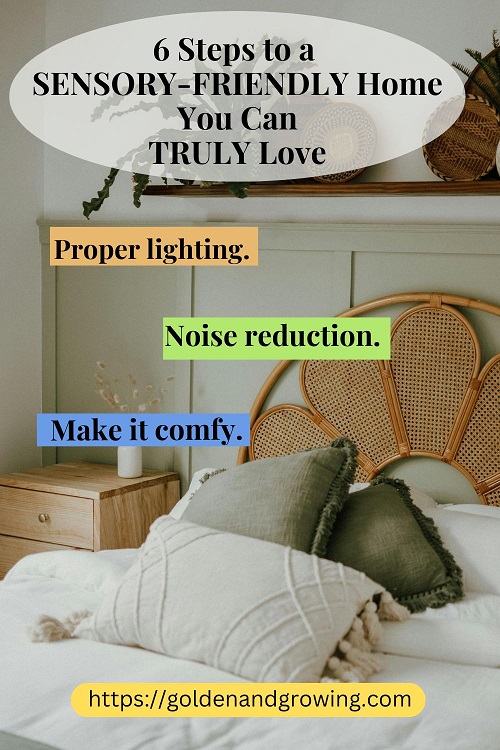
For neurodivergent women, sensory-friendly home design is critical for good mental health, hence for a slower, simpler life. Here are six steps to reach that goal.
The story.
Excitement bubbled inside me as I walked into my family’s house out of the pleasantly warm summer day. I’d just returned from the orientation to the private school I was going to start attending in the nearby town next month. It would mean a new start for me.
I was nervous about making new friends, but determined I would do all the right things to make that happen.
That had nothing to do with my excitement, however. A lot of other things had me anticipating the coming school year, a place that I expected would be a lot safer for me than the small town public school I’d been attending my whole life.
But there was something else. Something that most teenage kids wouldn’t appreciate.
This new school had a dress code. And the dress code excluded jeans.
I hated jeans. The denim was usually scratchy, and they always fit tight up against my crotch, a sensation I’d had to fight every school day to ignore. But I’d worn them because I’d already been ostracized enough in that school for not caring about – or being good at – sports. I wasn’t about to wear something that went against the norm.
The first day at the private school finally arrived. I got out of bed that morning and slid on the navy cotton slacks my mom had purchased for me. I don’t think I sighed out loud, but I remember being relieved as the fabric softly massaged my skin.
I could finally spend school days in comfort.
Sensory-friendly home design makes life simpler for the neurodivergent women.
Whatever label you want to give yourself, if you have sensory sensitivities, you need to make sure not to ignore them in your home. If you’re dealing with overwhelm in any of your five senses – or emotionally – due to having set up your home in a conventional way, you’re setting yourself up for future meltdowns, shutdowns, and burnouts.
And instead of your life getting simpler, it will get much more complicated.
Finding comfortable clothing is just a small part of the process. Following are the steps I’ve taken as a woman with AuDHD to create a neurodivergent-friendly home.
Steps you need to take, too, in order to reduce your stress levels as much as possible.
Step 1 for a sensory-friendly home: Watch the lights.
A while back, I had my husband buy lower-watt bulbs for the light on our ceiling fan. The full wattage on all four bulbs was too much.
Got fluorescent lights? Even if you can’t see it, they give off a constant micro-flicker that tends to increase the anxiety of people who are photosensitive. Get rid of them, and replace them with the LED equivalents.
My favorite light in our home comes from the lamp we have on early in the morning, and again about an hour before bed. It gives off a soft, warm, yellow glow. Should you have cool, blue light bulbs anywhere in your home, especially in a spot where you often need lighting, you might do better replacing them with bulbs that give off warm light.
If you’re on your computer or phone a lot, consider purchasing a pair of computer glasses. I have a pair each of TheraSpecs and Axon Optics computer glasses. Since I started wearing them, I’ve had a lot less eyestrain from working on the computer.
Sunlight is too strong for many highly sensitive autistic women. If that’s you, cover windows with blinds or sheer curtains to mute the brightness.
Reducing sensory overload at home in the area of lighting is one of the easiest.
Step 2 in setting up a sensory-friendly home: Reduce overstimulating sounds.
If you tolerate earplugs or noise-cancelling headphones, use them when running a vacuum or when someone’s running a blender or other loud appliance. Or when your neighbor is mowing their lawn. Or if someone is playing music you either don’t care for, or you’re trying to concentrate on something and don’t want the distraction.
Ideally, if you have to live in a home with other people (roommates or family), you establish rules about how loud music can be played and what appliances can be run when. For an autism-friendly home, you should also come to a consensus regarding respecting the quiet time needs of individual household members, including them announcing beforehand when they’re going to be turning on a particularly noisy appliance.
If you have children, train them well about the importance of using their “inside voice” when they’re in the house, especially in a common area like the kitchen or living room.
Make sure to model that principle yourself.
You may do well with having white noise, relaxing instrumental music, or nature sounds playing constantly in the background. This helps people with ADHD particularly, as it gives us something to focus on other than the whirlwind of thoughts inside our head.
Step 3 in establishing a sensory-friendly home: Make it comfy.
Standard wisdom dictates using a hard chair at your work desk so that you’ll stand up more often. Sitting for long periods takes a toll on the spine and leads to muscle atrophy.
However, this advice doesn’t work if you’re so touch-sensitive that sitting in a hard chair is painful. In that case, use either a soft seat cushion, or, if it’s within your budget, purchase a comfortable ergonomic chair. You might also buy a small, foldable table or desk that you can pull up to your sofa, and sit there to do your computer and adminstrative work.
Should you do this, however, be sure to set an alarm every twenty to thirty minutes to remind you to get up and stretch and take a brief stroll around the house.
In my introductory story about setting up a sensory-friendly home, I hinted at the importance of wearing comfortable clothing. If this is difficult due to your job, at least slip into something that soothes your skin when you’re home. In the same manner, sheets and blankets should be a treat to slide under at night. If something’s even a little bit scratchy, it will affect your sleep.
Many highly sensitive women appreciate fabrics like bamboo and jersey cotton for sheets and pillow cases.
Jersey cotton is the best for T-shirts and dresses, too, in my opinion, with a modal-cotton blend coming in a close second. For winter wear, I love my fleece sweats and chenille sweaters! (Remember to remove any tags.)
Sofas, mattresses, and pillows should fit your comfort needs, not the rules of some guru or online influencer. Your goal, remember, is reducing sensory overload at home.
Step 4 in creating a sensory-friendly home: Keep scents pleasant… or non-existent.
If you don’t already have one, install a ventilation fan above your stove to keep strong cooking smells (onions, broccoli, beans, etc.) from permeating the entire house. Insist that everyone turn on the bathroom ventilation fan when they go in to produce a “number two.”
Sensory-sensitive women tend to do best with cleaning and personal hygiene products with no fragrance; or a light, natural fragrance. Experiment to see which brands and types don’t cause you a low level of anxiety when you use them.
Ideally, they will spark the “happy” neurotransmitters in your brain.
Place an open box of baking soda at the back of your refrigerator if the combined smells of everything stored within threaten to knock you over whenever you open it. The baking soda won’t completely eliminate all smells, but it will deodorize the space to a more tolerable level.
Step 5 in setting up a sensory-friendly home: Assemble a “personal spa box.”
Of all the neurodivergent home tips, this is one most of us probably overlook.
Find a shoebox or another container of a similar size and place objects inside it which help regulate your nervous system when it gets overloaded. It may contain a smooth stone or soft material for stroking or rubbing against your cheek, a fidget toy, your favorite essential oil, a soft hat, or a sleep mask, for a few examples.
This printable PDF provides spur-of-the-moment ideas for soothing a frazzled nervous system.
Step 6 in creating a sensory-friendly home: Eliminate visual clutter.
Countertops should be kept as clear as possible from all items that don’t “live” there (blenders, coffee makers, etc.). Bookshelves should either be packed with books or contain minimal, visually-pleasing displays. Except for decorative displays, side tables, coffee tables, and similar surfaces should also be kept clear most of the time.
Be creative with your space, yet let it be calm.
If you have ADHD and tend to “spread out,” try to keep your projects within a certain area. I understand this may be difficult, but visual clutter affects you in a negative way, as well.
If nothing else, if you live with others, be respectful of their need for clutter-free surfaces.
Your home should be your sanctuary.
The home of a neurodivergent woman should be a sanctuary against the overwhelming world outside. I encourage you to look around and see what changes you might make to make your home feel like a permanent spa.
And tell us in the comments what you’ve done personally to convert your home into the coziest, friendliest place in the world!
