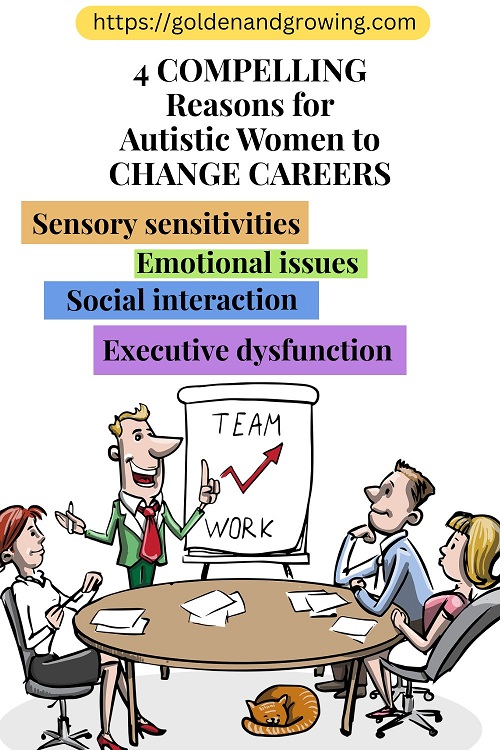
Career change for autistic women is usually a challenge, but sometimes a necessity. A bit of my story as I offer four huge reasons that you might need to switch gears.
The story.
I stumbled more than walked down the empty hallway of the old brick school building. I’d just left my first class of students, around twenty-five third-graders, with the P.E. teacher and had forty-five minutes of freedom.
A thousand thoughts swirled through my head as I made my way toward the office to check my “mailbox,” a little wooden cubby surrounded by dozens of others equally sized cubbies. What had happened? The children had been so well behaved. Now, in November, they were going wild. I was frequently raising my voice to get them to be quiet. The engaging lesson plans I spent the entirety of my weekends putting together fell apart as soon as I started teaching. Children would start whispering and giggling.
I had to answer the same question a minimum of ten times after explaining a concept: “Miss, how do I do this?” During independent work time, the children’s voices grew louder and louder, regardless of the clever discipline technique I tried. The girls had started backbiting and excluding each other from play, destroying my attempts to create a warm, safe community.
What was I doing wrong? I was smart and I’d done well with my student teaching. But that had been in a private school. No way I was going to get a job in a private school and be poor like my parents were. But these public school kids – ugh! Were they all like that? Well, no, because I’d seen other teacher’s classrooms and their students weren’t constantly acting up, trying to drive me crazy.
Then it was me. I had to be me. What was wrong with me?
Hot tears stung my eyes. I was a few yards from the office when I spotted Judy, a middle-aged fourth-grade teacher with whom I’d become well-acquainted during the past few months, coming toward me.
She stopped in front of me with a smile on her face and asked, “How are things going?”
My reply was to fall against her, wrap my arms around her, and wail, “Tell me this gets easier!”
It was the first of many job-related meltdowns I experienced during my thirteen years as a classroom teacher, though the only public one.
It wouldn’t take long for me to realize I’d chosen the wrong career, though several reasons I know of now, eluded me then.
Why career change for autistic women, however necessary, is so hard.
Before we move on to how neurodivergent women might benefit from a career change, we need to address what is probably the main reason most of us stick with a job or career even when it clearly isn’t working for us.
In my case, it was, “My degree is in elementary education. I don’t want to return to school to get a different degree. I’d end up poor like my parents and have to work like a slave for the rest of my life. So I have to teach. Teaching is the only job I can get with a teaching degree.”
A big part of my reluctance in leaving my job was that, though it would be decades before I found out I was autistic, I intuitively knew that I needed more than two weeks of vacation per year from a job. I needed two and a half months to recharge and regain enthusiasm for my chosen career.
That aside, I could not think of another stable job I might qualify for, even after getting a few years of teaching under my belt.
The truth is, I would have qualified for any number of professional jobs, especially if I’d been willing to take a couple of evening classes at a community college. But I couldn’t get myself to believe it at the time.
You may be holding to the same mindset. I want to reassure you: unless we’re talking law or the medical field, there is a lot more open to you than you realize. Keep that in mind as we move through some compelling reasons that a career change for autistic women might be necessary.
Especially if they want a simpler life.
Here are, in my humble opinion, the top four reasons.
Sensory sensitivities.
Dealing with sensory overload is one of the top reasons for career change for autistic women.
It’s also the main reason being an elementary school teacher wasn’t good for me.
Even had I been able to encourage my students to be mostly quiet most of the time, there were still the fluorescent lights, the chatter from other teachers during meetings and lunch, the ringing bells, the fire alarms for drills, the freezing temperature of the classroom, the myriad of odors, and so on.
If your career or job overstimulates you to the extent that you have to go home and shut the world out for several hours before you can think straight again, you may need a change.

Another big reason for career change for autistic women: emotional dysregulation.
Most of us are hypersensitive when it comes to emotions, and if we have ADHD on top of the autism, the challenge is doubled, if not tripled.
And if you have to interact with a lot of people frequently, you’re going to be in a constant state of high emotion – even if you suppress it. Because people say and do stupid things. They make decisions you disagree with. And, being autistic, we often have trouble discerning whether we’re the target of a joke or flippant remark, or not.
Even if we mostly get along with our coworkers, clients, or students, the positive emotions can also eventually overwhelm.
We do better if interactions with others are only occasional and then with no more than a small group, if that.
Executive function challenges.
Meetings and attendance and grading, oh my!
All the tasks classroom teachers are required to do pushes the executive function limit of neurotypical people. For neurodivergent people, it’s a nightmare, and a huge reason to consider career change for autistic women.
Here is a non-exhaustive list of what I was expected to do on my job:
- Create a lesson plan for every subject, every day of the week.
- Follow the lesson plans.
- Have a “Plan B” in mind for each lesson when the inevitable interruptions happened or the students weren’t getting it.
- Turn in lesson plans every week.
- Take attendance every day.
- Remember to turn in the attendance every day.
- Keep track of what twenty-plus little bodies are doing at every moment.
- Juggle working one-on-one with those who need help and keeping the more distractable ones on task.
- Collect papers.
- Grade papers.
- Enter grades into gradebook.
- Return papers.
- Remember meetings.
- Remember which special class the students go to this week.
- Create a schedule.
- Follow a schedule.
- Figure out how to improvise the schedule when you’re rudely interrupted by the school counselor who “has” to tell the class something “real quick” and ends up stealing fifteen precious minutes away from your teaching.
- Deal with excuse notes.
- Remember which parent goes with which student.
- Remember which ex-con relative/deadbeat dad is forbidden to pick up which student.
- Arrange field trips (at least ten steps right there).
- Plan and execute a hallway bulletin board.
- Plan for, set up, and execute parent-teacher conferences.
- Remember all the little requests other teachers and administrations throw at you throughout the day, and get them done.
Is your brain reeling yet? Wondering how I’m still alive to blog about it? If your job or career even remotely resembles this scenario, you might want to seriously consider changing gears.
Social interactions: another huge reason for career change for autistic women.
I remember every single day of every single school year coming home to my apartment completely done with people. Like most autistic people, I’m an introvert, but even extroverted autistic women struggle with social interactions.
What should I say? Am I saying the right thing? Is this an appropriate time to touch a hand or arm in empathy? Give a hug? They look angry. Did I do something wrong? No, wait, they’re talking about a problem with a student. But still, that fury is aiming straight at me.
I should look away. This feels like a personal violation. But they expect eye contact. Why does everyone expect eye contact when it feels so wrong?
Is my boss being sarcastic? He can’t be serious, can he? Wait, what my co-worker just said. I don’t get it. Am I missing some inside joke?
Right. You get it. Jobs and careers that require constant interaction with people are exhausting for autistic people. This difficulty is a huge part of what causes our emotional dysregulation, as discussed earlier.
You might love the actually work on your job, but if it also involves frequent social interactions that leave you wanting to crawl into a hidden cave at the end of every workday, you might want to consider something else.
When career change isn’t feasible.
Career change for autistic women isn’t always feasible. When it isn’t, there are steps you can take to reduce the stress it causes. I’ll address that in a future blog post.
In the meantime, check out the video below where YouTuber Taylor shares her thoughts about why her chosen career ended up not being the best for her autistic brain.
And be encouraged that even if it takes slow, gradual baby steps, you can craft a simpler, quieter life for yourself.

1 thought on “The Four Best Reasons for a Drastic Career Change as an Autistic Woman”