Why journaling is important is rarely talked about in terms of women with autism or ADHD. This article explains how the habit can be a game-changer for them.
The story.
Hot, angry tears pricking the back of my eyelids, my pen nearly ripped the page as I poured my emotions into silent, desperate words. I was so tired of it. Tired of it all. Angry that I’d made all the wrong decisions when I was younger. If only I hadn’t gotten married. If only I’d pursued my dream to be a published author harder when I was in college. My life sucked so bad, thanks to naysayers and my hormones.
Teeth grinding, I slammed my journal shut with a satisfying slap. Wiped my eyes with the back of my hands.
As I shoved my journal back into its hiding place in our clothes cupboard, a thought sashayed into my head like a Flamenco dancer entering the stage. Ignoring one of the primary targets of the entry I’d just written – my husband – I stepped over to the calendar hanging on the wall.
Four days before the new moon.
Closing my eyes, I suppressed the groan that wanted to come out, then walked back into the bedroom. Out came the journal, and I paged back to the last time I’d scribbled out my angst in fury.
One month ago, almost to the day. I didn’t have to check on the calendar to know that I’d written that entry four days before a new moon, as well.
I sighed. My life didn’t suck. I hadn’t screwed it up with a million wrong decisions. The new moon, as usual, was messing with my brain chemistry.
The next day, I was happy again. A month later, when the downward spiral of negative thoughts began, I remembered. Reminded myself of what was really going on.
And made it through the day without shedding a single tear or hating myself and my husband.
Journaling: a little-respected aspect of self-care for neurodivergent women.
Women with autism and women with ADHD are coached on how to deal with executive dysfunction, given hacks to help them maintain their physical health, and encouraged to seek therapy for anxiety and depression. Maybe I’ve been looking in the wrong places, but I haven’t seen anyone talking about why journaling is important for us, specifically. Sure, we can reap the same benefits from it as neurotypical women, but the benefits can weigh heavier for us. And there are additional benefits, as well.
I’ve seen them in my own life.
In the title, I use the word “success.” I don’t intend it in the usual mainstream use of having plenty of wealth, freedom, and a high social status. In the realm of why journaling is important for neurodivergent women, I define “success” as a fulfilling life, a life in which we are taking care of ourselves as well as doing at least some of the things we want to do.
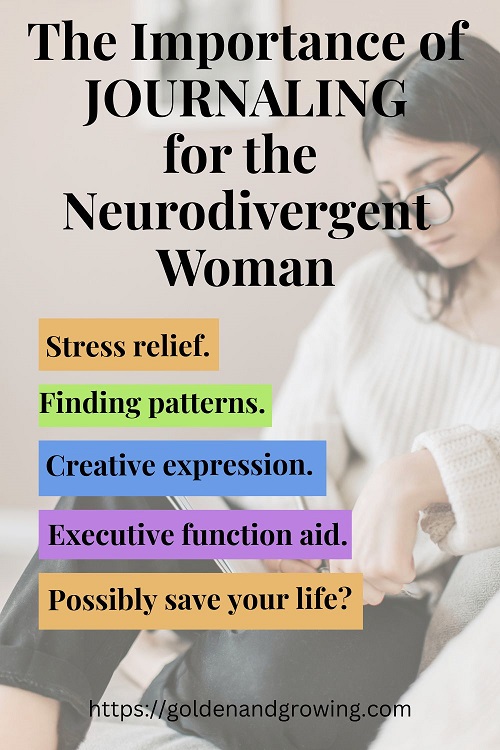
So, let’s talk about five ways that journaling is important for neurodivergent women in having a happier and more fulfilling life.
First way: it helps us find patterns.
We neurodivergent women tend to be highly sensitive, which means our emotions can become overwhelming at times. As my introductory story illustrates, if you journal on a regular basis, you may eventually see patterns that reveal what is triggering meltdowns or bursts of anger. It might be the anticipation of a particular task or event, or – as it was in my case – it might be something out of your control upsetting the balance of your brain chemistry.
Journaling can help you see patterns regarding sensory overload as well, what events trigger which symptoms. This printable PDF works as a great adjunct to a journal for that purpose.
Second way: It can serve as a stress reliever.
This reason is why journaling is important for anyone. Neurodivergent women benefit even more deeply because we carry more stress due to struggles with social interactions and difficulty with emotional regulation. Writing is cathartic and can help shed some of this burden.
The caveat is spewing out negativity on paper. If you’re like me, this only makes the downward spiral go deeper and faster.
For journaling to act as a stress reliever, focus on more positive aspects of life. You might make a list of several things you’re grateful for, or write a letter to yourself, encouraging yourself that you’re okay and life is okay. Or that, if they’re not, things will get better.
Third way in why journaling is important for neurodivergent women: creative expression.
If you have to work at a non-creative job in order not to starve, a journal is the perfect place to fulfill your need for creative expression.
You can write short stories. You can write poems. If you’re autistic, you can write out an imaginary conversation to practice your social skills and build up a repertoire of responses to common questions that don’t blow other people away or offend them.
You can also use your journal to sketch or doodle. You can write out thoughts and opinions on current events. You can write out an ideal day with detailed scenarios that you can begin to work toward.
If you have no other creative outlet, journaling will improve the quality of your life.
Fourth way: it can alleviate Rejection Sensitive Dysphoria.
You may have never heard the phrase “Rejection Sensitive Dysphoria”. But if you’re neurodivergent, chances are it plagues you like a mosquito in the middle of a hot and humid summer night. For autistic people, it results from our struggle with reading social cues and not knowing if what we said offended someone. For both people with ADHD and highly sensitive people, it’s a disproportionately strong reaction to someone saying “no” or otherwise turning us down. What they perceive as setting up or maintaining a boundary, we might perceive as an affront to our person.
As rejection.
Having a journal gives you space to write down what happened, how you felt, and alternatives to the other person’s intentions other than to reject you. Again, I created a printable that is the perfect companion to a journal for working through a Rejection Sensitive event.
Remember the definition of success I mentioned earlier? That sense of contentment and fulfillment will elude you if you walk around weighed down by feelings of rejection.
Journal it out.

Fifth way in why journaling is important: it aids in executive function.
This goes for my fellow postmenopausal women as well, because low levels of estrogen takes a toll on our brain’s ability to organize, plan, and generally keep life flowing more or less smoothly.
Journaling your problems often leads to solutions you wouldn’t have seen otherwise. If you use artist Julia Cameron’s “Morning Pages” strategy of stream-of-consciousness writing every morning, you can end up with a to-do list for the day. It can also remind you of upcoming appointments or events, because this activity brings things to mind which the whirlwind of life has shoved back into your subconscious.
In the same way, journaling is important because it can help you see what your priorities are. This subsequently motivates you to plan and organize whatever’s necessary to work on your priorities. And as you continue to journal, it motivates you to carry through with those plans. It reveals which of your choices are distracting you, and which ones are facilitating your goals.
Why journaling is important for neurodivergent women? It might just save our lives!
I don’t know about you, but two large and powerful thugs named Anxiety and Depression are constantly lingering around the corner, threatening to come after me. Journaling is a powerful weapon against them. It clears your mind, straightens out your perspective, empowers you by revealing where you have control and how you can make positive changes.
Why journaling is important? It can be great therapy. It can help you verbalize feelings that you can’t get out with your mouth. It’s a strong problem-solving tool.
It shows you that you matter, and that your imperfect, messed-up life is nevertheless worth living.

1 thought on “5 Ways Journaling Is INTEGRAL to a Neurodivergent Woman’s Success”
Comments are closed.