Exercise for Highly Sensitive Women can’t be the same as for neurotypical women. A bit of my story, plus what you need to know for your fitness.
The story.
Even though we sat in the shade of a sheltered picnic table, the heat of the Texas spring day permeated my skin. I took another swig from my water bottle, hiding my amazement as one of the other homeschooling mothers gave an account of her new exercise routine.
“…and then I do ten jump squats,” she was saying. “The whole workout is about an hour long.”
I’ve heard about people doing hour-long workouts, but I thought they were body builders or serious athletes. The woman talking was your run-of-the-mill stay-at-home mom, a little thinner than average for Texas but not slender. She was also, like most of us sitting at the picnic table, pushing or past forty years of age.
I considered myself fairly active, but never exercised for more than fifteen minutes at a time. And pretty much hated every single second.
Inwardly sighing, I thought, I am so lazy. Then I soothed myself with, But that kind of workout is extreme. Nobody needs to stress their body that much to stay fit!
What I didn’t realize at the time was that I was a highly sensitive neurodivergent; she was not.
And exercise for Highly Sensitive women has to be different than that of neurotypical women.
You are not lazy.
If you’re like I used to be, thinking that I was lazy because I refused to do long workouts, stop.
Whether you’re autistic or have ADHD, or just consider yourself Highly Sensitive, your nervous system is a lot touchier than normal. Because of that, vigorous exercise – especially if it goes on longer than fifteen to twenty minutes – produces a much greater stress response than that of neurotypical people. This can ramp up our anxiety rather than alleviate it.
And that increased anxiety can continue for several hours.
None of us needs that.
In addition, many of us tend to feel muscle feedback as “You’re injuring me!” as opposed to the usually more correct “I’m reaching my max for this session.” This nerve sensitivity (and sometimes wrong interpretation of nerve signals) makes long and/or vigorous workouts untenable.
Which causes the slight motivation we might have had to work out to evaporate like a drop of water on a burning hot sidewalk.
We shouldn’t ignore our need for exercise, however, as it’s an essential part of our self-care.
Exercise for Highly Sensitive Women: the basics.
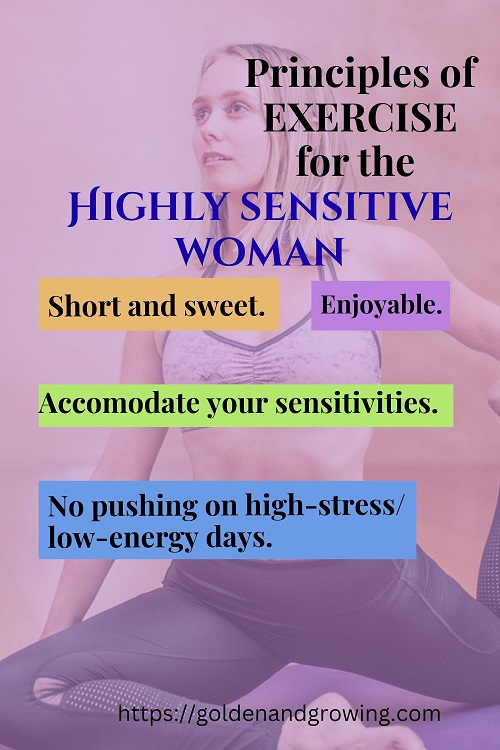
#1: Keep it short and sweet. If you’re an HSP, long workouts simply aren’t going to work out for you (ha ha). Keep them between ten and twenty minutes, and do two to three per day. Or do one fifteen-minute workout every single day, rather than the typically recommended three to four times per week.
#2: Choose movement you enjoy. This is great advice for anyone who doesn’t naturally love athletics, but it’s crucial in the realm of exercise for Highly Sensitive Women. Don’t choose a particular type of workout or activity just because somebody says it’s good for you. Choose activities that you’ll stick with in the long term.
#3: Make appropriate accommodations. If the noise in fitness centers makes you want to jump off a cliff, don’t get a membership! If sunshine gives you a raging headache, regardless of the type of sunglasses you wear, either choose activities you can do indoors or schedule your exercise for early morning or late evening.
#4: Don’t push yourself on low-energy or high-stress days. If you’re either slogging through the day or experiencing more anxiety and worry than usual, working out will be more detrimental than helpful as it will increase your body’s stress hormones.
There are two exceptions to this guideline.
First, there’s nothing like a leisurely stroll, preferably in nature, to calm your mind and while giving your muscles and ligaments the movement they need to continue to be strong. Second, for some of us, exercise can help alleviate stress, depending on how much we enjoy our chosen exercise, the life situation we’re dealing with, and our body’s responses. You have to figure out what works best for you.
#5: Incorporate a core workout. I’ll write more about that later. For now, suffice to say that from giving birth to having to move heavy objects by yourself, having a strong core (which includes all the muscles around the lower third of your trunk and down past your hips) will help you to prevent injury. It will also ensure better posture and fewer back problems as you age.
And a word to the wise under-forty-somethings: yes, you should be thinking about your future older self NOW. It’s a lot harder to play catch-up at age fifty than it is to develop healthy habits early on in life.
The best exercise for Highly Sensitive Women?
Exercise for autistic women or women with ADHD will vary. But overall, we tend to do better with quick bursts of activity or activities that involve slow movements.
Low-impact aerobic activities don’t overwhelm sensory input. This includes swimming, which is soothing and therefore can help regulate nervous system.
Many neurodivergent women do best with workouts based on slow, deliberate movements such as yoga or Tai-Chi. Besides keeping our stress levels down with deep and even breathing and forced calmness, they facilitate body awareness – usually a challenge for autistic people.
Exercises for women with ADHD might include a brisk morning walk to burn off excess nervous energy or help our brains calm down, or dynamic movement such as dancing or bounding on a trampoline. Because these exercises for Highly Sensitive women are generally perceived as fun, we are more motivated to add them to our day and stick to them.
An exercise schedule you can stick to.
Once you’ve decided on two or three activities – in addition to the non-negotiable core workout – that you enjoy, spread them out over the week and over the day. Monday, Wednesday, and Friday you might take a ten-minute power walk or thirty-minute stroll in the morning, and do a core workout before dinner that evening. Tuesday, Thursday, and Saturday you might do light weightlifting in the morning and Tai-Chi in the evening.
Sunday use as a total rest day, except perhaps for a leisurely stroll through the park or some easy stretching with relaxing music.
The above is just an example Put together a movement schedule that suits YOU, not some male neurotypical trainer.
The long and the short of exercise for Highly Sensitive Women.
Keep it brief.
Keep it low-stimulation.
Keep it fun. Above all, keep it as part of your day. Both your brain and your body will thank you for it.
